Organic-first toddler-meal shoppers
Parents and carers who want an organic claim and stated age guidance may prefer a toddler jar or pouch, even when they began by looking for a tin.


Choose a toddler-labelled organic jar or pouch if both the organic claim and stated age guidance are priorities; the conventional tins in the UK listings considered here are general desserts, not equivalent products. If a larger, shelf-stable tin suits the household better, check its ingredients, allergens, sugars, salt and instructions for leftovers rather than assuming it is organic or toddler-labelled.
Parents and carers who want an organic claim and stated age guidance may prefer a toddler jar or pouch, even when they began by looking for a tin.
Shoppers considering a 400g tin for the household need to compare the exact product’s ingredients, sugars, salt, serving information and leftover instructions.
When avoiding dairy or checking for milk or egg, the ingredient and allergen statements matter more than the word “organic”. The products considered here have different formulations.
Decide which requirement comes first for the toddler’s meal, then check that requirement on the exact pack. A tin, toddler pouch and chilled pot need not have the same age guidance or storage instructions.
| Concern | What to check | Who this matters to |
|---|---|---|
| Organic claim and age guidance | Look for the organic claim, stated age and pack format. The HiPP jar and Ella's Kitchen pouch listed by Tesco have guidance from 7 months; they are not tins. | If organic labelling and an age-labelled product are my starting requirements, a general dessert tin does not answer the same question. About 37% of consumers put that combination first. |
| Sugars, salt and ingredients | Compare sugars and salt per 100g on the exact products, and read the ingredients for added sugar or sweeteners. Do not use adult reference-intake percentages as toddler targets. | When rice pudding is part of dinner, I want to know what is in the portion rather than judge it by “organic” or “Light” on the front. About 27% of consumers make nutrition-label comparison their primary concern. |
| Milk, egg and dairy-free fit | Read the current pack’s ingredients and allergen statement. Tesco lists an Ella's Kitchen dairy-free pouch, while the conventional tins considered here contain milk. | For a household avoiding an ingredient, the first decision is whether this particular recipe fits, not whether it comes in a tin. About 18% of consumers prioritise dietary and allergen fit. |
| Portions and leftovers | Check pack size, servings and the instructions after opening. The listed toddler formats are 80g and 160g; Sainsbury's lists two servings for its 400g tin. | If dinner is shared with the family, I need to know how much will be left and how the opened product must be stored. About 18% of consumers put portion and storage practicality first. |
In Great Britain, “organic” concerns production and labelling rules, not a pudding’s sugar content. Tesco lists organic sugar among the ingredients of Rachel's Organic Divine Rice.
Check the ingredients and per-100g nutrition panel separately from the organic claim.
The listed organic toddler jar and pouch carry age guidance, whereas the conventional tins are general desserts. A chilled pot also has different storage requirements from an unopened shelf-stable tin.
Choose the format around the age label and how the pudding will be stored and served; then compare products within that choice.
Opened-storage instructions differ: the Ambrosia tin listed by Waitrose says to remove remaining contents from the can, refrigerate them and consume them within three days; Marks & Spencer says to eat its pudding within 24 hours of opening.
Follow the instructions on the exact pack, including any directions about transferring leftovers or warming the pudding.
Reference-intake percentages on general dessert labels may be based on an average adult, so they are not a toddler-specific portion guide.
Use the ingredient list and comparable per-100g figures to understand the products, while following any product-specific age and serving instructions.
A conventional canned rice-pudding line, including standard and Light versions in the Waitrose listings considered here.
Lists conventional tinned rice pudding separately from organic toddler products in jars and pouches.
Lists an own-label 400g creamed rice-pudding tin and a separate organic HiPP toddler jar.
Offers a conventional 400g creamy rice-pudding tin for shoppers considering a family dessert.
Lists a conventional Essential rice-pudding tin alongside organic rice-pudding products in other formats.
This selection is for shoppers considering an age-labelled, dairy-free rice-pudding pouch instead of a tin. Check the current pack for its organic claim and full allergen information before choosing it for a toddler.
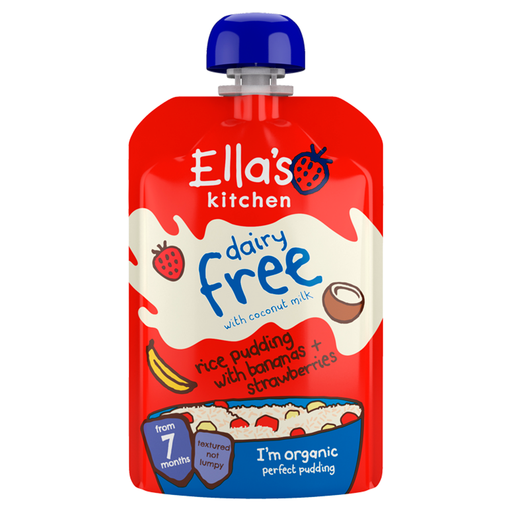 No image available
Consider this pouch if dairy-free formulation and stated guidance from 7 months matter more than buying a tin. It is an 80g bananas-and-berries variant; check the current organic claim, ingredients and allergen statement on the pack.
Yes. The Department for Environment, Food & Rural Affairs says food marketed as organic in Great Britain must meet organic-production and labelling rules. The claim does not by itself tell you the pudding’s sugar content, allergens or age guidance.
No. Check the exact product’s age statement, ingredients and nutrition panel, and consider how it fits the meal. Tesco lists organic sugar in Rachel's chilled rice pudding, while its HiPP and Ella's Kitchen toddler listings use no-added-sugar wording; neither detail makes all organic puddings equivalent.
Follow the instructions for the particular jar or pouch. The listed HiPP jar allows serving at room temperature or warming and says to check the temperature before feeding; the Ella's Kitchen pouch instructions say to warm it in hot water rather than microwave the pouch.
Use the exact pack’s storage instructions, because the periods differ. Waitrose lists three days under refrigeration after transferring leftover Ambrosia pudding from its can, while Marks & Spencer instructs shoppers to eat its pudding within 24 hours of opening.
Not in the listings considered here. The conventional 400g tins are general desserts, whereas the listed HiPP jar and Ella's Kitchen pouch state guidance from 7 months. Do not transfer that guidance from one product to another.