What matters when choosing?
Decide whether organic certification or added nutrients matter more, then compare the drinks’ labels on the same per-100ml basis and plan for use after opening.
| Priority | What to check | Your needs |
|---|
| Added nutrients |
Check the nutrition panel for added calcium and vitamins. The UK government’s 2025 SACN/COT assessment says UK plant-based drinks labelled organic cannot be fortified with nutrients; NHS guidance identifies plant drinks with added calcium as a calcium source. |
If this drink is replacing one I used for added calcium or vitamins, I need to account for those nutrients elsewhere rather than assume an organic carton supplies them. |
| Organic claim |
Read the organic claim and certification information on the current pack. Defra’s UK organic labelling guidance requires organic production rules to be met and certification through an approved control body. |
I want certification behind the organic claim, not just a description such as plant-based or natural. |
| Sugars and protein |
Compare sugars and protein per 100ml, then read the ingredients. Alpro Organic lists 0g sugars and 3.3g protein per 100ml; the Plenish Organic product information lists 3.2g protein per 100ml. |
For a plain drink used regularly, I care about what is in each carton. Protein figures alone will not tell me whether it contains added micronutrients. |
| Allergens |
Check the current ingredients and allergen wording for soya and any other relevant warnings. An organic label does not remove soya from a soya drink. |
When shopping for someone with an allergy, I need to check the exact pack rather than rely on the product category. |
| Opened-carton use |
Check the refrigeration instructions and time allowed after opening. Alpro Organic product information specifies five days; Plenish Organic product information specifies four days. |
If shopping trips are infrequent or a carton is used slowly, I need a quantity that can realistically be finished after opening. |
Organic soya brand references
These examples show different ingredient and nutrition details to check; a brand reference does not mean that every product it makes has the same formulation.
Alpro
Alpro Organic Soya is a long-life option for everyday drinks and recipes.
- Alpro’s product information lists water and 8.8% organically grown hulled soya beans, with 3.3g protein per 100ml.
- For a UK organic plant drink, added calcium or vitamins should not be assumed: the UK government’s SACN/COT assessment says organic-labelled plant drinks cannot be fortified.
Plenish
Plenish Organic Soya has a listed two-ingredient formula of spring water and organic soybeans.
- Sainsbury’s product information lists 3.2g protein per 100ml and identifies Soil Association Organic certification.
- Its product information specifies consumption within four days of opening; check whether that suits the household’s use.
Rude Health
Rude Health’s organic soya drink is another short-ingredient option.
- The manufacturer lists water, 12% organic soya beans and sea salt.
- If added nutrients are the reason for buying a plant drink, check the current nutrition panel rather than choosing by the stated bean proportion.
Organic soya options on Joybuy
This Alpro option is for shoppers considering an organic soya drink for tea, coffee or cereal; check its pack details alongside the nutrition trade-off discussed above.
 No image available
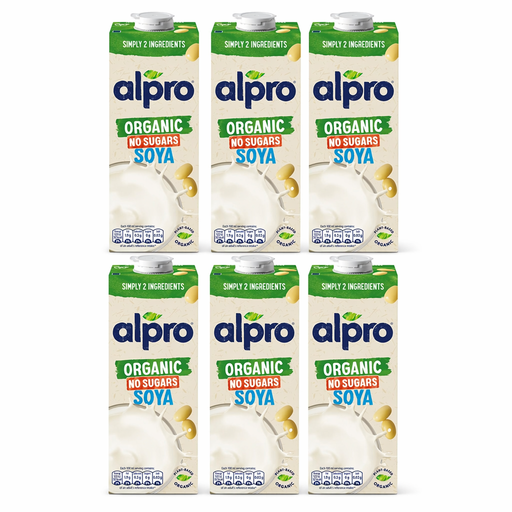
Alpro Organic Soya Drink (6)
For tea, coffee or cereal, this UHT soya drink lists water and 8.8% hulled soya beans, with 0g sugars and 3.3g protein per 100ml. It contains soya; refrigerate after opening and use within five days. If organic certification is decisive, check the control-body details on the current pack.
View on Joybuy
Frequently asked questions
Does organic soya drink contain added calcium and vitamins?
Not when it is labelled organic in the UK. The UK government’s 2025 SACN/COT assessment says organic-labelled plant-based drinks cannot be fortified with nutrients. If added calcium or vitamins matter to the purchase, compare a fortified non-organic drink and consider other dietary sources.
How can I check an organic claim?
Look for the organic claim and certification information on the current pack. Defra’s UK organic labelling guidance says an organic label requires the applicable production rules to be met and certification through an approved organic control body. Sainsbury’s Plenish listing, for example, identifies Soil Association Organic certification.
Can organic soya drink be the only milk replacement for an older person?
Do not assume it replaces the added nutrients in a fortified drink. The UK government’s SACN/COT assessment says UK organic-labelled plant drinks cannot be fortified, while NHS guidance identifies plant drinks with added calcium as a calcium source. Check what the person relies on the drink to provide before making the swap.
How long do Alpro Organic and Plenish Organic keep after opening?
Follow the instructions on the carton: the Alpro Organic product information specifies refrigeration and use within five days of opening; the Plenish Organic information specifies refrigeration and consumption within four days.
Is organic soya drink suitable for someone with a soya allergy?
No. Organic status does not remove soya from a soya drink. Avoid it for someone with a soya allergy and check the current pack for any additional allergen warnings.


