Organic-first shoppers comparing fat
If you want an unsweetened organic soya drink, compare total fat per 100ml as well as saturates. Organic status does not tell you either figure.


Choose an organic soya drink if organic production matters to you, but compare total fat on the nutrition panel rather than treating organic as a low-fat claim: Alpro declares 1.9g per 100ml and Tesco Groceries lists 1.6g per 100ml for Plenish. If you use soya drink regularly in place of dairy and want added nutrients from the drink, compare unsweetened fortified alternatives instead; the UK Department of Health and Social Care states that plant-based drinks labelled organic in the UK cannot be fortified. For a clinician-prescribed minimal-fat diet, follow your individual advice: Oxford University Hospitals NHS Foundation Trust advises people on its 20g-a-day plan to avoid drinks above 1.5g fat per 100ml.
If you want an unsweetened organic soya drink, compare total fat per 100ml as well as saturates. Organic status does not tell you either figure.
If soya drink is a frequent choice for cereal, hot drinks or cooking, check whether you want the drink to contain added calcium, iodine or vitamins. UK organic plant-based drinks cannot be fortified, according to the Department of Health and Social Care.
If a clinician has prescribed a strict fat limit, use your individual plan rather than a general low-fat shopping rule. Oxford University Hospitals NHS Foundation Trust advises people following its 20g-a-day plan to avoid drinks with more than 1.5g fat per 100ml.
Start with total fat for the amount you will use, then decide whether organic status or added nutrients matter more for this drink.
| Priority | What to check | Your needs |
|---|---|---|
| Total fat | Compare total fat per 100ml and your serving size. Alpro declares 1.9g per 100ml for Organic Soya Drink; Tesco Groceries lists 1.6g per 100ml for Plenish Organic Soya. | I want to compare drinks on the same basis, rather than assuming an organic claim tells me how much fat is in a serving. |
| Prescribed limit | For its specific 20g-a-day minimal-fat plan, Oxford University Hospitals NHS Foundation Trust advises avoiding drinks above 1.5g total fat per 100ml. Follow the advice given for your own diet. | If I have been prescribed a minimal-fat diet, I need to check the relevant total-fat limit with my clinical team before choosing a drink. |
| Organic and added nutrients | Check organic certification on the pack. For a dairy alternative, check the current label for added calcium, iodine and vitamins; the Department of Health and Social Care states that UK plant-based drinks labelled organic cannot be fortified. | I would choose between an organic preference and a drink with added nutrients based on how I use soya drink in my usual meals. |
| Sugars and protein | Read both values per 100ml rather than relying on the word ‘unsweetened’. Alpro declares 3.3g protein per 100ml for its Organic Soya Drink; Tesco Groceries lists 3.2g for Plenish Organic Soya. | For cereal or hot drinks, I want to compare the declared sugars and protein alongside fat, without treating one figure as the whole nutritional picture. |
Total fat and saturated fat are different figures. Alpro declares 1.9g total fat and 0.3g saturates per 100ml for its organic drink; Tesco Groceries lists 1.6g and 0.3g respectively for Plenish.
Check total fat first if it is the figure your diet limits, then compare saturates separately.
The Department of Health and Social Care states that plant-based drinks labelled organic in the UK cannot be fortified. That distinction matters when a drink is used frequently in place of dairy.
If added calcium, iodine or vitamins are part of your buying decision, compare the current labels of non-organic fortified drinks.
Oxford University Hospitals NHS Foundation Trust’s advice to avoid drinks above 1.5g fat per 100ml belongs to its specific plan for people advised to consume no more than 20g fat a day. It is not a general definition for every shopper.
If you have been prescribed that kind of diet, use the limits and drink choices agreed with your clinical team.
Its Organic Soya Drink and non-organic No Sugars line serve different buying priorities.
Its Organic Soya 1L is an option for comparing declared fat within the organic drinks discussed here.
Its Unsweetened Soya Drink is a non-organic example to compare when added nutrients matter.
These options cover an Alpro soya drink presented for the organic route and a separate Alpro No Sugars multipack for comparing a regular dairy alternative. Check each pack against the fat and nutrient priorities that matter to you.
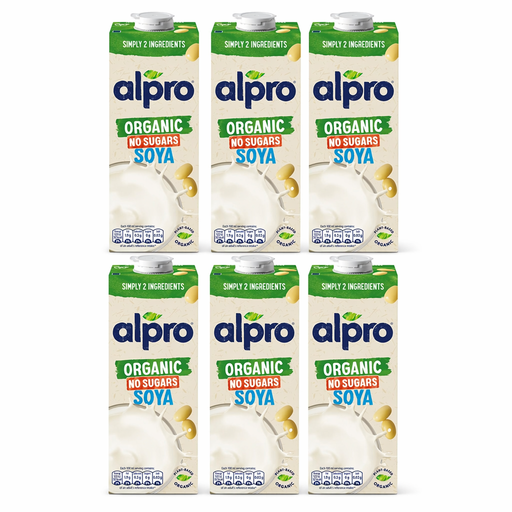 No image available
For an organic preference, check the certification on the pack and compare its total fat per 100ml. If you follow a prescribed minimal-fat plan, confirm that the drink fits your individual limit.
 No image available
The 8 x 1L long-life pack is an option to compare for repeat use. Check its current label for total fat and added nutrients, including iodine if that is a reason for choosing a fortified drink; do not assume it is organic.
No. Organic status does not set the drink’s total-fat figure. Alpro declares 1.9g fat per 100ml for its Organic Soya Drink, while Tesco Groceries lists 1.6g per 100ml for Plenish Organic Soya; compare the panel and the amount you use.
A fortified non-organic drink may suit you if you regularly use soya drink in place of dairy and want added nutrients from that drink. The UK Department of Health and Social Care states that plant-based drinks labelled organic cannot be fortified; Marks & Spencer lists calcium, iodine, vitamin D and vitamin B12 in its Unsweetened Soya Drink. Check the current label of the product you choose.
Do not assume they do. Oxford University Hospitals NHS Foundation Trust advises people on its no-more-than-20g-fat-a-day plan to avoid drinks above 1.5g fat per 100ml; the Alpro and Plenish organic drinks discussed here declare 1.9g and 1.6g per 100ml respectively. Ask the clinical team managing your diet which drinks fit your individual plan.
Check its organic certification and read the nutrition panel for total fat, saturates and sugars per 100ml. Certification concerns organic status, not whether the drink meets a particular fat limit or contains added nutrients.