Cereal and tea drinkers
An organic long-life carton may suit a weekend breakfast of cereal, porridge or tea. Check the exact drink’s sugar content and after-opening instructions if you will use it over several days.


Choose an organic everyday soya drink for cereal or tea, or an organic barista drink when foamed coffee is the priority. If added calcium, iodine or vitamins matter more than organic status, compare fortified non-organic drinks instead: the UK government’s SACN/COT assessment says UK organic plant-based drinks cannot be fortified with nutrients.
An organic long-life carton may suit a weekend breakfast of cereal, porridge or tea. Check the exact drink’s sugar content and after-opening instructions if you will use it over several days.
If a latte or cappuccino is the plan, look for an organic drink explicitly described as foamable rather than assuming any soya drink will produce the texture you want.
If the drink is replacing another regular breakfast drink, consider organic status separately from fortification. The UK government’s SACN/COT assessment says UK organic plant-based drinks cannot be fortified with nutrients.
Start with how you will use the drink, then check the organic claim, nutrition panel and current carton instructions before deciding between products.
| Priority | What to check | Your needs |
|---|---|---|
| Organic status | Look for an organic claim on the exact product. UK government guidance ties organic food labelling to applicable production rules and certification by an approved organic control body; plant-based or vegan wording is not a substitute. | I want an organic soya drink, not simply a dairy-free one. |
| Added nutrients | Check the nutrition panel for calcium, iodine and vitamins on the exact carton. The UK government’s SACN/COT assessment says UK organic plant-based drinks cannot be fortified with nutrients. | If added nutrients are central to my choice, I would compare fortified non-organic drinks rather than assume an organic drink supplies them. |
| Breakfast use | For cereal or tea, check the stated uses and sugars per 100 ml. For a latte, look for a drink explicitly described as foamable; Plenish describes its Organic Barista Soya that way. | A straightforward pour matters for cereal, while foam matters more when I make a cappuccino. |
| Ingredients | Compare the current ingredient lists, not just product names. Ocado lists water, organic soya beans and sea salt for its Rude Health drink, while Joybuy lists a Rude Health formulation that also contains organic rice syrup. | I want to know what is in the carton I am buying, particularly if I am choosing it for a short ingredient list. |
| Allergens and storage | Read the current pack’s soya and precautionary allergen statements. Check its refrigeration and use-after-opening instructions; the Rude Health listings at Ocado and Joybuy state different periods. | If allergies affect my household or a carton will last beyond one breakfast, those pack details affect my choice. |
The UK government’s SACN/COT assessment says UK organic plant-based drinks cannot be fortified with nutrients. An organic claim therefore does not tell you that calcium, iodine or vitamins have been added.
Check the nutrition panel. If fortification is a requirement, compare suitable non-organic fortified drinks separately.
Joybuy lists 1.6 g sugars per 100 ml for Plenish Organic Barista Soya and 0 g per 100 ml for Alpro Organic Soya Drink. These figures describe those products, not every drink in either category.
Choose a barista drink for its stated coffee use, and compare per-100-ml sugars and protein on the cartons if those figures matter to you.
Organic status does not remove soya as an allergen. The Food Standards Agency identifies soya as an allergen, while the Plenish and Rude Health product information includes nut-related precautionary statements.
If someone has a food allergy, check the ingredients and allergen statements on the current physical pack before use.
Ocado and Joybuy list different ingredients and different after-opening periods for their Rude Health organic soya drinks. A product name alone is not enough to establish which formulation is in a particular carton.
Check the carton’s ingredients, allergen statement, best-before date and after-opening instructions when buying for the weekend.
Its Organic Soya Drink is a UHT option listed for cereal, tea and coffee.
Its organic soya range includes a barista drink for shoppers making foamed coffee.
An organic soya option worth comparing by its current ingredient list.
Tesco lists Alpro Organic Soya Drink as a long-life organic product for breakfast uses.
Its soya category lists Plenish organic options, including a barista version.
Its Unsweetened Soya Drink provides a non-organic comparison when added nutrients matter more than an organic claim.
This Alpro option is for shoppers considering an organic soya drink for cereal, tea or coffee; a foam-focused barista drink or a fortified non-organic drink calls for different checks.
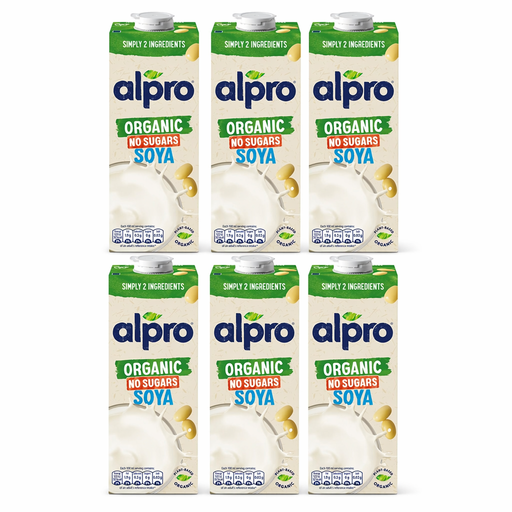 No image available
An organic UHT soya drink described for cereal, tea and coffee. The product information lists 1 L, 0 g sugars and 3.3 g protein per 100 ml; it says to refrigerate after opening and use within five days. Contains soya.
UK government guidance says food labelled organic must meet applicable organic production rules, with the product and suppliers certified by an approved organic control body. Plant-based, natural or vegan wording does not itself establish an organic claim.
UK organic plant-based drinks cannot be fortified with nutrients, according to the UK government’s SACN/COT assessment. If added calcium, iodine or vitamins matter to your choice, check the exact nutrition panel and compare fortified non-organic options.
Not necessarily: an everyday UHT drink can suit cereal or tea, while a latte calls for a product explicitly described as foamable if foam is important to you. Alpro lists its Organic Soya Drink for cereal, tea and coffee; Joybuy describes Plenish Organic Barista Soya as foamable.
No. Organic certification does not remove the soya allergen; the Food Standards Agency identifies soya as an allergen. Check the current pack for other relevant allergen and precautionary statements too.
Follow the instruction on the particular carton and refrigerate it as directed. Joybuy lists five days after opening for Alpro Organic Soya Drink; Ocado lists seven days for its Rude Health drink, while a separate Joybuy Rude Health listing states five days.