Easter shoppers looking for organic labelling
If organic status is the priority, check that the claim applies to the drink as a whole, not just to an ingredient. Defra’s UK organic-labelling rules distinguish those claims.


Choose a plain organic soya drink for cereal and general Easter recipes, or a barista formula if coffee foam is the deciding requirement. Check the whole drink’s organic labelling and ingredients: the recipes differ, and the UK Office for Health Improvement & Disparities states that organic plant-based drinks cannot be fortified with nutrients.
If organic status is the priority, check that the claim applies to the drink as a whole, not just to an ingredient. Defra’s UK organic-labelling rules distinguish those claims.
A plain drink suits a different shopping need from a coffee-focused barista recipe. Compare the ingredients and the intended use before choosing a carton for cereal, cooking or hot drinks.
If added calcium, iodine or vitamins matter to the comparison, read the exact nutrition panel. The UK Office for Health Improvement & Disparities notes that plant-based drinks vary in nutrient content and that organic versions cannot be fortified.
Start with the organic claim, then choose the recipe for how you will use it. Nutrition and allergen checks matter particularly when the drink will be served to others or used regularly.
| Priority | What to check | Your needs |
|---|---|---|
| Organic status | Check that the product itself is labelled organic and inspect its certification details. Defra says UK food labelled organic must meet organic production rules and contain at least 95% organic agricultural ingredients. | I want an organic drink, not merely a drink that names an organic ingredient. |
| Recipe and use | Compare plain and barista ingredients. Sainsbury’s lists two ingredients for plain Plenish Organic Soya; Waitrose describes Plenish Organic Soya Barista as foamable for coffee. Check the exact carton’s storage instructions. | For cereal or general recipes, I want a plain formula. If I am making coffees for guests, foamability matters more. |
| Nutrition | Compare sugars, protein and listed micronutrients per 100ml on the exact pack. The UK Office for Health Improvement & Disparities states that organic plant-based drinks cannot be fortified with nutrients. | If I regularly replace a fortified drink, I need to compare nutrient information rather than assume the organic carton has the same additions. |
| Allergens | Check the current ingredients and allergen panel. The Food Standards Agency identifies soya as an allergen; Joybuy’s Plenish Organic Barista listing also carries a “May Contain Nuts” statement. | When serving guests, I need to know whether soya or a product-specific precautionary statement affects what I can offer. |
The UK Office for Health Improvement & Disparities states that organic plant-based drinks cannot be fortified, while nutrient content varies across plant-based drinks.
If the drink will regularly replace another one, compare their nutrition panels rather than treating the organic claim as a nutrition comparison.
Sainsbury’s describes plain Plenish Organic Soya as soya beans and spring water. Joybuy’s Plenish Organic Barista listing also names agave syrup, coconut milk and sea salt.
Choose by the intended use, and check the barista carton’s ingredients if a short ingredient list is important to you.
Soya itself is an allergen. The Plenish Organic Barista listing also says “May Contain Nuts”.
Ask guests about their requirements and check the physical carton’s current allergen information before serving it.
Waitrose advises that recipes can change, affecting nutrition and allergen information.
Recheck the carton when you shop, including its ingredients, allergens and instructions for storage after opening.
These brand and retailer references help identify the exact drink to compare; a retailer name alone does not establish that a product is organic.
Alpro Organic Soya No Sugars is a long-life organic drink listed by UK grocers.
Plenish has a plain organic soya drink and a separate organic barista recipe.
Tesco Groceries lists Alpro Organic Soya and Plenish Organic Soya in its soya-drinks category.
Sainsbury’s lists both Alpro Organic Soya No Sugars and plain Plenish Organic Soya.
Asda lists Alpro Organic Soya No Sugars 1L with nutrition and storage information.
M&S provides a comparison when added nutrients are part of the buying decision.
An Alpro soya drink to consider for cereal or hot drinks during the Easter shop; check the carton’s organic labelling before choosing it.
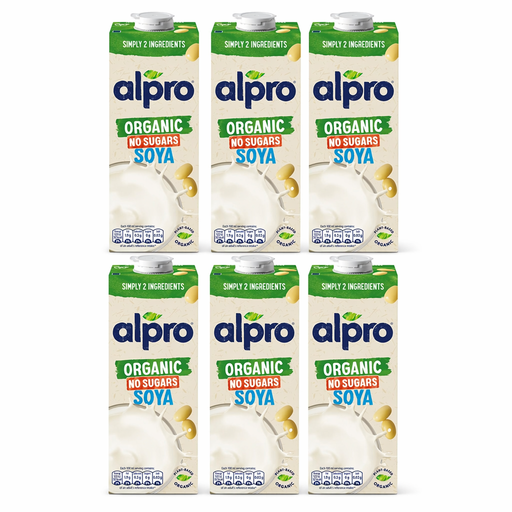 No image available
The listing describes this as an organic soya drink for cereal and hot drinks. Check the carton’s organic certification details and allergen panel: it contains soya. Refrigerate after opening and use within five days.
Check that the organic claim applies to the whole product and inspect its certification details. Defra says UK food labelled organic must meet organic production rules and contain at least 95% organic agricultural ingredients; an ingredient described as organic does not establish that the whole drink qualifies.
Do not assume it will. The UK Office for Health Improvement & Disparities states that organic plant-based drinks cannot be fortified with nutrients; compare the exact cartons if added calcium, iodine or vitamins matter to your choice.
Check the guest’s requirements and the current carton before serving it: dairy-free soya drink still contains soya. The Food Standards Agency identifies soya as an allergen, and Joybuy’s Plenish Organic Barista listing also states “May Contain Nuts”.
Choose a barista formula if coffee foam is a requirement. Waitrose describes Plenish Organic Soya Barista as foamable for coffee, but its ingredients differ from the plain Plenish drink, so check the recipe if you also plan to use it for cereal or cooking.
Follow the instructions on the exact carton. Asda’s Alpro Organic Soya No Sugars 1L listing says to refrigerate it at +1°C to +7°C and use it within five days of opening; Joybuy’s Plenish Organic Barista listing says to refrigerate it at 0–6°C and consume it within four days.