Households choosing organic for everyday use
An unsweetened UHT carton can cover cereal, tea and cooking. Before buying several, compare the opened-carton instructions with how quickly your household finishes one, and check the allergen label.


For everyday use, choose an unsweetened organic UHT soya drink if organic status and a straightforward recipe matter most; choose an organic barista formulation when making foamed coffee is the priority. If the drink regularly replaces dairy and added calcium or other nutrients matter, check the carton rather than assuming an organic drink is fortified. NHS guidance notes that organic plant milks do not usually contain added calcium, so a fortified non-organic option may better fit that requirement.
The useful distinction for a weekly shop is whether the carton is mainly for everyday meals and drinks, foamed coffee, or regular use in place of dairy.
An unsweetened UHT carton can cover cereal, tea and cooking. Before buying several, compare the opened-carton instructions with how quickly your household finishes one, and check the allergen label.
A barista formulation addresses a different use: Plenish describes its Organic Barista Soya as foamable for coffee. Its recipe differs from the brand’s standard unsweetened organic drink, so check the ingredients if you also plan to use it throughout the week.
If a plant drink regularly replaces dairy and added nutrients are important to your choice, inspect the label for calcium, iodine and vitamins. NHS guidance notes that organic plant milks do not usually contain added calcium; organic status alone does not settle the fortification question.
Start with how you will use the drink, then compare the exact carton’s ingredients, fortification and opened-storage instructions. An organic everyday drink and an organic barista drink need not have the same recipe.
| Priority | What to check | Your needs |
|---|---|---|
| Organic recipe | Check the organic designation on the carton, then read its ingredients and sugars per 100 ml. Ocado lists spring water and 8% organic soybeans for standard Plenish Organic Soya; the Plenish barista recipe also contains agave syrup, coconut milk and salt. | I want an organic drink for cereal, tea or cooking, but I still want to know whether its recipe suits those everyday uses. |
| Fortification | Look for added calcium, iodine, vitamin D and vitamin B12 on the current pack. NHS guidance says organic plant milks do not usually contain added calcium; M&S lists those nutrients in its non-organic Unsweetened Soya Drink. | If this drink regularly replaces dairy in my household, I need to check its labelled nutrients rather than treat organic status as evidence of fortification. |
| Coffee use | Check whether the product is formulated for foam and compare its ingredients with a standard unsweetened carton. Tesco describes Plenish Organic Barista Soya as foamable; that description does not make its recipe interchangeable with standard Plenish Organic Soya. | For regular cappuccinos or cortados, foam matters to me; for a general household carton, I would also consider the recipe. |
| Storage and allergens | Read the refrigeration temperature and use-within period after opening, plus the soya and any may-contain declarations. Asda lists five days after opening for Alpro Organic Soya; Ocado lists four days for standard Plenish Organic Soya. | I want to buy enough for the week without opening more cartons than we can use within their labelled periods. Anyone in the household with a soya allergy also needs the exact carton’s allergen information. |
NHS guidance notes that organic plant milks do not usually contain added calcium. An organic carton may therefore meet an ingredient preference without meeting a household’s fortification requirement.
Check the current pack for added calcium, iodine and vitamins. If labelled fortification is the deciding factor, compare fortified non-organic drinks too.
Plenish Organic Barista Soya includes agave syrup, coconut milk and salt, while Ocado lists only spring water and organic soybeans for the standard Plenish Organic Soya drink.
Choose the barista carton for its stated foamable coffee use; compare ingredients separately if you also want a general-use drink.
UHT storage before opening does not extend a carton’s use-within period once opened. Asda states five days for Alpro Organic Soya, while Ocado states four days for standard Plenish Organic Soya.
Plan how many cartons to open at once, refrigerate them as directed and follow each carton’s labelled period.
The Food Standards Agency identifies soya as an allergen. Standard Plenish Organic Soya also carries a possible-nut-presence statement.
Check the allergen declaration on the exact carton before buying; a soya drink is not suitable for someone with a soya allergy.
These examples show how specific product lines differ; the brand name alone does not establish a carton’s ingredients, fortification or suitability.
Alpro Organic Soya No Sugars is a 1 L UHT organic option for everyday use.
Plenish has a standard unsweetened Organic Soya drink and a separate Organic Barista Soya formulation for coffee.
M&S Unsweetened Soya Drink provides a non-organic comparison when labelled fortification matters more than an organic-only choice.
This Alpro option represents the organic everyday-drink route. Check the listing’s pack quantity before planning how many cartons to buy for the week.
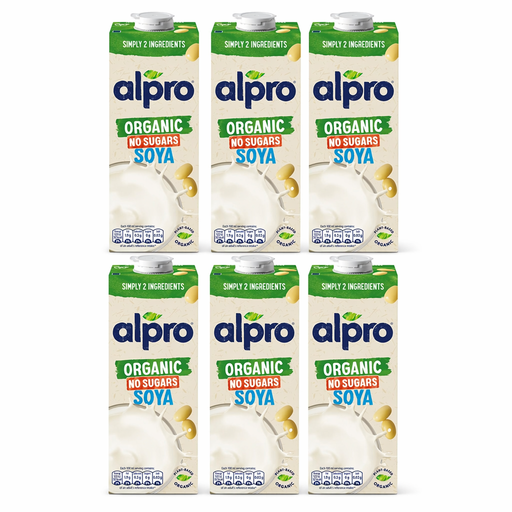 Image unavailable
An organic soya drink for everyday uses such as cereal and hot drinks. The product details list water and 8.8% hulled soya beans, 3.3 g protein and 0 g sugars per 100 ml, and use within five days after opening. The listing title suggests six units while its detailed quantity states 1 L, so confirm the total pack contents before ordering. Check the current carton for fortification if added nutrients matter; the drink contains soya.
Check the organic designation on the specific carton, then read its ingredients and nutrition label. Organic status alone does not tell you whether a drink has a short recipe, contains added sugars or has added calcium and vitamins.
No. NHS guidance notes that organic plant milks do not usually contain added calcium. If fortification matters, check the pack for added calcium, iodine and vitamins; Marks & Spencer lists these in its non-organic Unsweetened Soya Drink.
Follow the instructions on the particular carton. Asda lists refrigeration at +1°C to +7°C and use within five days for Alpro Organic Soya; Ocado lists 0°C to 6°C and use within four days for standard Plenish Organic Soya.
No. Soya is an allergen, so a soya drink is not suitable for someone with a soya allergy. Check the exact carton’s allergen declaration for other relevant warnings too; standard Plenish Organic Soya carries a possible-nut-presence statement.