Bakers controlling a recipe’s sweetness
If your cake, pancake or dessert recipe already specifies sugar, an unsweetened drink lets you follow that quantity without choosing a sweetened milk substitute.


For cakes and pancakes that use milk as a liquid, an unsweetened organic soya drink is a practical starting point if you want the recipe to control sweetness. Check the current ingredient and allergen labels before buying, and follow the recipe rather than assuming every bake will turn out the same.
Organic soya drink is worth comparing if you use milk as a liquid in home baking and care about the drink’s ingredients, sweetness or organic label.
If your cake, pancake or dessert recipe already specifies sugar, an unsweetened drink lets you follow that quantity without choosing a sweetened milk substitute.
If organic status matters to you, check the individual drink’s label and ingredients. Plant-based or vegan wording does not, by itself, mean a product is organic.
If you prefer a drink made from water and soya beans, compare the actual ingredient panels. Soya remains an allergen, and any precautionary nut statement also matters when sharing a bake.
Start with the recipe’s sweetness and the product’s organic label, then check whether its allergen and storage instructions work for your household.
| Priority | What to check | Your needs |
|---|---|---|
| Sweetness and ingredients | Look for plain, unsweetened wording; read the sugars value per 100 ml and the full ingredient list. “No added sugar” and “no sugars” are different label descriptions. | My cake already has a measured amount of sugar, so I want to know what the drink adds to the recipe. |
| Organic status | Check that the drink itself is labelled organic. The Department for Environment, Food & Rural Affairs says UK organic labelling requires applicable production rules and certification by an approved control body. | I’m choosing an organic product, rather than treating “plant-based” as an organic claim. |
| Use in the recipe | Check that the recipe calls for milk as a liquid ingredient and start with its stated quantity. Holland & Barrett describes direct soya-drink substitution in bakes such as cakes and pancakes; the rest of the recipe still matters. | For pancakes or a cake, I want a milk substitute I can measure into the recipe without assuming it guarantees the same finished result. |
| Allergens and storage | Read the pack’s soya declaration and any precautionary nut statement. Follow that product’s refrigeration and use-after-opening instructions. | I may share the bake with someone else or use one carton over several baking days. |
A dairy-free soya drink may not meet an organic purchasing requirement. These are separate claims.
Check the individual product’s organic wording and ingredient panel. The Department for Environment, Food & Rural Affairs says UK organic claims are subject to production and certification rules.
A sweetened or flavoured drink introduces ingredients that the recipe may not account for.
If the recipe specifies its own sugar, compare plain, unsweetened organic drinks first and read the current pack before making a substitution.
Soya drinks contain soya. The Food Standards Agency identifies soya as an allergen; Waitrose & Partners also lists a may-contain-nuts warning for Plenish Organic Soya.
Check the physical pack’s allergen and precautionary statements when baking for others.
Opened-pack guidance differs: Waitrose & Partners lists four days under refrigeration for Plenish Organic Soya, while Abel & Cole lists three days for Sojade Natural Soya Drink.
Choose a quantity you can use within the instructions on the carton you buy.
These product lines offer different ingredient and opened-carton details; compare the current pack rather than applying one product’s information to a whole brand.
Alpro UK lists its Organic Soya drink as water and organically grown hulled soya beans (8.8%).
Tesco lists Plenish Organic Soya as spring water and organic soybeans (8%), with no added sugar, oils or additives.
Abel & Cole lists Sojade Natural Soya Drink as water and organic hulled soya beans (7.5%).
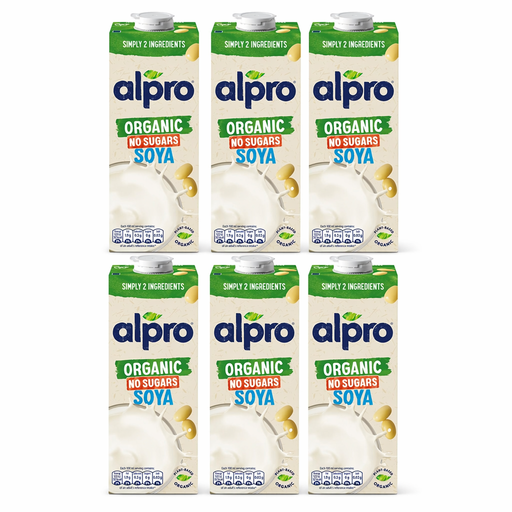
This Alpro soya drink is an option to consider for organic home baking; confirm the current pack’s organic wording, ingredients and sugars information against your recipe.
 No image available
For a bake with a measured amount of sugar, check this variant’s organic wording, ingredients and sugars information on the current pack before using it. It contains soya; read the allergen advice when baking for others.
It can be a starting substitute where the recipe uses milk as a liquid: Holland & Barrett describes using soya drink directly in place of cow’s milk in cakes and pancakes. Start with the recipe’s stated quantity, while recognising that its other ingredients also affect the result.
The Department for Environment, Food & Rural Affairs says a food labelled organic must meet the applicable organic production rules, agricultural-ingredient requirements and approved-body certification requirements. Check the individual drink’s pack; vegan or plant-based wording is not a substitute for an organic claim.
An unsweetened drink is a sensible starting point when the recipe already specifies its sugar and you do not want a sweetened milk substitute. Check the current pack: Alpro UK lists no sugars for Alpro Organic, Tesco lists no added sugar for Plenish Organic, and Abel & Cole lists 0 g sugars for Sojade Natural.
A soya-containing drink is unsuitable for someone with a soya allergy; the Food Standards Agency identifies soya as an allergen. Read the precise pack statement for other warnings too: Waitrose & Partners lists a may-contain-nuts warning for Plenish Organic Soya.
Follow the instructions on that carton. Waitrose & Partners says to refrigerate opened Plenish Organic Soya at 0–6°C and consume it within four days; Abel & Cole says to refrigerate Sojade Natural Soya Drink and use it within three days.