Who is this choice for?
The useful comparison depends on whether carbohydrate, organic ingredients or use as a regular milk replacement matters most to you.
Organic shoppers comparing carbohydrate
If you are managing carbohydrate intake, compare the total carbohydrate on each carton on a per-100ml basis, then consider the amount you will drink. An organic label and a no-sugar name do not replace that check; Diabetes UK advises using the total carbohydrate figure.
People replacing dairy milk regularly
If soya drink is a daily substitute in tea, cereal or cooking, consider more than its carbohydrate figure. Diabetes UK advises checking that dairy-free alternatives are unsweetened and fortified with calcium; the UK government’s SACN/COT summary says organic plant-based drinks cannot be fortified in the UK.
Shoppers who prefer short ingredient lists
If a short list matters to you, compare the ingredients alongside the nutrition panel. Waitrose & Partners lists spring water and organic soybeans for Plenish Organic No Added Sugar Soya; its organic status also means it is not a fortified option in the UK.
What should you check?
Start with the back-of-pack nutrition panel, then decide whether organic certification or fortification matters more for how you use the drink.
| Priority |
What to check |
Your needs |
| Total carbohydrate |
Compare total carbohydrate per 100ml on the back label. Work out the amount for your usual serving; front-of-pack traffic-light labels do not show total carbohydrate, according to Diabetes UK. |
I want to compare what is in the amount I actually pour, rather than judge cartons by their names. |
| Sugars and ingredients |
Check sugars and total carbohydrate separately, then read the ingredient list. Waitrose & Partners lists 0g sugars per 100ml for both Alpro Organic No Sugar and Plenish Organic No Added Sugar, but their listed total carbohydrate figures are 0g and 0.8g respectively. |
For tea or cereal, I want an unsweetened option without assuming that 0g sugars means 0g total carbohydrate. |
| Organic status |
Check the exact carton’s organic labelling. The Department for Environment, Food & Rural Affairs says food labelled organic must meet organic production rules and be certified by an approved organic control body. |
If organic certification is important to me, I still need to make a separate nutrition-label comparison. |
| Fortification |
Check whether the drink lists added calcium and other nutrients you are comparing. Diabetes UK advises checking calcium fortification in dairy-free alternatives; the UK government’s 2025 SACN/COT summary says UK organic plant-based drinks cannot be fortified. |
If I use soya drink regularly instead of dairy milk, I need to decide whether an unsweetened fortified, non-organic drink better fits that use. |
| Allergens |
Read the current pack’s soya allergen declaration and any product-specific precautionary statements. The Food Standards Agency identifies soya as an allergen. |
Where an allergy is relevant, I need the label for the exact carton, not an assumption based on it being plant-based or organic. |
Brand and retailer examples
These named cartons illustrate the organic-versus-fortified choice; compare figures only when their stated units match.
Alpro
Waitrose & Partners lists Alpro Organic No Sugar Long Life Soya Drink as an organic option with 0g total carbohydrate and 0g sugars per 100ml.
- The listed ingredients include water and organic hulled soya beans; protein is listed as 3.3g per 100ml.
- As an organic plant-based drink in the UK, it cannot be fortified with nutrients, according to the UK government’s SACN/COT summary.
Plenish
Waitrose & Partners lists Plenish Organic No Added Sugar Soya with spring water and organic soybeans as its ingredients.
- Its listed nutrition is 0.8g total carbohydrate, 0g sugars and 3.2g protein per 100ml.
- It is an organic option, not a fortified substitute for a non-organic soya drink.
Tesco
Tesco Organic Longlife Soya Drink Unsweetened provides another organic, unsweetened carton to compare.
- Tesco lists 0.9g total carbohydrate, 0g sugars and 3.4g protein per 100ml.
- Check availability and the current carton label before relying on its listing for a purchase.
Waitrose
Waitrose Essential Unsweetened Soya Drink illustrates the non-organic, fortified alternative to an organic carton.
- Waitrose & Partners lists added calcium, vitamin D, vitamin B12, riboflavin and iodine.
- It does not meet an organic-only preference.
M&S
M&S Unsweetened Soya Drink is another non-organic fortified option for comparing what the organic choice leaves out.
- Marks & Spencer lists added calcium, iodine, vitamin D and vitamin B12, and 1.5g carbohydrate per 100g.
- Its carbohydrate figure is stated per 100g, so do not compare it directly with cartons labelled per 100ml without a like-for-like basis.
Organic soya drink on Joybuy
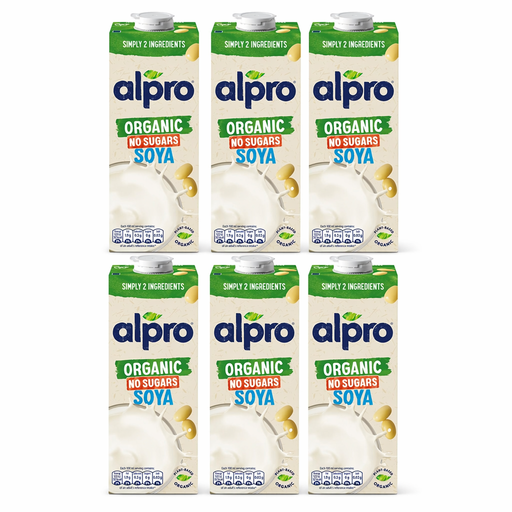
This Alpro listing represents the organic soya-drink route. Check the current carton label and pack quantity when deciding whether it fits your usual serving and shopping needs.
 No image available
Alpro Organic Soya Drink (listing marked 6)
An organic soya option to consider when comparing the total carbohydrate on current cartons. Check how much the listing’s initial '6' represents before ordering. If this will regularly replace dairy milk, bear in mind that UK organic plant-based drinks cannot be fortified with nutrients, according to the UK government’s SACN/COT summary.
View on Joybuy
Questions about organic soya drink
Does organic soya milk automatically suit someone managing diabetes?
No. Organic labelling concerns production, not the carbohydrate in your serving. Diabetes UK advises checking total carbohydrate on the label; compare the per-100ml figure and the amount you actually drink.
Why check total carbohydrate as well as sugars?
The two label figures answer different questions: a drink can list 0g sugars and still contain carbohydrate. Diabetes UK advises checking total carbohydrate and notes that front-of-pack traffic-light labels do not show it.
Can organic soya drink be fortified in the UK?
No. The UK government’s 2025 SACN/COT summary says plant-based drinks labelled organic in the UK cannot be fortified with nutrients. If you regularly replace dairy milk, compare this with an unsweetened non-organic option that lists added calcium; Diabetes UK advises checking calcium fortification in dairy-free alternatives.
What does an organic label tell me?
It indicates that the food meets organic production rules and is certified by an approved organic control body, according to the Department for Environment, Food & Rural Affairs. It does not state how much carbohydrate or added nutrients the drink contains.
Is organic soya drink suitable for someone with a soya allergy?
No. Soya remains an allergen whether the drink is organic or not; the Food Standards Agency identifies it as a possible health risk for people allergic to soya. Check the current pack’s allergen declaration and any relevant precautionary statements.


