What should you check?
Start with what the drink needs to do at breakfast, then compare its organic claim, ingredients and nutrient panel on the exact carton.
Organic soya drink
Choose when: Organic production matters most for a drink used on cereal or porridge.
Bear in mind: Organic certification does not establish whether nutrients have been added.
Fortified unsweetened soya drink
Choose when: You want a drink that lists added calcium, iodine or vitamins for regular use.
Bear in mind: Tesco’s listed fortified example is not described as organic.
Barista soya drink
Choose when: Espresso-based coffee and foam are central to your morning routine.
Bear in mind: Check its ingredients and organic status separately; a barista label does not establish either.
| Priority |
What to check |
Your needs |
| Organic status |
Look for an organic claim on the exact product. For UK food, the Department for Environment, Food & Rural Affairs says organic labelling requires compliance with organic production rules, at least 95% organic agricultural ingredients and certification of the product and suppliers by an approved organic control body. |
I want an organic drink for everyday breakfasts, rather than relying on words such as “natural” or on one organic ingredient. |
| Fortification |
Compare the listed calcium, iodine, vitamin D and vitamin B12 on each carton. Tesco lists added calcium, iodine and vitamins for its Unsweetened Soya Drink; its listing gives 0.4 g sugars per 100 ml. Plenish Organic Soya’s listed ingredients are spring water and 8% organic soybeans. |
If I use soya drink regularly instead of dairy milk, I want to know which added nutrients, if any, are in the one I buy. |
| Breakfast use |
Check whether the product is described for cereal, tea or coffee. For espresso-based drinks, look for a specific barista or foamable description rather than treating ordinary coffee-use wording as a foam claim. |
Most mornings it goes on cereal; if I make cappuccinos instead, how it behaves in hot coffee matters to me. |
| Allergens |
Read the current ingredients and allergy statement. GOV.UK identifies soya beans as an allergen that must be clearly labelled when present in prepacked food; the listed M&S unsweetened soya drink also states that it is unsuitable for people with nut or peanut allergies. |
In an allergy-managed household, I need the statement for this particular carton, not reassurance from a vegan or dairy-free description. |
| After opening |
Follow the individual pack’s refrigeration and use instructions. Tesco’s listing for Plenish Organic Soya says to refrigerate it at 0–6°C after opening and consume it within four days. |
If I use only a little at breakfast, the opened-carton instructions affect which size fits my routine. |
Brand and product-line references
These named products illustrate different breakfast choices; a brand name alone does not establish the ingredients or nutrition of every drink it makes.
Alpro
Tesco describes Alpro Soya Organic as an organic long-life drink for uses including cereal, tea and coffee.
- The Tesco listing describes this product as organic, vegan and containing no sugar.
- Check the current carton for its full ingredients and nutrient panel; the listed uses do not establish barista-style foam.
Plenish
Plenish Organic Soya offers a short ingredient list, while the brand describes a separate barista range for coffee.
- Tesco lists spring water and 8% organic soybeans for Plenish Organic Soya, with 3.2 g protein and 0 g sugars per 100 ml.
- Do not assume the standard two-ingredient drink has the recipe or coffee behaviour of a barista variant; check each product separately.
Tesco
Tesco’s listed Unsweetened Soya Drink provides a fortified comparison with the organic examples.
- Its listing names added calcium, potassium iodide and vitamins B12, B2 and D2, and gives 0.4 g sugars per 100 ml.
- That listing does not describe the drink as organic; check its full ingredient list if a short recipe matters to you.
M&S Plant Kitchen
M&S describes its Unsweetened Soya Drink as fortified with calcium, iodine, vitamin D and vitamin B12.
- The named added nutrients make the product worth comparing when fortification is a buying priority.
- M&S states that this product is unsuitable for people with nut or peanut allergies; its listing does not describe it as organic.
Joybuy soya drink option
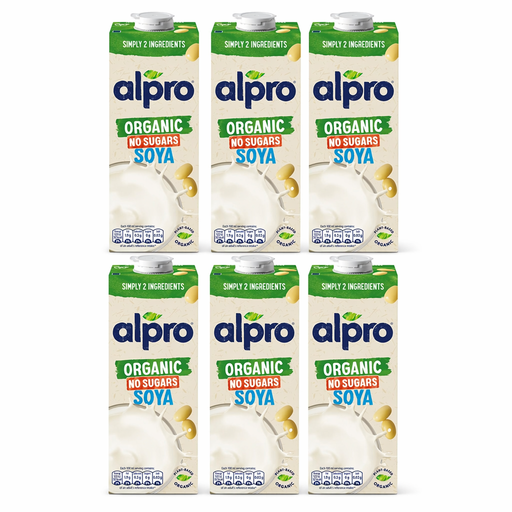
This Alpro option relates to the organic soya drink route for weekday cereal and other everyday breakfast drinks. Compare its current carton with your requirements for fortification and coffee use.
 No image available
6 Alpro Soya Drink OG
Its product description identifies organically grown soya and suggests use on breakfast cereal, as well as in tea and coffee.
If added calcium, iodine or vitamins matter to your choice, check the current carton. Coffee use is described, but a barista foam claim is not established for this product.
View on Joybuy
Common questions
Does organic soya milk have added calcium and vitamins?
Not necessarily. UK organic labelling concerns production and certification, not fortification. Tesco lists Plenish Organic Soya with water and organic soybeans, while its Unsweetened Soya Drink lists added calcium, iodine and vitamins B12, B2 and D2; check the exact carton for the nutrients you want.
Should I buy a different soya drink for espresso coffee?
If foam or separation matters, look for a product explicitly intended for barista use. Plenish says heat and acidic coffee can cause plant drinks to separate and describes its barista drinks as formulated for coffee; an ordinary organic claim alone does not establish how a drink will behave.
How long can I keep soya drink after opening it?
Follow the instructions on the individual pack. Tesco’s listing for Plenish Organic Soya says to refrigerate it at 0–6°C after opening and consume it within four days; do not apply that period to every soya drink.
Is dairy-free soya milk suitable for someone with a soya allergy?
No. Soya beans are an allergen, and GOV.UK says they must be clearly identified in the ingredients list when present in prepacked food. Dairy-free wording does not change that; read the current product’s ingredients and allergy statement.
What does an organic food claim mean in the UK?
The Department for Environment, Food & Rural Affairs says a food labelled organic must meet organic production rules, have at least 95% organic agricultural ingredients and have its product and suppliers certified by an approved organic control body. The claim does not tell you whether a soya drink is fortified or intended for barista use.


