For a compact retirement-shop range, start with an organic everyday black tea, then consider an organic decaf black tea for customers who still want that style of drink and an organic herbal infusion for those seeking a naturally caffeine-free option. Check the current pack’s organic claim and certification details for each product: in the UK, Fairtrade, Rainforest Alliance and “natural” wording do not establish that food may be labelled organic.
Who is the range for?
A small range can serve different preferences without treating every organic tea bag as the same kind of drink.
Retirement-shop buyers building an organic range
Choose distinct tea types and check the organic claim on each current pack. UK organic-labelling guidance from the Department for Environment, Food & Rural Affairs requires the product and its suppliers to be certified by an approved organic control body.
Customers looking for everyday black tea
An organic black-tea bag gives customers a conventional tea choice without asking them to switch to a herbal infusion. Clipper Tea Shop lists organically grown black tea as the ingredient in its Organic Everyday Tea.
Customers choosing decaf or a herbal drink
Make the distinction clear: Clipper describes its Organic Everyday Decaf as decaffeinated black tea, while Twinings describes Organic Pure Peppermint as a naturally caffeine-free herbal infusion. They offer different flavours as well as different caffeine descriptions.
What should you check before stocking tea?
Decide on the drink types first, then check each product’s organic labelling, ingredients and pack format. A decaf black tea and a caffeine-free herbal infusion should have separate shelf descriptions.
| Priority |
What to check |
Your needs |
| Organic labelling |
Check the current pack’s organic claim and certification details. The Department for Environment, Food & Rural Affairs says food labelled organic must meet organic rules and have an approved organic control body certifying the product and suppliers; other sourcing or packaging claims are not substitutes. |
I want to describe a tea as organic on the shelf only when its own pack supports that description. |
| Everyday black tea |
Check that black tea is listed as the ingredient, then compare bag counts and pack weights. Clipper Tea Shop lists Organic Everyday Tea as 80 bags and 250 g; pack details belong to that product, not to every organic black tea. |
I want a familiar black-tea choice alongside any decaf or herbal options. |
| Decaf black tea |
Look for a product explicitly described as decaffeinated black tea. Check its current caffeine wording and pack contents rather than calling decaf caffeine-free. |
Some customers still want black tea but ask specifically for a decaf version. |
| Herbal infusion |
Check the named ingredients and the product’s caffeine description. Twinings describes Organic Pure Peppermint as 100% organic peppermint and naturally caffeine-free; a mint blend may have different ingredients. |
I would like a caffeine-free herbal choice, but not one presented as a replacement for black tea. |
| Medication questions |
Describe teas by ingredients and stated caffeine status, not medical suitability. Cambridge University Hospitals advises people taking warfarin to discuss significant dietary changes with their clinician; direct individual medicine questions to a pharmacist or clinician. |
If I take medicine, I need an answer about my circumstances from a healthcare professional, not a general assurance on a tea shelf. |
What can cause confusion on the shelf?
-
Assuming an ethical or packaging claim means organic
Fairtrade, Rainforest Alliance certification and plant-based tea bags describe different product attributes. They do not, by themselves, satisfy the UK conditions for labelling food organic.
Check the organic wording and certification details on each current product pack before placing it in an organic range.
-
Using “decaf” and “caffeine-free” as the same shelf label
Clipper’s Organic Everyday Decaf is decaffeinated black tea; Twinings describes Organic Pure Peppermint as a naturally caffeine-free herbal infusion. A customer choosing by flavour or caffeine description needs to see which is which.
Keep the two drink types separate and use each manufacturer’s current caffeine wording.
-
Suggesting herbal or green tea suits everyone taking medicines
Cambridge University Hospitals advises consistency and clinical discussion around significant dietary changes for people taking warfarin. An NHS medicines resource also identifies green tea and certain herbal ingredients among potential warfarin-interaction considerations.
Make no treatment or universal suitability claims. Refer questions about an individual’s medicines to a pharmacist or clinician.
-
Ordering a large quantity without checking the format
The cited Clipper Organic Everyday Tea comes in an 80-bag, 250 g format, while Twinings Organic Pure Peppermint is listed as 20 bags. The same quantity of packs would therefore provide different numbers of bags.
Check bag count, weight and the drink type before deciding how much of each line to stock.
Which brands offer useful reference points?
Judge organic status by the particular tea, not by the brand name: the examples below include both products described as organic and conventional teas that require a separate organic check.
Clipper
Clipper Tea Shop lists organic everyday and organic decaf black-tea products, making them relevant references for two different black-tea choices.
- Organic Everyday Tea lists organically grown black tea; Organic Everyday Decaf lists decaffeinated organically grown black tea.
- Check organic labelling on the particular pack rather than applying one product’s description to every Clipper tea.
Twinings
Twinings lists Organic Pure Peppermint as a herbal option and also has a UK trade site for stockists.
- The Organic Pure Peppermint product is described by Twinings as 100% organic peppermint and naturally caffeine-free.
- Confirm the organic status and format of the exact product being ordered, including through a trade channel.
Yorkshire Tea
Yorkshire Tea describes a decaf range, which is a reference point when comparing black-tea formats.
- The brand identifies decaf tea as a distinct choice from its other teas.
- Decaf wording alone does not establish organic status; check the exact pack before including it in an organic range.
Typhoo
Typhoo’s Everyday One Cup provides an example of a conventional everyday tea with a separate sourcing claim.
- Typhoo describes Everyday One Cup as Rainforest Alliance Certified.
- That certification is not an organic claim; look for product-level organic labelling if organic status is required.
Tetley
Tetley Pure Green Tea is a reference for checking what a certification claim actually covers.
- The cited retail description identifies Rainforest Alliance certification for Pure Green Tea.
- Do not treat that sourcing claim as proof that this product may be labelled organic.
PG Tips
The cited Original PG Tips retail description discusses tea-bag material and Rainforest Alliance certification.
- Those details can help distinguish packaging and sourcing claims when reading a pack.
- Neither detail establishes organic status for Original PG Tips; check for a separate organic claim on any product intended for the organic range.
Joybuy tea-bag options
These options cover everyday black tea, decaf black tea, a mint infusion and a flavoured black tea. They are different choices for the shop’s range, not interchangeable answers to every caffeine or flavour preference. Check each current pack’s organic claim and certification details before labelling or shelving it as organic.
 No image available
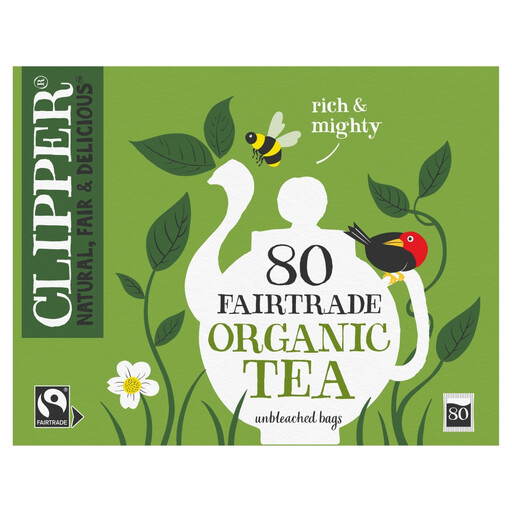
Clipper Organic Fairtrade Black Tea, 80 Bags, 232g
An everyday black-tea option for customers who want a conventional brew. The listing describes organically grown black tea and an 80-bag, 232 g pack; it does not describe this product as decaf.
Check the current pack’s organic certification details before using an organic shelf label.
View on Joybuy
 No image available
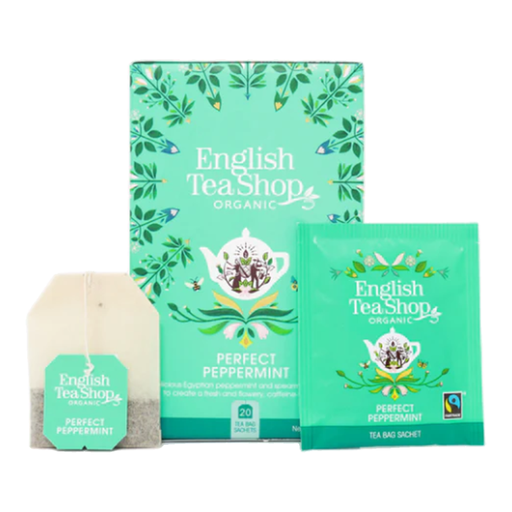
English Tea Shop Organic Perfect Peppermint, 20g
A mint infusion rather than a black-tea substitute. Its listing specifies 70% organic peppermint and 30% organic spearmint, and states 0 mg caffeine; check the current pack wording when describing it on the shelf.
Check the pack’s organic certification details. Refer individual questions about medicines and herbal ingredients to a pharmacist or clinician.
View on Joybuy
 No image available
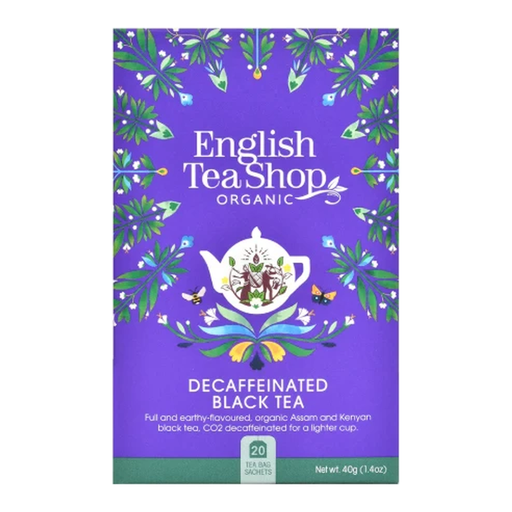
English Tea Shop Organic Decaffeinated Black Tea, 20g
A black-tea choice for customers asking for decaf. The listing identifies decaffeinated organically grown black tea; describe it as decaffeinated, not caffeine-free.
Check the bag count and organic certification details on the current pack before stocking and labelling it.
View on Joybuy
 No image available
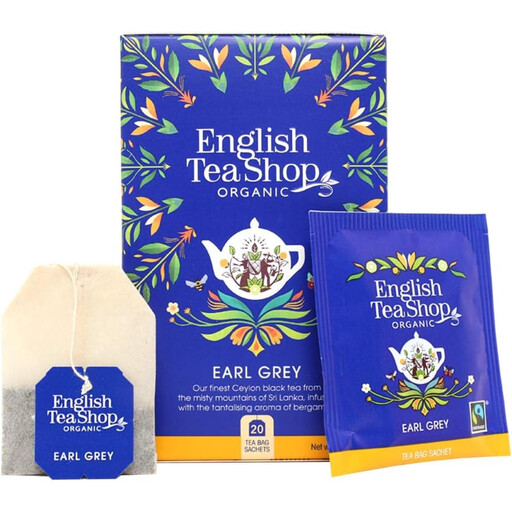
English Tea Shop Organic Earl Grey, 20 Sachets, 45g
A flavoured black tea for customers who want Earl Grey rather than an unflavoured everyday blend. The listing specifies 95% organic Ceylon black tea and 5% organic bergamot oil in a 20-sachet, 45 g pack; it is not described as decaf.
Check the current pack’s organic certification and caffeine wording before preparing shelf information.
View on Joybuy
Common questions
How can a UK shop check whether tea bags are organic?
Check the current product pack for an explicit organic claim and certification details. The Department for Environment, Food & Rural Affairs says a food product and its suppliers must be certified by an approved organic control body for the product to be labelled organic; “natural”, Fairtrade and Rainforest Alliance wording do not replace that requirement.
Should a small range include black tea, decaf and herbal tea?
They meet different preferences, so start with the types your customers are likely to ask for rather than treating them as substitutes. An organic everyday black tea offers a conventional choice; organic decaf keeps a black-tea option for someone seeking decaffeinated tea; a naturally caffeine-free organic peppermint infusion is a separate herbal choice, as the cited Clipper and Twinings product descriptions illustrate.
Is decaf black tea the same as a caffeine-free herbal infusion?
No. Clipper describes its Organic Everyday Decaf as decaffeinated black tea, while Twinings describes Organic Pure Peppermint as a naturally caffeine-free herbal infusion. Use the current product wording for each shelf label rather than calling decaf caffeine-free.
Can a shop say herbal or green tea suits everyone taking medicines?
No universal suitability claim should be made. Cambridge University Hospitals advises people taking warfarin to discuss significant dietary changes with their clinician, and an NHS medicines resource identifies green tea and certain herbal ingredients as potential interaction considerations. Direct questions about an individual’s medicines or a substantial change in tea intake to a pharmacist or clinician.


