Families making a quick hot lunch
A cupboard-stable soup can make lunch preparation straightforward at home. Check the heating directions and calculate salt for the amount served rather than assuming the whole tin is one child’s portion.


For a hot school-holiday lunch at home, choose an organic soup by checking the exact pack’s ingredients, allergens and salt per portion—not the word “organic” alone. Among three Mr Organic tins listed by Ocado, Garden Pea & Vegetable has the highest protein and fibre per 100g but contains celery; Tomato & Basil has the lowest listed salt, while Tomato & Lentil has the highest listed salt.
A cupboard-stable soup can make lunch preparation straightforward at home. Check the heating directions and calculate salt for the amount served rather than assuming the whole tin is one child’s portion.
Look for both claims on the exact soup: an organic label does not, by itself, tell you whether a recipe is vegan. The Mr Organic Tomato & Basil, Garden Pea & Vegetable and Tomato & Lentil examples are described as organic and vegan by their product pages.
Read the current ingredients and allergen declaration for the particular recipe. Ocado lists celery in Mr Organic Garden Pea & Vegetable Soup, while its Tomato & Basil page states that it is free from cereals containing gluten; neither detail describes every soup from the brand.
Start with the claim and ingredients on the exact pack, then compare nutrition for the portion you plan to serve and check how the soup must be heated and stored.
| Priority | What to check | Your needs |
|---|---|---|
| Organic label | Check the exact product’s organic claim and certification details. Defra’s UK organic-labelling guidance says food labelled organic must have at least 95% organic agricultural ingredients and certification through an approved organic control body. | I want to know what the organic claim applies to, rather than assume that every soup from a familiar brand meets the same criteria. |
| Salt and portion | Compare salt per 100g, then scale it to the amount served. NHS Healthier Families gives daily maximum salt amounts of 3g for ages 4–6 and 5g for ages 7–10; other food eaten that day also counts. | A smaller serving may make more sense than treating a 400g tin as one lunch portion. I can use the pack’s nutrition panel to see how much salt is in the serving. |
| Recipe and allergens | Compare ingredients and the protein and fibre figures per 100g without treating either figure as proof that a soup suits everyone. Read the current allergen declaration; Ocado lists celery in Mr Organic Garden Pea & Vegetable Soup. | If someone eating lunch must avoid an ingredient, the declaration on that specific pack matters more to me than broad organic or vegan wording. |
| Heating and leftovers | Follow the pack’s heating instructions and check its after-opening storage period. The Mr Organic product information instructs users to transfer opened soup out of the tin and refrigerate it; stated use periods differ by recipe. | I’m serving a hot lunch at home and may have soup left over, so I need directions for the particular pack I open. |
Ocado lists 0.61g to 0.73g salt per 100g across the three Mr Organic soups compared here. Organic status does not replace a check of the nutrition panel.
Compare salt per 100g and calculate it for the portion served. NHS Healthier Families advises considering children’s salt intake across the day, not just at lunch.
Ocado declares celery in Mr Organic Garden Pea & Vegetable Soup, which is also described as organic and vegan.
Check the ingredients and allergen declaration on the current pack whenever an ingredient must be avoided.
A 400g tin contains four 100g portions. At Ocado’s listed 0.73g salt per 100g, a whole 400g tin of Mr Organic Tomato & Lentil Soup would contain 2.92g salt.
Decide how much soup to serve, then scale the nutrition figures to that amount.
The product information gives different refrigerated use periods: Ocado states 48 hours for Mr Organic Garden Pea & Vegetable and 72 hours for Tomato & Lentil.
Transfer leftovers from the opened tin to a suitable container, refrigerate them and follow the instructions on the pack you used.
Its Tomato & Basil, Garden Pea & Vegetable and Tomato & Lentil soups provide three organic, vegan recipes to compare for a heated lunch at home.
Sainsbury’s tinned-soup range includes Heinz Cream of Tomato, Vegetable, Lentil and Minestrone as conventional soup reference points.
Sainsbury’s lists own-label tinned soups, including Cream of Tomato and Vegetable, alongside other brands.
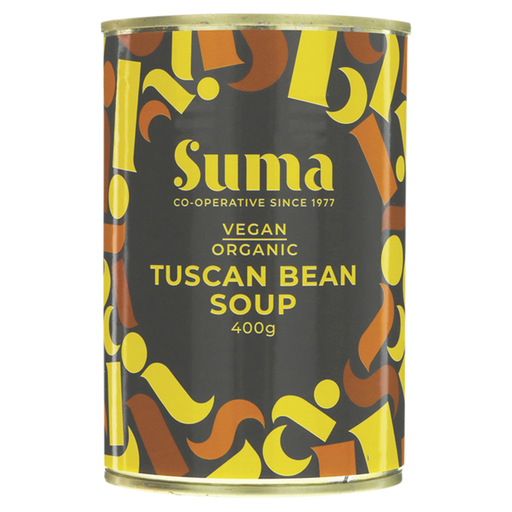
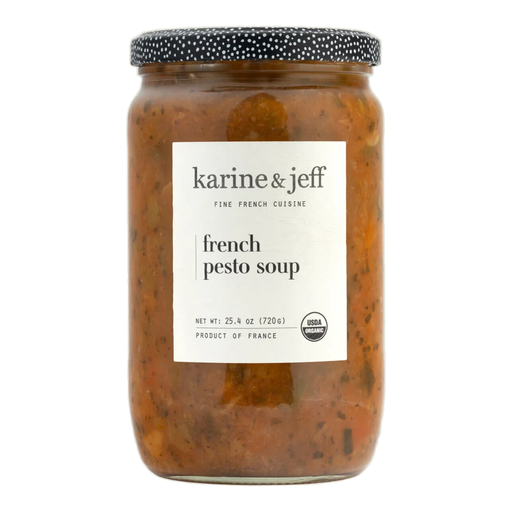
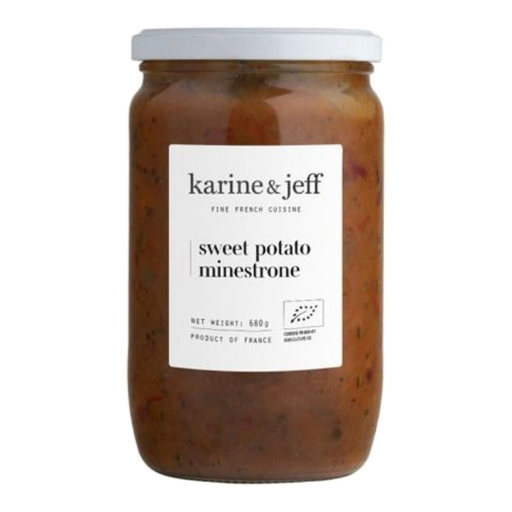
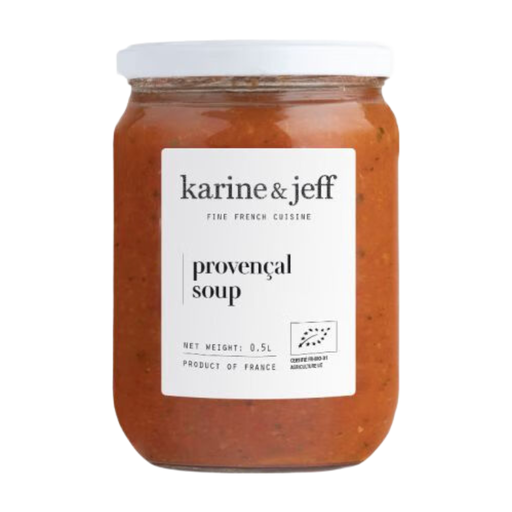
These options include a Suma soup described as a 400g can and three Karine & Jeff soups. If you specifically need a tin, confirm the pack format of the Karine & Jeff products before ordering; check the current organic label on each choice.
 No image available
This bean soup is described as a 400g can to heat for lunch. Its listing gives 2.6g protein, 2.0g fibre and 0.70g salt per 100g, and declares celery. Check the current pack’s organic certification details and allergen label; the listing says to transfer leftovers to a suitable container, refrigerate them and use within two days.
 No image available
The listing describes a bean-and-vegetable soup to heat for lunch, with 2.7g protein, 3.3g fibre and 0.5g salt per 100g. It warns that the product may contain wheat, soy and celery. Check the current organic and allergen labels, pack format and after-opening directions if those affect your choice.
 No image available
This sweet-potato, bean and vegetable soup is described as one to heat and serve. The listing gives 2.6g protein, 2.6g fibre and 0.71g salt per 100g, and identifies milk and mustard allergens. Check the pack format, current organic and allergen labels, and heating directions; the listing says not to microwave the lid.
 No image available
The listed recipe includes tomatoes, peppers, courgettes, carrots and herbs, with 0.9g protein, 1.2g fibre and 0.60g salt per 100g. Its allergen warning says it may contain wheat, soy, sesame, celery, mustard, milk and nuts. Check the current organic and allergen labels, whether the 500ml pack is a tin, and its heating and after-opening instructions before planning a hot lunch.
Defra’s UK organic-labelling guidance says a food labelled organic must have at least 95% organic agricultural ingredients, with the product and its suppliers certified by an approved organic control body. Check the claim and certification information on the exact soup rather than assuming it applies to a brand’s whole range.
No. Organic labelling and salt content answer different questions. NHS Healthier Families warns that ready-made soups can be salty; compare the pack’s salt figure per 100g and calculate it for the amount served.
No. Read the current ingredients and allergen declaration for the exact recipe. Ocado lists celery in Mr Organic Garden Pea & Vegetable Soup despite describing it as organic and vegan.
Plan the Mr Organic examples as hot lunches: their product information gives heating directions for the hob or microwave. For a packed lunch, check the chosen product’s preparation directions and how you will heat and serve it.
Follow the particular pack’s instructions, transferring soup out of an opened tin and refrigerating it where directed. Ocado states a 48-hour refrigerated use period for Mr Organic Garden Pea & Vegetable Soup and 72 hours for Tomato & Lentil, so do not apply one recipe’s timing to another.