For everyday toddler snack time, choose a softer option rather than relying on organic tortilla chips: UK organic certification concerns how food is produced and labelled, not whether a crisp is easy for a child to manage. The NHS advises avoiding salty foods such as crisps for babies, while South West Yorkshire Partnership NHS Foundation Trust warns that sharp, hard crisps may need to be avoided depending on a child’s development. If considering tortilla chips for a toddler who already manages crunchy textures, check the current pack and supervise them while they eat seated upright.
Who needs to consider these checks?
Carers considering a crunchy snack
A toddler’s ability to manage hard, splintering foods matters more than an organic claim. South West Yorkshire Partnership NHS Foundation Trust advises considering age and development, and the NHS calls for upright seating and supervision while young children eat.
Carers looking for certified-organic food
UK organic labelling rules, set out by the Department for Environment, Food & Rural Affairs, require eligible production and certification. That makes the claim useful for checking how a product is produced, but not for judging its texture or nutrition.
Carers managing allergens or food-setting rules
Check the ingredients and precautionary allergen statements on the current pack, particularly when packing food for nursery or school. Corn tortilla chips do not all have the same allergen information, and the setting may have its own food rules.
What matters when choosing a snack?
Start with whether the child can manage the texture. Then compare the exact pack’s nutrition and allergen information; an organic claim answers a different question.
| Priority |
What to check |
Your needs |
| Texture |
Consider whether the crisp is hard or splinters and whether the child can manage that texture. Follow NHS advice on upright seating and supervision. |
I need a snack my toddler can chew and swallow comfortably; if crunchy crisps are difficult for them, I would choose a softer food instead. |
| Salt and saturated fat |
Read both values on the current nutrition label. Compare products on the same basis, such as per 100g, and check the amount you intend to serve. The NHS advises avoiding salty foods such as crisps for babies. |
For routine snack time, I want to avoid relying on crisps, regardless of whether the pack says organic. |
| Organic claim |
Check the pack’s organic labelling. UK rules described by the Department for Environment, Food & Rural Affairs require organic products to meet production and certification conditions; they do not establish toddler suitability. |
I prefer a certified-organic product, but I still need to assess its texture, nutrition and ingredients separately. |
| Allergens |
Read the current ingredients, highlighted allergens and precautionary statements. Check the nursery or school’s rules before packing food. |
Gluten or another allergen matters in my household, so I cannot assume every corn tortilla chip has the same labelling. |
What assumptions should you avoid?
-
Assuming organic means suitable for toddlers
Organic certification addresses production and labelling. It does not tell you whether a crisp is hard, how much salt it contains or whether your child can manage it.
Assess texture first, then read the nutrition and allergen information on the current pack. For an everyday snack, consider a softer alternative.
-
Using hard crisps to test chewing skills
South West Yorkshire Partnership NHS Foundation Trust identifies sharp, hard crisps that splinter as foods that may need to be avoided according to a child’s age and development.
If a toddler cannot manage the texture, choose something softer. Keep young children seated upright and supervised while eating, as the NHS advises.
-
Assuming corn means gluten free or allergen free
Allergen information is product-specific. For example, Tesco’s listing for Well & Truly gluten-free tortilla chips also carries a precautionary statement about milk and soya.
Read the current physical pack for ingredients and precautionary statements, particularly when an allergen must be avoided or food is going to nursery or school.
-
Letting the organic label replace a nutrition check
A certified-organic crisp can still contain added salt. Abel & Cole lists Trafo Natural Tortilla Crisps at 0.80g salt and 2.2g saturated fat per 100g.
Compare salt and saturated fat using the same measurement basis, and consider the amount being served rather than treating the organic claim as a nutrition measure.
Organic tortilla-chip brand references
These retail-listed products illustrate what an organic claim can accompany; none of the listings establishes suitability for every toddler.
Amaizin
Real Foods lists Amaizin Organic Natural Tortilla Chips as an organic cornflour, sunflower-oil and sea-salt product.
- The Real Foods listing describes this product as gluten free.
- Its organic and gluten-free claims do not answer whether a toddler can manage the crisp texture. Check the current pack for allergens.
Trafo
Retail listings describe Trafo Natural Tortilla Crisps as organic corn crisps with sunflower oil and sea salt.
- Abel & Cole lists 0.80g salt and 2.2g saturated fat per 100g, giving shoppers figures to compare on the same basis with another pack.
- The Abel & Cole listing says the product may contain traces of soya. Its crisp texture also needs separate consideration for a toddler.
Tostitos
Costco UK lists Tostitos Organic Scoops as bowl-shaped tortilla chips made with organic corn.
- The listed scoop shape distinguishes this product from a flat tortilla chip.
- Costco UK describes the scoops as sturdy for dips; that description is not evidence that their texture suits a toddler.
A Joybuy tortilla-chip option
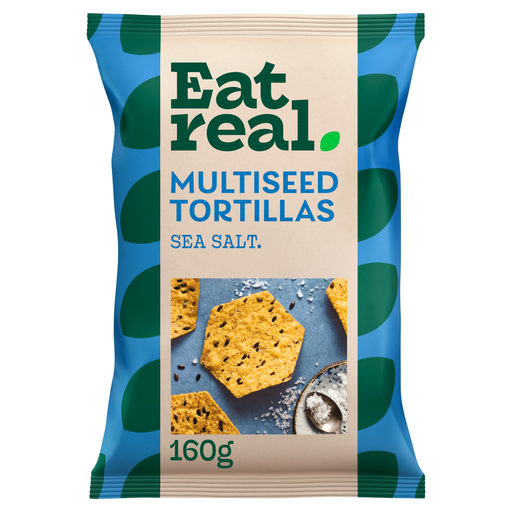
This sea-salt multiseed tortilla chip is an option to assess against the toddler-snack checks above. If organic certification or gluten-free labelling matters, confirm it on the current pack rather than inferring it from the product name.
 No image available
Eat Real Sea Salt Multiseed Tortillas 160g
For toddler snack time, assess whether the child can manage a crunchy tortilla chip and supervise them seated upright while eating. This is a 160g sea-salt multiseed product; check the current pack for salt, saturated fat, allergens and any organic or gluten-free claim.
Joybuy
Questions about tortilla chips for toddlers
Does organic mean tortilla chips are suitable for toddlers?
No. UK organic rules described by the Department for Environment, Food & Rural Affairs concern production and certification, not a chip’s texture, salt content or suitability as an everyday toddler snack. Assess those separately on the current product and for the individual child.
Can a toddler eat tortilla chips?
Consider the child’s chewing ability and the chip’s texture before offering one. South West Yorkshire Partnership NHS Foundation Trust warns that sharp, hard crisps can splinter and may need to be avoided depending on age and development; the NHS advises seating young children upright and supervising them while they eat.
Do tortilla chips always contain gluten?
No; gluten status depends on the product, not the category name. Real Foods lists Amaizin Organic Natural Tortilla Chips as gluten free, but check the current pack’s ingredients and precautionary allergen statements whenever gluten avoidance matters.
How can I check an organic claim on a UK pack?
Look for the product’s organic labelling and, where shown, its control-body code. The Department for Environment, Food & Rural Affairs says food marketed as organic must meet the applicable production rules and be certified by an approved organic control body.


