What should you check?
Start with the organic claim and ingredients, then check the serving information and choose a format for the drinks or food you actually make.
| Priority | What to check | Your needs |
|---|
| Organic claim |
Check the current product's organic wording and ingredient list. UK guidance from the Department for Environment, Food & Rural Affairs says an organic food claim requires the product and suppliers to be certified by an approved organic control body. |
I want an organic claim I can check, rather than relying on words such as ‘natural’. If I only want matcha powder, I also want to see what else is in the pack. |
| Caffeine and portions |
Check the preparation amount and any product-specific caffeine information. If pregnant or breastfeeding, count matcha with other caffeine sources against the NHS guidance of no more than 200 mg a day. |
A clearly stated portion would help me keep track of the matcha I use. I also need to account for caffeine from other drinks and foods. |
| Format and use |
Compare loose powder with pre-portioned sachets, then check whether the product is presented for mixing into food and milk drinks or for whisking with water. A sachet gives a stated portion; loose powder still needs measuring. |
For lattes or recipes, I want a powder I can measure to suit the preparation. If I mainly drink matcha plain, the preparation directions matter more to me. |
Brand references
These examples show different product formats and levels of product detail; a brand’s inclusion does not establish that every matcha it sells is organic.
Clearspring
Clearspring lists organic ceremonial matcha, premium-grade powder presented for drinks and recipes, and an organic matcha product in 8 × 1 g sachets.
- Its ceremonial powder and sachets list organic matcha as their ingredient; the sachet format gives a stated 1 g portion.
- The amount of caffeine still needs to be considered alongside the rest of the day’s intake.
JING Tea
JING lists a 30 g organic ceremonial matcha with directions for drinking it with water.
- Its preparation directions specify 1.5 g per 160 ml cup.
- If you track caffeine, check for product-specific information rather than applying another brand’s figure to this matcha.
Teapigs
Teapigs has a matcha category for shoppers comparing tea brands.
- The category provides a starting point for checking individual products.
- Check the particular pack for its organic claim, ingredients and serving directions; the category name does not establish these for every product.
Matcha options on Joybuy
These OMGTea listings include a 30 g gift set and two 30 g matcha variants. Check what the gift set contains and confirm the current pack’s organic details before choosing.
 No image available
OMGTea AA Organic Matcha Gift Set, 30 g
A gift-set option for preparing matcha at home. Confirm the included items, organic certification details and caffeine information on the current product and pack if those details affect your choice.
View on Joybuy
 No image available
OMGTea Organic Matcha AAA+, 30 g
A powder to consider if you mainly prepare matcha to drink plain. Check the current pack’s organic certification details and use its own serving and caffeine information when recording intake.
View on Joybuy
 No image available
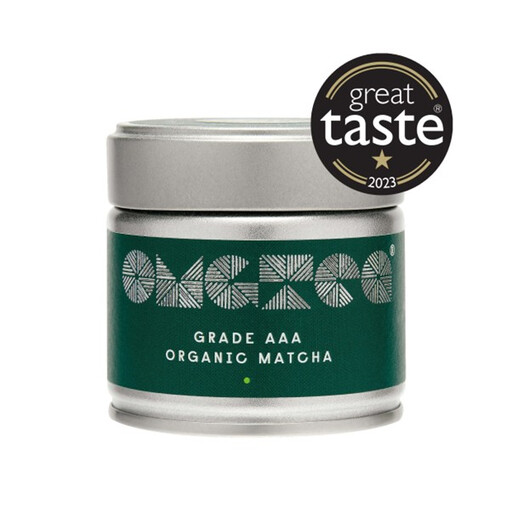
OMGTea AAA Organic Matcha, 30 g
A powder to consider for matcha drinks or recipes. If you need to record caffeine intake, confirm the preparation amount and product-specific caffeine information before deciding how much to use; check the current pack’s organic certification details too.
View on Joybuy
Common questions
Does organic matcha contain caffeine?
Yes. Organic is a production and labelling claim, not a caffeine-free claim. Check the amount of matcha you prepare and count it alongside other caffeine sources.
Can I drink matcha while pregnant?
Include matcha in your total caffeine intake: the NHS advises no more than 200 mg of caffeine a day during pregnancy. Check the product’s serving and caffeine information where available, and ask your midwife or clinician if you need individual advice.
What if I am breastfeeding?
The NHS recommends no more than 200 mg of caffeine a day while breastfeeding. If you choose matcha, count it with caffeine from other drinks and foods rather than considering the matcha serving on its own.
How do I check an organic claim on UK matcha?
Check the current pack’s organic wording and ingredients. UK guidance from the Department for Environment, Food & Rural Affairs says a food product and its suppliers must be certified by an approved organic control body for it to be labelled organic.
Should I choose loose powder, sachets or ceremonial grade?
Choose by preparation: loose powder lets you measure matcha for mixed drinks or recipes, while sachets provide a stated portion. Consider ceremonial-grade matcha if you mainly whisk it with water, and check its serving directions and caffeine information just as you would for other formats.


