
24/7 Customer Support

Free returns

Same-day & Next-day Delivery

Quality Guaranteed

Unlock Your Welcome Offers: FREE Delivery | Up to 80% OFF | Free 30-day JoyPlus trial
Download the APP
Finding furniture that is both stylish and practical can be a challenge, especially when you're trying to make the most of your space. An ottoman bench is a remarkably versatile piece that can solve several common household dilemmas at once, offering a comfortable seat, a place to store clutter and a touch of decorative flair. Whether you need a smart solution for your hallway, extra seating in the living room or a finishing touch for your bedroom, the right bench can transform a space.
This guide is designed to help you navigate the options available. We will look at key features to consider before you buy and highlight a few recommended models that balance style, function and value, helping you find the perfect fit for your UK home.
Choosing the right ottoman bench involves more than just picking a colour you like. To ensure it meets your needs, consider these three practical points.
First, decide what you need your bench to do. If your main goal is discreet organisation, a storage ottoman with a hinged lid is essential. Look at the internal dimensions to ensure it can hold what you have in mind, be it blankets, shoes or children's toys. If you're primarily seeking extra seating, focus on comfort. An upholstered bench with thick padding and a sturdy frame will be more suitable. Many models offer a blend of both, providing a comfortable seat on top of a useful storage compartment.
The fabric of your ottoman bench affects its look, feel and durability.
Also, check the frame and leg materials. Powder-coated steel offers a modern, industrial look and excellent stability, while solid wood legs provide a more traditional and classic feel. For safety, look for products that meet UK fire safety standards, such as BS5852.
Measure the space where you plan to place your bench. An end of bed bench should ideally be slightly narrower than the width of your mattress to look balanced. For a hallway bench with storage, ensure there's enough room to walk past comfortably and for the lid to open fully without obstruction. Consider the height as well; it should be comfortable for sitting, typically between 40-50 cm, which is standard for entryway seating.
Here are a few ottoman benches that offer great versatility and style for different needs and home aesthetics.
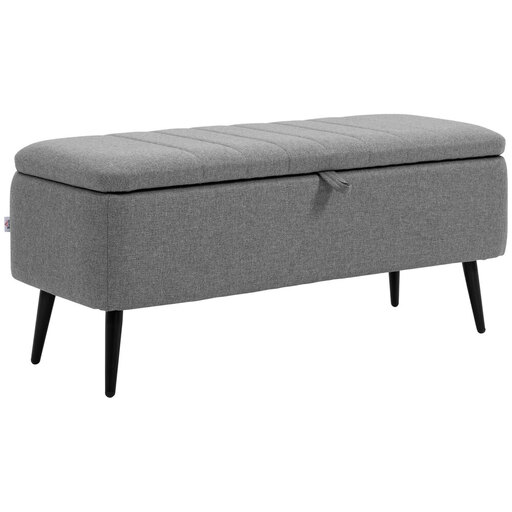
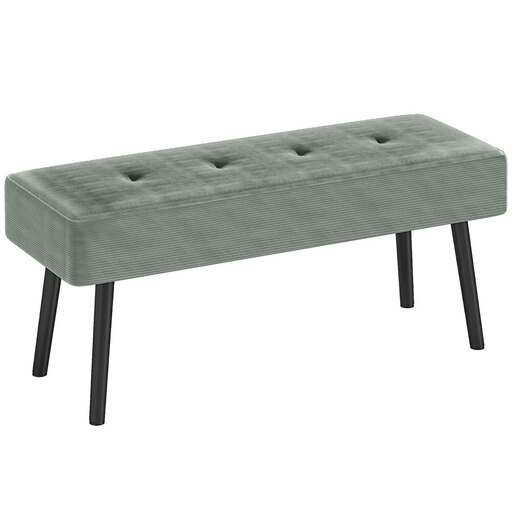
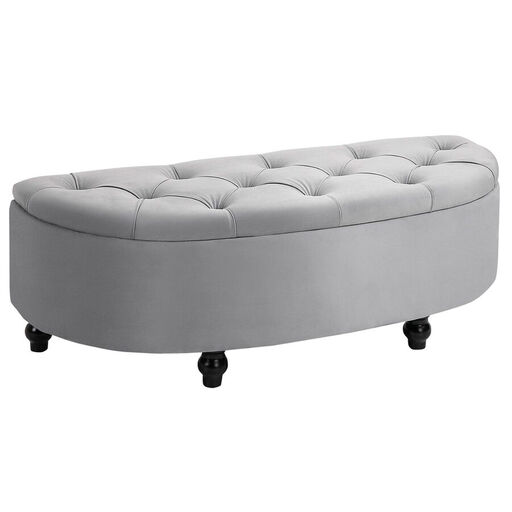
If an ottoman bench isn't quite the right fit for your space, or if you're searching for a more compact or individual seating option, there are other possibilities to explore. A smaller, versatile stool can often provide that extra seat or surface without taking up too much room.
For more ideas, why not browse our collection of accent stools?
Yes, most storage ottomans are designed to be used as seating. However, it is crucial to check the product's specified weight capacity. For example, the models we've highlighted have capacities ranging from 120 kg to 220 kg, making them perfectly safe for one or two adults to sit on, provided the weight limit is not exceeded.
The terms are often used interchangeably, but there can be subtle differences. A bench is typically a long seat for several people, with or without a back. An ottoman is traditionally a padded, upholstered footstool, but modern designs have evolved into larger, bench-like forms, often with the added feature of a storage compartment. An ottoman bench effectively merges the two concepts.
An ottoman bench is incredibly versatile. You can place it against a wall under a window to create a cosy reading nook. It can also sit opposite your main sofa to provide flexible entryway seating for guests. Alternatively, use it in place of a traditional coffee table by placing a decorative tray on top to hold drinks and remote controls, giving you a soft surface when you want to put your feet up and a stable one when you need it.