
24/7 Customer Support

Free returns

Same-day & Next-day Delivery

Quality Guaranteed

Unlock Your Welcome Offers: FREE Delivery | Up to 80% OFF | Free 30-day JoyPlus trial
Download the APP
Outdoor garden lights can transform a dark patio, balcony or pathway, but choosing the wrong product may lead to weak illumination, short battery life or fittings that are unsuitable for exposed British weather. Before buying, look beyond attractive photographs and promotional wording. The important details are usually found in the specifications.
This guide explains the main pitfalls, the technical details worth checking and a selection of outdoor garden lights for different homes and uses.
Terms such as “waterproof”, “weather-resistant” and “outdoor safe” are not interchangeable. Look for an IP rating, which indicates protection against solid particles and water. An IP65 outdoor light, for example, is protected against dust and water jets, but it should not be submerged. Solar panels, plugs and control boxes may also have separate limitations.
For uncovered patios, fences and garden borders, check the rating of the complete product rather than assuming every component has identical protection.
A long cable or high LED count does not automatically mean brighter or more practical lighting. Consider the distance between bulbs, the total length and where the power source will sit. A 12-metre solar strand may work well around a small tree, while a longer connectable set may be more suitable for a pergola or event space.
Also check whether bulbs are replaceable, whether strands can be connected and whether the product is intended for decorative glow or functional illumination.
Solar garden lights need direct sunlight to charge effectively. Shaded walls, north-facing gardens and frequent winter cloud can reduce operating time. Mains-powered outdoor string lights may offer more consistent brightness but require a suitable socket, safe cable routing and protection from standing water.
For any product, check the instructions, keep panels clean and store removable lights in a dry place during severe weather where recommended.
For garden lighting, an IP rating provides a useful starting point:
Even with IP65 outdoor lights, do not submerge control units, solar panels or connectors unless the instructions specifically permit it.
Solar lights are convenient because they do not require mains wiring. However, their performance depends on daylight, panel position, battery condition and season. A product stating 8–14 hours of illumination after approximately 6–8 hours of sunlight offers a useful reference, not a guaranteed result in every UK garden.
Plug-in LED outdoor lights generally provide steadier output. Check cable length, plug requirements, timer settings and whether an outdoor-rated socket is needed.
For decorative fairy lights and patio lights, shatterproof ABS bulbs can be more practical than glass in households with children, pets or busy entertaining areas. Warm white string lights create a softer appearance, while cooler light may provide a more functional feel around entrances.
Flexible copper wire is useful for wrapping around railings, branches and balcony frames. For outdoor wall lights, check the mounting method, sensor settings and whether the fitting is suitable for the wall surface.

Why This Fits Their Persona: Two solar-powered 12-metre strands provide a flexible way to decorate a garden, balcony, fence or patio without planning a mains cable route.
The stated IP65 rating, automatic dusk-to-dawn operation and solar panel position guidance make the outdoor requirements clearer than a vague “weatherproof” description.
Two 12-metre strands, 120 warm white LEDs per strand, eight lighting modes and a memory function.
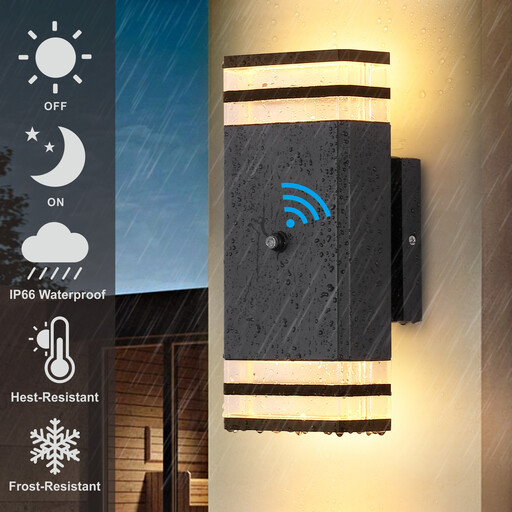
Why This Fits Their Persona: A paired set of outdoor wall lights suits homeowners who want coordinated fittings near a front door, side passage, garage or garden entrance.
The listed IP65 rating helps clarify its intended resistance to dust and water jets, while the motion sensor avoids leaving entrance lighting switched on continuously.
Two matching LED exterior lamps with motion-sensor functionality and a black wall-sconce design.

Why This Fits Their Persona: The longer strand is suited to larger patios, pergolas, garden seating areas, weddings and party layouts requiring broader decorative coverage.
Its specifications state the length, bulb count, IP65 rating, connectable design and replaceable bulbs, helping buyers assess coverage and future maintenance.
15.24-metre length, 50 shatterproof G40 LED bulbs, dimming, timer functions and support for connecting up to 500 bulbs.
Why This Fits Their Persona: This format works for renters and event planners who want warm decorative lighting that can be draped across railings, fences or temporary celebration spaces.
The stated IP44 rating is clearly different from IP65, so buyers can reserve it for suitable outdoor areas and protect connections from direct water exposure.
20-metre cable, 23 warm white G40 LED bulbs, dimmable settings and connectable design.
We have compiled a complete, real-time list of products that fully satisfy these strict selection criteria and UK safety regulations.
They can be suitable when the solar panel receives direct daylight and is kept clean. Output may be lower during overcast periods or shorter winter days, so solar lights are often more appropriate for decorative illumination than dependable security lighting.
Running cost depends on wattage, daily use and the electricity tariff. LED bulbs generally use less electricity than older bulb types, while solar garden lights do not draw power from a household socket. Check the product’s power rating and use timer settings where available.
That depends on the product’s IP rating, installation and local exposure. Keep plugs and connections away from standing water, follow the manufacturer’s storage guidance and inspect cables before use. For sheltered areas, IP44 outdoor string lights may be suitable; more exposed locations may call for an IP65-rated product.