
24/7 Customer Support

Free returns

Same-day & Next-day Delivery

Quality Guaranteed

Unlock Your Welcome Offers: FREE Delivery | Up to 80% OFF | Free 30-day JoyPlus trial
Download the APP
Outdoor garden lights can transform a patio, driveway, balcony or garden border, but attractive photographs do not always reveal whether a product will suit the British climate. The right choice depends on more than brightness or bulb count. You also need to consider charging conditions, water protection, installation, running costs and the area you want to illuminate.
Before choosing solar garden lights, outdoor string lights or LED floodlights, watch for these common purchasing traps.
Outdoor fairy lights and garden decorative lights are designed to create atmosphere rather than light a pathway or deter unwanted visitors. A long string with many LEDs may look impressive but still produce relatively soft illumination.
For steps, driveways, garages and side passages, look for a stated lumen output, a suitable beam angle and, where appropriate, motion activation. Patio lights and string lights are more suitable for visual ambience around seating areas, pergolas and fences.
Water-resistance ratings have practical limits. An IP65 rating generally indicates protection against dust and water jets, making it suitable for exposed outdoor positions when installed correctly. It does not mean the solar panel, control box or connections should be submerged.
An IP44 rating offers more limited protection against solid objects and splashing water. It may work in a sheltered location, but connections should be kept away from standing water and direct heavy rain where possible.
Solar garden lights rely on daylight, not simply outdoor placement. A panel shaded by a wall, tree or fence may not collect enough energy, particularly during overcast winter weather. Advertised lighting durations are usually dependent on charging conditions, battery condition and the selected brightness or mode.
Choose a product with a panel that can face a reasonably bright part of the garden, and keep it free from dirt and leaves.
Check both the stated charging time and expected lighting duration. The VIVREAL solar copper wire string lights listed here specify approximately 6–8 hours of direct sunlight for a claimed 8–14 hours of illumination, depending on weather conditions.
Automatic dusk-to-dawn operation is convenient, but check that the switch is turned on before first use. Clean the panel periodically with a soft, damp or dry cloth, depending on the manufacturer’s instructions. Avoid harsh chemicals and do not cover the panel with decorative materials.
For decorative outdoor string lights, consider:
For security lighting, lumens, detection distance and coverage matter more. A broad beam can reduce dark areas, while adjustable heads help direct light towards a gate, garage entrance or driveway without unnecessarily lighting neighbouring properties.
Solar lights normally require no mains wiring, making them practical for renters and gardens without an outdoor socket. Mains-powered outdoor wall lights and floodlights need an appropriate supply, weather-protected connections and secure mounting. Hardwired products should be installed according to the instructions, with electrical work carried out by a suitably qualified person where required.
Also check whether the product is intended for a wall, fence, ground stake or hanging installation. A light with a strong specification can still disappoint if it cannot be positioned securely or receive enough sunlight.
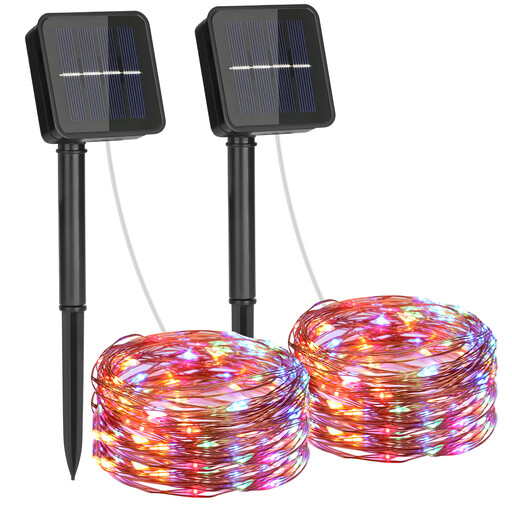
Why This Fits Their Persona: A straightforward solar option for renters, first-time buyers and smaller patios, balconies or garden features where mains wiring is inconvenient.
It states an IP65 rating, charging guidance and weather-dependent operating time rather than relying only on appearance. The solar panel needs direct sunlight and should not be submerged.
Two 8-metre strands, 80 LEDs per strand, eight lighting modes and automatic dusk-to-dawn operation.

Why This Fits Their Persona: Suitable for homeowners, hospitality settings and event planners wanting a defined warm-white display across a pergola, fence or outdoor dining area.
Its IP65 rating is clearly specified, while the shatterproof bulbs are more appropriate for busy outdoor areas than fragile decorative bulbs. Protect connections from standing water.
50 warm-white G40 LED bulbs, dimmable brightness, replaceable bulbs and connectable support for up to 500 bulbs total.

Why This Fits Their Persona: Designed for driveways, garages, porches, gardens and larger outdoor spaces where functional illumination is more important than soft decorative light.
The specification provides a stated 3,000-lumen output, 60-foot (18-metre) detection distance, 180° sensor angle and IP65 rating, allowing comparison beyond LED count alone.
Three adjustable heads, 270° coverage range, three lighting modes and solar charging with an 1,800mAh lithium-ion battery.

Why This Fits Their Persona: A flexible choice for wrapping trees, railings, fences, vases or balcony structures during everyday entertaining and seasonal events.
The 12-metre length and IP65 rating are stated clearly, while the instructions specify direct sunlight and protection of the control unit from submersion.
Two 12-metre strands, 120 warm-white LEDs per strand, eight modes and a memory function that retains the last setting.
We have compiled a complete, real-time list of products that fully satisfy these strict selection criteria and UK safety regulations.
Yes, provided the solar panel receives sufficient daylight and the product is positioned correctly. Performance can vary with cloud cover, shade, panel cleanliness and battery condition. Solar lights are convenient for decorative use and locations without a suitable outdoor socket, but they may provide less consistent output than mains-powered lights.
Solar string lights do not draw electricity from the mains while operating, although their rechargeable battery will eventually require replacement according to its condition and the product design. Mains-powered LED string lights generally use less electricity than equivalent traditional bulbs, but running cost depends on wattage and daily operating time.
Install each light according to its stated IP rating, keep solar panels clean, protect plugs and connectors from standing water, and secure cables away from sharp edges or heat sources. Store suitable decorative lights in a dry place during severe weather if the instructions recommend it. For hardwired outdoor wall lights and floodlights, isolate the power before maintenance and follow the manufacturer’s installation guidance.