
24/7 Customer Support

Free returns

Same-day & Next-day Delivery

Quality Guaranteed

Unlock Your Welcome Offers: FREE Delivery | Up to 80% OFF | Free 30-day JoyPlus trial
Download the APP
An outdoor LED floodlight can improve visibility around a driveway, garden, garage, patio or entrance, but choosing one based only on lumen claims can lead to disappointing results. A light may be bright on paper yet offer poor coverage, insufficient weather protection or an awkward installation.
The most common buying traps are easy to overlook:
Lumens describe the visible light output. Wattage describes the electricity consumed by the light source. For a small entrance or side path, a 10W LED floodlight producing around 650 lumens may be sufficient. For a driveway, garage frontage or larger garden, a 20W LED floodlight with 1,300–1,500 lumens may provide more practical coverage.
A 30W LED floodlight producing approximately 2,400 lumens is more suitable for wide driveways, building perimeters, workshops and commercial outdoor areas. However, higher output is not automatically more appropriate. Excessive brightness can cause glare for neighbours, drivers or people approaching the property.
Check the beam angle as well as the lumen figure. A 110° beam, for example, spreads light across a broad area and can be useful for driveway security lighting or large gardens.
Colour temperature is measured in kelvins (K):
A 4,000K or 5,000K outdoor LED floodlight can make paths, gates and entrances easier to see. For a seating area where atmosphere matters, a warm-light fitting may feel more suitable.
The IP rating identifies protection against solids and water. The first digit refers to solid particles, while the second relates to water. An IP65 floodlight is dust-tight and protected against water jets, making it suitable for many exposed outdoor locations when installed correctly.
IP44 offers protection against solid objects over 1mm and splashing water from different directions. It may be appropriate for a sheltered entrance, covered patio or garage side, but it provides less protection than IP65.
The rating does not mean a fitting can be immersed in water. Mount the unit according to the instructions, keep cable connections properly protected and ensure the wall surface and fixings are suitable. Mains-powered hardwired fittings should be installed by a suitably qualified person where required.
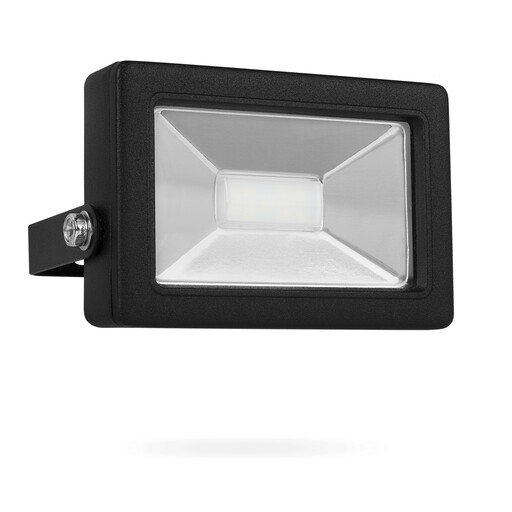
Why This Fits Their Persona: A compact option for homeowners lighting a front path, shed, small garden, entrance or garage side without selecting a higher-output fitting than necessary.
Its stated 650-lumen output and 10W rating make the brightness-to-consumption comparison clear, while IP65 protection avoids relying on a vague outdoor-use description.
Integrated 10W LED, 650 lumens, 4,000K natural white light and compact 105 × 134 × 38mm dimensions.
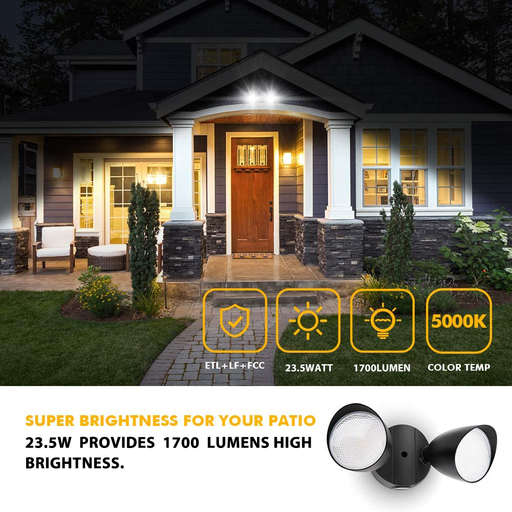
Why This Fits Their Persona: Suitable for property owners who want adjustable illumination across an entrance, patio, garage frontage or garden rather than a single fixed direction.
The two adjustable heads allow the coverage direction to be set during installation, helping reduce dark patches caused by a fixed narrow beam.
Twin integrated LED heads, 360° rotation per head, black die-cast aluminium housing and IP54/IP65 weather-resistant specifications.
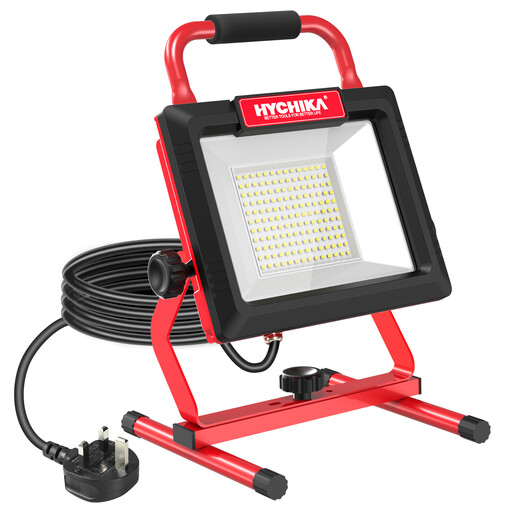
Why This Fits Their Persona: Designed for workshops, garages, construction tasks, vehicle repairs and temporary outdoor work where very high output and repositioning matter more than discreet wall mounting.
Its stated high and low modes show that output can be adjusted, while the foldable stand and 360° rotation address the limitations of a permanently fixed floodlight.
Two output settings of 6,000 or 12,000 lumens, IP65 rating, 2m cable and foldable stand with adjustable positioning.
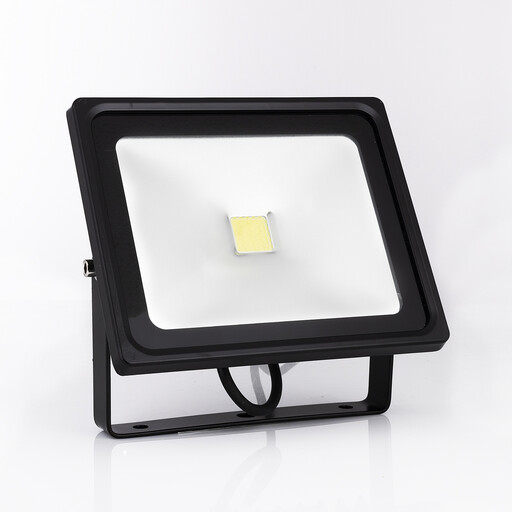
Why This Fits Their Persona: A practical match for larger driveways, parking areas, gardens, storage yards and building edges requiring broad fixed coverage.
The 110° beam angle gives a measurable indication of coverage, while the IP65 rating is more informative than a general claim of weather resistance.
30W integrated LED, 2,400 lumens, 110° beam angle and IP65 protection for exposed outdoor mounting.
LED fittings generally use less electricity than comparable traditional lamps, but the actual cost depends on the tariff and operating time. Use this simple calculation:
Wattage ÷ 1,000 × hours used × electricity price per kWh = running cost
For example, a 20W floodlight uses 0.02kWh for every hour it operates. A dusk-to-dawn light running for ten hours would use approximately 0.2kWh per night before applying the current electricity tariff.
Integrated LED designs remove the need for routine bulb replacement. Keep the lens clean, check that seals and cables remain intact and switch off mains power before carrying out maintenance. Motion sensors, timers or dusk sensors can reduce unnecessary operating hours where available.
We have compiled a complete, real-time list of products that fully satisfy these strict selection criteria and UK safety regulations.
An IP65 floodlight is designed to resist dust and water jets, making it suitable for many exposed outdoor positions when correctly installed. It should not be submerged and electrical connections must be protected according to the manufacturer’s instructions.
A smaller driveway may work with around 650–1,500 lumens, depending on mounting height and beam angle. Larger driveways or property perimeters may benefit from approximately 2,400 lumens and a wide beam. Avoid directing the light towards roads, neighbouring windows or drivers.
They usually require no bulb changes because the LED module is built into the fitting. Maintenance generally involves cleaning the lens and checking the housing, fixings and cable condition. Hardwired models should be installed or serviced by a qualified electrician where appropriate.