
24/7 Customer Support

Free returns

Same-day & Next-day Delivery

Quality Guaranteed

Unlock Your Welcome Offers: FREE Delivery | Up to 80% OFF | Free 30-day JoyPlus trial
Download the APP
An outdoor LED floodlight is more than just a light fitting; it's a practical tool for improving the safety, security and usability of your property after dark. Whether you need to illuminate a dark driveway, secure a garden perimeter, or simply light up a patio for evening use, selecting the right model is crucial. However, the market is filled with confusing specifications and marketing claims that can lead to a disappointing purchase. Before you buy, it's important to understand the common pitfalls that many shoppers fall into.
Many outdoor lights fail prematurely not because of the LED itself, but due to poor construction. Here are a few issues to watch for:
To ensure your new outdoor LED floodlight performs reliably for years, focus on these core specifications. They are the true indicators of quality and suitability, cutting through the marketing jargon.
The Ingress Protection or IP rating is a two-digit number that defines a light's resistance to solids (like dust) and liquids (like rain). For any waterproof outdoor light intended for exposed installation in the UK, an IP65 floodlight rating should be your minimum standard.
A lower rating, like IP54, may be acceptable for sheltered spots (e.g., under a deep porch), but for general-purpose garden floodlights or driveway lights, IP65 offers far greater peace of mind.
Forget judging a light by its wattage. Watts measure energy consumption, while lumens (lm) measure the actual amount of light produced. Modern energy efficient outdoor lighting can produce a high lumen output from a very low wattage.
Here’s a practical guide to lumens for different applications:
Always check the lumen output to ensure the light is fit for your purpose. A reliable mains powered security light will provide consistent brightness without you having to worry about battery levels.
The colour temperature determines the "feel" of the light. For most outdoor security and functional task lighting, a neutral or cool white light is most effective.
We've filtered through the options to find models that meet these practical criteria. Here are our recommendations, matched to different UK household needs.

Why This Fits Their Persona: This is a no-nonsense solution for the average UK home. It provides ample light for a two-car driveway or a medium-sized garden without creating excessive glare for neighbours. It's a fit-and-forget option for reliable, everyday security and visibility.
Its IP65 rating ensures it withstands heavy rain, unlike lower-rated "weatherproof" models. The 1500 lumen output is bright enough for security but avoids the blinding glare of oversized floodlights.
Features a balanced 4000K cool white light for clear visibility. The integrated 20W LED is energy-efficient and requires no bulb changes.
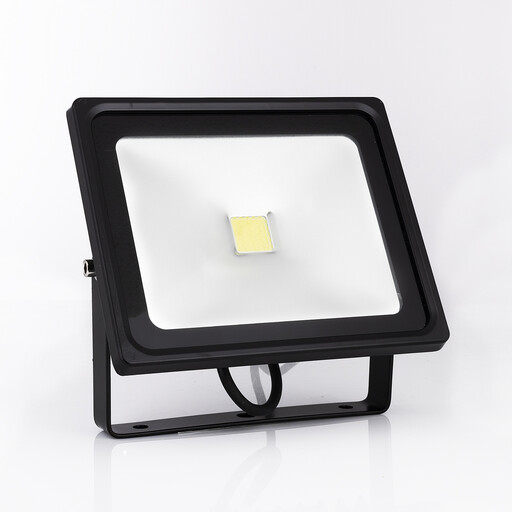
Why This Fits Their Persona: For those with a large garden, a long driveway or a small commercial yard, sheer power and coverage are essential. This model delivers a high-intensity output to illuminate wide areas, eliminating dark spots across a large perimeter.
While it is a very bright led floodlight at 2400 lumens, its 110° beam angle distributes the light broadly and evenly, reducing the harsh central "hotspot" and glare that plagues poorly designed high-power lights.
Delivers powerful illumination equivalent to an old 200W halogen light while only using 30W. Its robust IP65 build is designed for exposed, demanding environments.
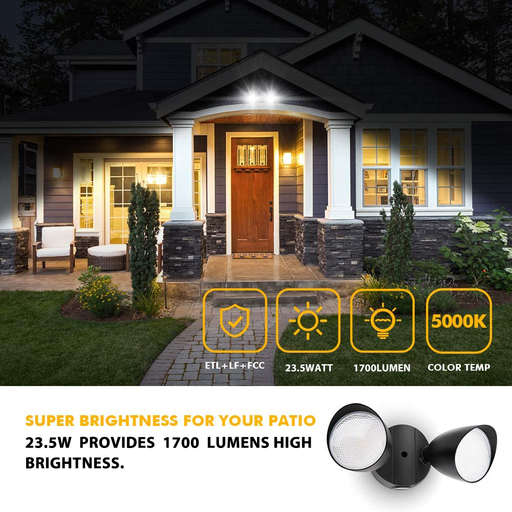
Why This Fits Their Persona: This user needs to cover multiple angles from a single point, such as a corner of a house that overlooks both a garden and a side path. The adjustable twin heads provide the flexibility to aim light exactly where it's needed, creating a customised security zone.
Instead of using one oversized, fixed floodlight that wastes light and creates glare, this twin-head design allows for precise, targeted illumination. You light up the ground and walls, not the sky or your neighbour's windows.
Each head is independently adjustable for 360° rotation, offering maximum flexibility. The die-cast aluminium construction and IP65 rating ensure durability.
We have compiled a complete, real-time list of products that fully satisfy these strict selection criteria and UK safety regulations.
The running cost is very low. For example, a 20W LED floodlight, if left on for 8 hours every night, would use approximately 0.16 kilowatt-hours (kWh) of electricity. Based on average UK electricity prices (around 28p per kWh as of mid-2026), this would cost about 4.5 pence per night or less than ?1.40 per month. This is a fraction of the cost of an old halogen equivalent.
In the UK, any fixed electrical installation in a "special location" like a garden must comply with Part P of the Building Regulations. This generally means the work must be carried out and/or certified by a qualified electrician to ensure it is safe. While replacing an existing light might seem simple, we always recommend hiring a professional for any new hardwired outdoor lighting installation.
Most integrated LED floodlights are rated for a lifespan of between 25,000 and 50,000 hours. If you use the light for 8 hours per night, a 30,000-hour lifespan translates to over 10 years of use. The main benefit of an integrated LED is that there are no bulbs to replace, making it a low-maintenance solution. The ultimate lifespan is often determined by the quality of the housing and its ability to withstand the elements.