
24/7 Customer Support

Free returns

Same-day & Next-day Delivery

Quality Guaranteed

Unlock Your Welcome Offers: FREE Delivery | Up to 80% OFF | Free 30-day JoyPlus trial
Download the APP
Choosing outdoor LED lights can seem straightforward until a product fails after a few wet weeks, leaves dark patches across a driveway or costs more to install than expected. UK gardens and entrances face rain, wind, condensation and limited winter daylight, so the right choice depends on more than brightness or a low shelf price.
This guide explains the common buying traps, the specifications worth checking and which lighting formats suit different households.
An IP rating describes protection against solids and water under defined test conditions. It does not mean that a fitting can be submerged or exposed to every installation environment.
For example, IP65 outdoor lighting is dust-tight and protected against water jets. That makes it suitable for many exposed walls and garden locations, but it should not be placed in standing water. A fitting marked IP54 offers a different level of water protection and may need a more sheltered position.
Always check the complete product specification rather than relying on phrases such as “waterproof garden lighting”.
A high lumen figure does not automatically produce useful illumination. A narrow beam may create a bright spot while leaving steps, gates or driveway edges in shadow. Conversely, decorative solar garden lights often provide a softer, lower output designed for atmosphere rather than security.
For practical lighting, consider the number of adjustable heads, beam direction, detection angle and mounting height alongside lumens.
Solar lights need sufficient direct daylight to recharge. Shading from fences, trees and neighbouring buildings can reduce runtime, particularly during overcast UK weather. Dust and bird residue on a panel can also reduce charging efficiency.
Hardwired outdoor security lights avoid dependence on sunlight but require suitable electrical connections. Battery-powered or smart lamps offer placement flexibility, although runtime depends on brightness, temperature and operating mode.
Match the rating to the position:
For fixed outdoor wall lights, LED floodlights and garage lighting, inspect whether the housing, lens and cable entry are designed for outdoor use. Hardwired products should be installed with the power disconnected, following the instructions. If you are unsure about wiring or the suitability of an existing junction box, use a qualified electrician.
Lumens indicate the visible light output. Lower outputs can work well for borders and ambience, while driveways, garages and security applications usually need broader or stronger illumination.
Colour temperature is measured in kelvins:
For solar pathway lights, modest output can be preferable because glare may make steps harder to see. Position them at consistent intervals along walkways rather than relying on one bright unit.
Compare the practical trade-offs:
Also check whether the light head can be adjusted. A 360-degree rotating head can be more useful than a fixed high-output fitting when you need to cover a path, entrance and side passage from one wall.
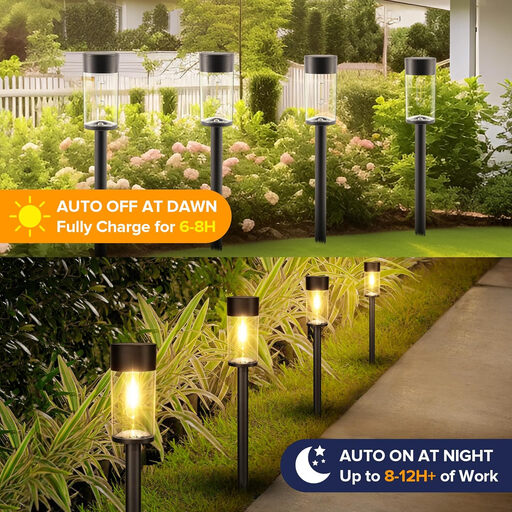
Why This Fits Their Persona: These stake-mounted lights suit renters and first-time garden owners who want pathway or lawn-edge illumination without mains wiring.
The specification states an IP65 rating, automatic dusk-to-dawn operation and a recommended 6–8 hours of direct sunlight for charging.
Two lights are supplied, each with 10 lumens, a 3000K warm-white output and ground stakes for straightforward placement.
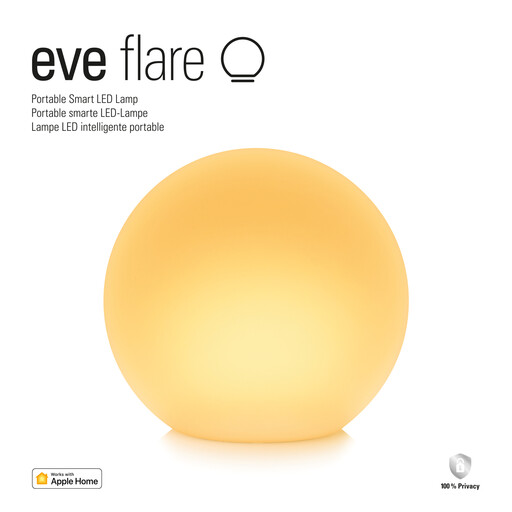
Why This Fits Their Persona: A suitable option for households wanting portable patio lights with adjustable colour and integration with a compatible Apple Home setup.
Its IP65 rating is clearly accompanied by a warning that the lamp is not for immersion. Thread features also require a compatible home hub.
The lamp provides up to 90 lumens, up to six hours of cordless illumination, a carry-and-hang handle and wireless charging.

Why This Fits Their Persona: This format suits homeowners and property managers needing broad, sensor-activated coverage around garages, driveways, gardens or entrances without mains wiring.
The stated specification includes a 60-foot detection range, 180-degree sensor angle, three lighting modes and IP65 protection.
It has three adjustable heads, a stated 3000-lumen output and a 270-degree lighting coverage range.
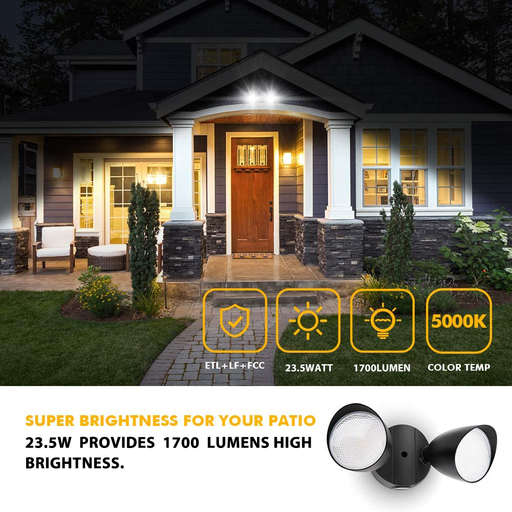
Why This Fits Their Persona: A practical match for homeowners wanting permanent illumination across a driveway, garage entrance, patio or property perimeter.
The two-head design allows each light head to rotate through 360 degrees, helping reduce fixed-beam blind spots. The listing specifies weather resistance as IP54/IP65, so check the exact variant before installation.
It uses integrated LED beads, a 5000K output and a die-cast aluminium housing with PC lenses. It is a 220–240V/AC 120V hardwired wall fitting, subject to the product label.
LEDs generally use less electricity than equivalent halogen lighting, but the actual cost depends on wattage and usage. Use this simple calculation:
Wattage ÷ 1,000 × hours used × electricity price = running cost.
Motion sensors and timers can reduce operating hours. Solar products avoid direct grid electricity use during operation, but their rechargeable batteries may eventually require replacement. Clean lenses, solar panels and sensor windows with a soft cloth, and inspect seals and mounting hardware periodically.
We have compiled a complete, real-time list of products that fully satisfy these strict selection criteria and UK safety regulations.
They can be economical when the wattage and operating time are controlled. A low-wattage fitting used by a motion sensor for short periods will normally consume less electricity than a brighter lamp left on all night. Check the wattage, not only the lumen figure.
Only if the product rating and installation instructions suit the location. IP65 fittings resist dust and water jets but should not be submerged. Keep mains connections sealed, mount the fitting correctly and follow the supplied safety instructions.
The LED light source can operate for many years, but total product life also depends on the driver, battery, seals, temperature and installation quality. Solar units may show reduced runtime as their rechargeable batteries age, while outdoor lenses and panels need periodic cleaning to maintain useful output.