
24/7 Customer Support

Free returns

Same-day & Next-day Delivery

Quality Guaranteed

Unlock Your Welcome Offers: FREE Delivery | Up to 80% OFF | Free 30-day JoyPlus trial
Download the APP
Outdoor LED lights can make a patio more usable, add atmosphere to a wedding or party and improve visibility around entrances and driveways. However, product listings often focus on bulb counts, large lumen figures or phrases such as “weatherproof” without explaining what those details mean in everyday UK conditions.
Before buying, consider three common pitfalls:
The right choice depends on the area, intended brightness and how often you plan to use the lights.
For a warm, inviting display, look at LED string lights, outdoor fairy lights and decorative garden lights. These are suitable for pergolas, fences, balconies, trees, wedding venues and dining areas. Bulb spacing and total cable length matter more than the headline bulb count: a short strand may look attractive in a table arrangement but provide limited coverage along a garden fence.
Warm white light generally creates a softer evening atmosphere. Cool white light can look sharper and more noticeable, which may suit winter displays or contemporary outdoor spaces.
Christmas lights and battery-operated star lights are useful where no outdoor socket is nearby. Battery power also helps renters avoid permanent installation. Check whether the battery compartment is protected from moisture, whether a timer is included and how long the lit section is.
A built-in timer can reduce the need to switch lights on and off manually. For seasonal storage, remove batteries and keep the wire, controller and bulbs dry.
For entrances, garages, driveways and side passages, choose motion sensor outdoor lights, solar security floodlights or waterproof LED floodlights with a suitable IP rating. A higher lumen figure generally indicates more light output, but coverage also depends on beam angle, mounting height and the number of adjustable heads.
A decorative strand should not be used as a replacement for a dedicated security fitting. Conversely, a powerful floodlight may be too harsh for a dining area or intimate garden gathering.
The first digit in an IP rating relates to protection against solids and dust; the second concerns water protection. For example:
An IP rating applies to the product as specified. Plug connections, battery boxes and joined strands may have different limitations, so avoid leaving these areas sitting in puddles or exposed to prolonged water flow.
Battery-operated lights are convenient for temporary displays, balconies and locations without sockets. Solar lights avoid regular battery replacement but need a panel positioned where it receives adequate daylight. Mains-powered lights can provide consistent output, but outdoor sockets, cable protection and installation requirements need attention.
For connectable or dimmable lights, check the maximum number of strands or bulbs that can be joined. The dimmer or controller must also be compatible; not every LED fitting works with a standard dimmer switch.
Measure the installation area before buying. A 9.8-foot strand may suit a mantelpiece, wreath or small balcony, whereas a 20-metre strand is more practical for a pergola or long fence. For floodlights, compare lumens, colour temperature, detection range and lighting angle rather than wattage alone.
A 4000K light is generally a neutral white, while a 7000K specification indicates a much cooler appearance. Check the listing carefully, as wording such as “warm white” can sometimes conflict with the stated colour temperature.
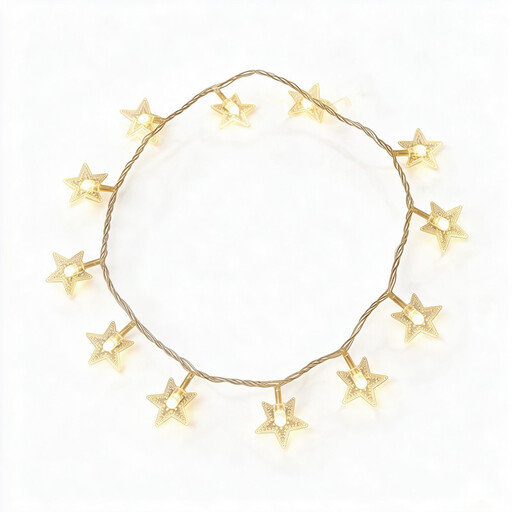
Why This Fits Their Persona: A compact battery-operated strand for renters, first-time decorators and small indoor or outdoor displays where a socket is inconvenient.
The stated 9.8-foot length makes coverage clear, while battery operation avoids trailing extension leads. Check the battery compartment before leaving it outdoors.
20 star-shaped LEDs, warm white light and indoor/outdoor decorative use.

Why This Fits Their Persona: Designed for homeowners, wedding planners and hosts wanting longer patio and garden lighting with adjustable presentation options.
The listing specifies 20 metres, IP44 protection, dimmable operation and connectability. Keep connections protected from direct water exposure.
23 shatterproof G40 bulbs and the stated ability to connect up to 500 bulbs in total.

Why This Fits Their Persona: Suitable for homeowners needing practical illumination around garages, driveways, porches, gardens or larger outdoor areas without mains wiring.
Its stated IP65 rating and motion detection specification are more relevant to exposed security use than a decorative strand. Position the panel for adequate daylight.
302 LEDs, stated 3000-lumen output, three heads, three modes and a 60-foot detection distance.

Why This Fits Their Persona: A flexible choice for wreaths, mantelpieces, table runners and patio details during repeated seasonal decorating.
The 4-metre lit length, timer cycle and battery compartment are stated clearly. The battery box must remain sealed and should not be submerged.
80 cool white star-capped LEDs, flexible silver wire and a six-hours-on/eighteen-hours-off timer.
We have compiled a complete, real-time list of products that fully satisfy these strict selection criteria and UK safety regulations.
LEDs generally have a longer operating life than traditional incandescent bulbs, but the actual lifespan depends on weather exposure, power components, battery condition and installation quality. Keep connections dry, avoid pulling thin wires and store seasonal lights carefully.
Only when the product is specifically rated for outdoor use and installed within its stated limitations. Check the IP rating and protect plugs, controllers and battery boxes from standing water. An IP44 string should not be treated in the same way as an IP65 floodlight.
LEDs typically use less electricity than equivalent incandescent lighting, but running cost depends on wattage, operating hours and the number of strands. Battery-operated and solar lights have different costs: they reduce reliance on a mains socket but may require battery replacement or sufficient daylight for reliable performance.