
24/7 Customer Support

Free returns

Same-day & Next-day Delivery

Quality Guaranteed

Unlock Your Welcome Offers: FREE Delivery | Up to 80% OFF | Free 30-day JoyPlus trial
Download the APP
Choosing outdoor lights involves more than selecting a style that suits your garden. The right fitting must cope with rain, changing temperatures, limited winter daylight and the practical demands of your space. Whether you need outdoor wall lights for a porch, outdoor security lights for a driveway or outdoor string lights for entertaining, a few checks can prevent an unsuitable purchase.
A product described as waterproof may only be protected against light splashes. Check the IP rating rather than relying on promotional wording. IP44 is generally intended for protection against splashing water, while IP65 provides protection against dust and water jets. Neither rating means a fitting should be submerged or installed where water collects.
Also check whether the rating applies to the complete unit, the plug, the transformer and any cable connections. Outdoor string lights may need their connections positioned under cover, even when the light strand itself is suitable for outdoor use.
A high lumen figure does not automatically mean a light will illuminate the area you need. Beam angle, mounting height and head adjustment affect the result. A narrow spotlight can highlight a tree or doorway, while a broad floodlight is more suitable for driveways and larger gardens.
For decorative garden lights, a lower output may be preferable. Excessive brightness can create glare, reduce comfort and make adjacent areas appear darker by comparison.
Solar outdoor lights are convenient, but their performance depends on panel placement and daylight. Shaded gardens, north-facing walls and short winter days can reduce charging time. Mains-powered LED floodlights offer more consistent output, but hardwired models may require a qualified electrician.
Before buying, confirm whether the light is plug-in, solar-powered or designed for fixed wiring. A fitting that cannot be installed safely in your chosen location is not a practical saving.
Use the intended location to guide your choice:
Always follow the installation instructions. For hardwired outdoor wall lights and security fittings, switch off the power before installation and use a qualified electrician where required.
Lumens indicate the amount of visible light. As a general guide, decorative patio lights may use modest output, whereas a driveway or garage entrance may need considerably more. Adjustable heads can help direct light away from windows and neighbouring properties.
Colour temperature is measured in Kelvin:
Integrated LEDs usually avoid routine bulb replacement. For solar pathway lights, check the expected charging conditions and clean the panel periodically. Motion sensor lights should be positioned so that the sensor covers the approach area without pointing directly at busy roads or constantly moving foliage.
For mains-powered products, compare wattage with the required brightness. A simple running-cost estimate is:
Wattage ÷ 1,000 × hours used × your electricity tariff
This gives an approximate electricity cost, excluding standing charges and any tariff-specific pricing.
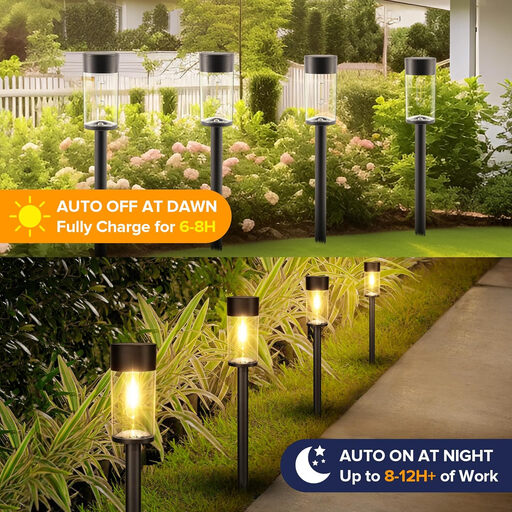
Why This Fits Their Persona: These solar pathway lights suit renters, first-time garden improvers and anyone wanting simple installation without mains wiring or an additional electricity connection.
The stated IP65 rating is clearer than a general waterproof label, while automatic dusk-to-dawn operation avoids leaving the lights switched on manually.
Two ground-mounted lights, 3000K warm light, integrated solar batteries and 10 lumens per unit.
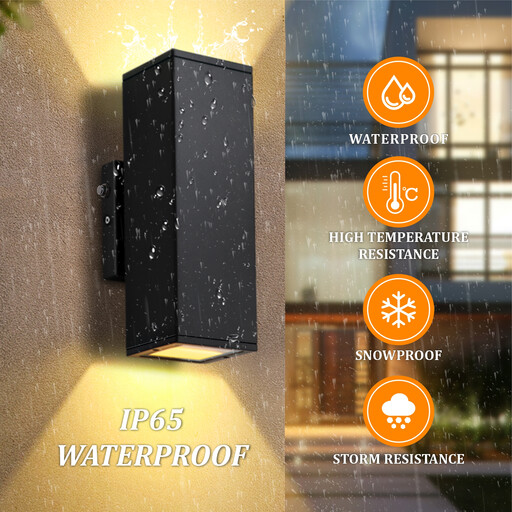
Why This Fits Their Persona: A homeowner seeking a coordinated porch, patio or garage entrance fitting may prefer a fixed wall light with a modern square profile and warm up-and-down illumination.
Its listed 2700K colour temperature sets a clear expectation for warm light, and the product is described as waterproof and ETL certified rather than relying only on appearance-led marketing.
Integrated LED, motion-sensor operation, matte black finish and up-and-down light distribution.

Why This Fits Their Persona: This suits larger driveways, garages, yards and property perimeters where broad, sensor-triggered coverage is more useful than subtle accent lighting.
The listing specifies a 60-foot detection distance, 180-degree sensor angle, three lighting modes and an IP65 rating, making the operating arrangement easier to assess before purchase.
302 LEDs, listed 3000-lumen output, three adjustable heads, solar charging and no mains wiring required.

Why This Fits Their Persona: The 20-metre strand is suited to pergolas, fences, balconies and party layouts where flexible, warm decorative lighting matters more than security-level brightness.
The listed IP44 rating indicates splash protection, so users can plan sheltered placement and protect connections instead of assuming immersion resistance.
Twenty-three shatterproof G40 LED bulbs, dimmable operation, replaceable bulbs and connectable strands up to 500 bulbs.
We have compiled a complete, real-time list of products that fully satisfy these strict selection criteria and UK safety regulations.
They can be suitable, but output may be reduced by shorter daylight hours, cloud cover and shaded positioning. Choose a location with good daytime exposure, clean the panel regularly and treat stated illumination times as conditions-dependent rather than guaranteed every night.
Running cost depends on wattage, usage time and your electricity tariff. LED products generally use less electricity than equivalent traditional lamps, but calculate the likely cost using the fitting’s actual wattage. Solar products do not use mains electricity during operation, although their batteries and panels still require care.
The correct rating depends on exposure and installation. IP44 can suit sheltered locations, while IP65 offers stronger dust and water-jet protection for many exposed walls and garden areas. Check the complete installation, including cables and connectors, rather than assessing the light body alone.