
24/7 Customer Support

Free returns

Same-day & Next-day Delivery

Quality Guaranteed

Unlock Your Welcome Offers: FREE Delivery | Up to 80% OFF | Free 30-day JoyPlus trial
Download the APP
Outdoor solar lights can improve visibility around a home without adding wiring or a noticeable electricity bill. However, product listings often highlight large LED counts, high lumen figures and broad coverage while leaving out details that affect everyday performance.
Before buying, UK homeowners, renters, landlords and garden enthusiasts should look beyond headline claims. The right choice depends on where the light will be installed, how much sunlight it receives and whether you need security illumination, pathway marking or decorative ambience.
A listing may promote hundreds of LEDs, but LED quantity alone does not show how effectively a light illuminates a driveway or garden. Lumens provide a more useful indication of total light output, although beam angle and mounting height also influence the result.
A high-output solar flood light may suit a garage or side passage, while a lower-lumen solar pathway light is more appropriate for marking borders. Using a decorative light for security can leave dark areas, whereas installing an intense floodlight beside a seating area may create uncomfortable glare.
IP65 outdoor lighting is designed to resist dust and water jets, making it suitable for many exposed walls, fences and garden areas. It does not mean the product should be submerged or placed where water regularly pools.
Also check the construction materials. Stainless steel posts, sealed housings and a protected solar panel can help outdoor lights cope with rain, frost and seasonal changes. No weather-resistant rating removes the need for sensible placement and occasional cleaning.
Solar lights need sufficient daylight to charge. Shaded gardens, north-facing walls, nearby trees and winter cloud can reduce runtime. A dusk-to-dawn outdoor light may operate automatically, but its illumination period depends on the panel, battery capacity and available sunlight.
Motion sensor outdoor lights usually conserve energy by switching to a brighter setting only when movement is detected. Check the sensor range and angle rather than assuming that every sensor will cover a whole driveway.
Use the intended purpose as your starting point:
A multi-head design can spread light across a wider area. Look for stated coverage angles, adjustable heads and a mounting height suited to the installation point.
A product listing should ideally state the battery type, capacity, estimated charging time and expected runtime. For example, the UME security light listed below includes an 1800mAh lithium-ion battery and is specified for charging through its solar panel.
Runtime figures are not guaranteed in every UK season. Position panels where they receive direct sunlight, keep them free from leaves and dirt, and avoid placing them beneath overhanging branches. A panel that can be angled towards the sun may be easier to optimise than one fixed in a shaded position.
For exposed locations, check the stated IP rating, mounting method and materials. Ground-mounted lights should have stable stakes, while wall-mounted units need a secure fixing surface and suitable screws for brick, render or timber.
Solar lighting is generally easier to install because it does not require mains wiring. Mains-powered wall lights are different: follow the installation instructions and use a suitably qualified electrician where required. For UK properties, also check the product’s supplied documentation, markings and suitability for the intended electrical installation.
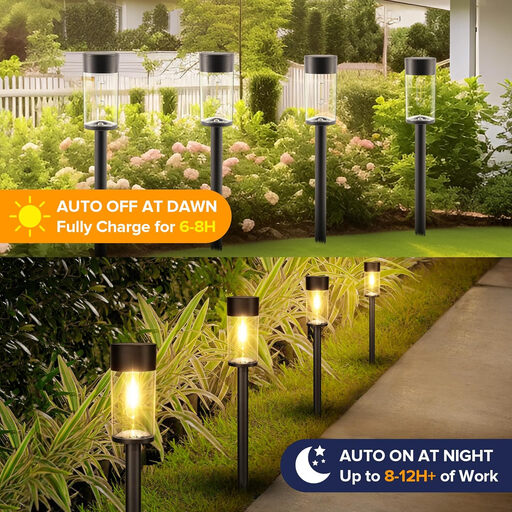
Why This Fits Their Persona: A practical starting point for renters and homeowners who want to define a walkway, lawn edge or driveway without electrical installation.
It states a 10-lumen output per light, 3000K colour temperature, IP65 rating and automatic dusk-to-dawn operation, so its role is clearer than a generic high-LED-count listing.
Two-light pack; ground stakes; stainless steel construction; stated 6–8 hours charging for 8–12 hours of illumination.
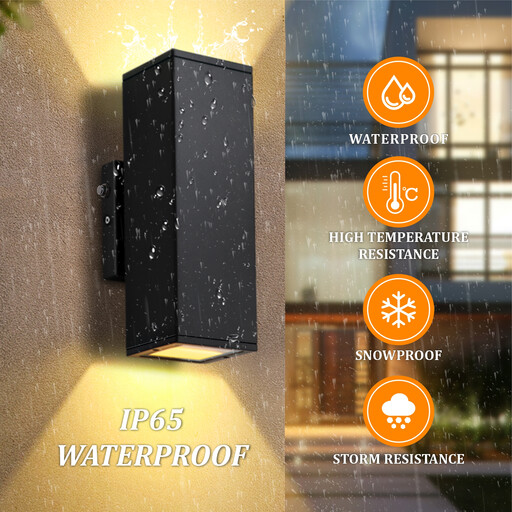
Why This Fits Their Persona: Suited to buyers wanting a more permanent porch, patio or garage fitting with a warm 2700K up-and-down light effect.
The stated motion sensor, waterproof design and defined 2700K colour temperature make it easier to match with an entrance rather than relying on vague ambience claims.
27cm square wall-sconce format; warm 2700K LED illumination; suitable for porch, patio or garage positioning.

Why This Fits Their Persona: Designed for larger driveways, gardens, garages, porches and other areas where broad motion-activated illumination is more important than subtle decoration.
It provides stated figures for 3000 lumens, a 60-foot detection range, 180° sensor angle, 270° head coverage and three lighting modes.
Three adjustable heads; IP65 rating; wall mounting; solar operation; two-year warranty stated in the product information.
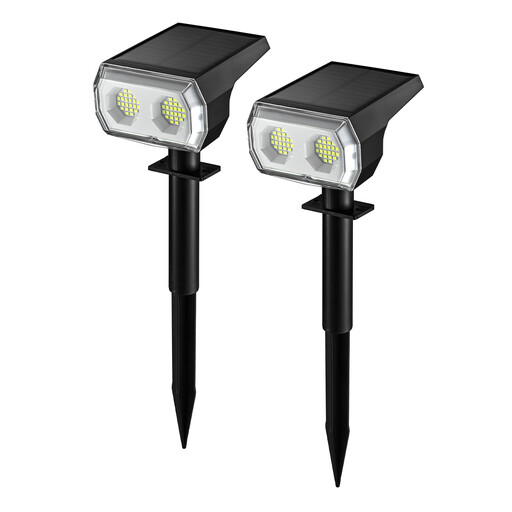
Why This Fits Their Persona: A two-pack format for highlighting planting, walls, ornaments or other garden features where directional warm white light is preferred.
Its spotlight format helps set a clear purpose: directing light towards selected features rather than expecting one small fitting to cover an entire garden.
Two-pack; 48 LED design; warm white format; solar-powered spotlight layout for garden accents.
We have compiled a complete, real-time list of products that fully satisfy these strict selection criteria and UK safety regulations.
They can be suitable for pathways, gardens, patios and security areas where direct sunlight is available. Running costs are limited because the light charges during daylight, but winter cloud and shade may reduce brightness or operating time. Select the output and battery specifications according to the location rather than expecting every fitting to illuminate all night at full intensity.
The duration varies by battery, panel size, sunlight and lighting mode. Motion-activated models can conserve stored energy by remaining dim or off until movement is detected. Product listings may provide estimated runtimes, but these should be treated as guidance because UK weather and seasonal daylight affect charging.
For many exposed garden and wall locations, IP65 indicates protection from dust and water jets. It is not intended for submersion. Always install the fitting according to its instructions, keep drainage areas clear and check whether the product is suitable for the exact position you have chosen.