What matters when choosing?
Choose the screen arrangement before comparing refresh-rate labels: a wider display or three-screen rig changes both the space required and what the PC must render.
Single 27-inch QHD screen
Choose it when: You want one 2560 × 1440 practice display without arranging multiple panels.
Trade-off: It offers less lateral coverage than the wider arrangements; check which input reaches the refresh mode you want.
49-inch 32:9 ultrawide
Choose it when: A broad, uninterrupted view is the priority and a large panel fits your desk or cockpit. Samsung describes its Odyssey G91F as a 49-inch Dual QHD screen.
Trade-off: Your PC must render the wider image, and one panel does not provide separately angled side screens.
Three matching monitors
Choose them when: Your supported PC simulator, graphics outputs and rig can accommodate measured side-screen geometry.
Trade-off: iRacing Support advises using the same resolution across all three screens; mounting, alignment and simulator configuration take more work.
| Concern |
What to check |
Who this matters to |
| Readable motion |
Check the refresh rate through your chosen input, the stated response-time mode and compatible variable refresh rate (VRR). |
If I am practising close to other cars, I want motion to remain readable rather than choosing by the refresh-rate label alone; around 42% of consumers would put motion and response behaviour first. |
| Detail and PC workload |
Check native resolution and whether your PC can sustain the frame rates you want at your simulator settings. |
When track detail matters but my PC also has to render every frame, I need a resolution I can use comfortably; roughly 33% of consumers would make that balance their primary concern. |
| Wider view |
Measure available width and viewing distance; for triples, check graphics outputs and use screens at the same resolution. |
If I am building a cockpit around lateral coverage, I can accept a larger display or more setup work; about 25% of consumers would prioritise that wider view. |
Relevant monitor brands for reference
These examples illustrate model-specific options and limitations; a brand name alone does not establish which monitor suits your connections or rig.
Alienware
Dell's 27-inch QHD AW2725DM is a single-screen option for PC practice.
- Dell specifies up to 180Hz through DisplayPort and lists G-SYNC Compatible and AMD FreeSync support.
- Dell lists up to QHD 144Hz through HDMI; its stated 1ms GtG figure applies to Extreme mode.
LG UltraGear
The 27GS75QN-B is a 27-inch QHD IPS model for a conventional single-screen arrangement.
- LG specifies 180Hz and an optional 200Hz overclocked mode.
- LG says the 200Hz mode requires a DisplayPort 1.4-capable graphics card and cable; do not assume it applies to an HDMI connection.
ASUS ROG
The ROG Strix XG27ACS-W combines a 27-inch QHD display with height adjustment and multiple input choices.
- ASUS lists DisplayPort and USB-C DisplayPort input at up to 180Hz for this model.
- Its listed HDMI limit is up to 144Hz, so connection choice affects the available refresh mode.
BenQ MOBIUZ
BenQ positions the 27-inch EX270M as a high-refresh PC monitor with setup features including height adjustment and a USB hub.
- BenQ specifies 240Hz and AMD FreeSync Premium for the EX270M.
- Check the current model specification for native resolution, input modes and the setting used for its stated response time.
Samsung Odyssey
Samsung's 49-inch Odyssey G91F represents the large, curved 32:9 route rather than a conventional 27-inch screen.
- Samsung specifies Dual QHD resolution and a 144Hz refresh rate for the G91F.
- Allow for the panel's physical width and the PC workload of its wider resolution before choosing this arrangement.
Joybuy monitor choices
These monitors cover compact QHD practice screens and a 34-inch ultrawide alternative. The 34-inch model is a different size and format from the 49-inch 32:9 route discussed above; assess each against your own space, connections and simulator.
 No image available
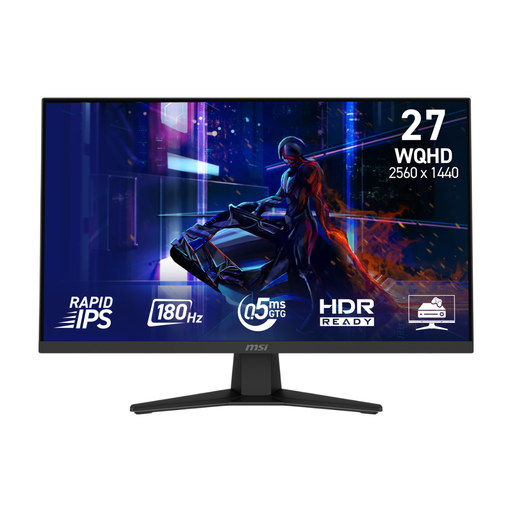
MSI MAG 274QF 27-inch WQHD gaming monitor
Consider this for a single-screen PC practice setup where QHD detail and adaptive sync matter.
The product name specifies a Rapid IPS panel, 180Hz refresh rate, Adaptive Sync and a 0.5ms response-time claim. Check which connection provides the mode you intend to use; the response-time figure alone does not establish performance across settings.
View on Joybuy
 No image available
LG UltraGear 34GX900A-B 34-inch OLED WQHD monitor
Consider this if you want a wider, continuous screen and have room for a 34-inch monitor.
The product name specifies OLED and 240Hz. This is not the 49-inch 32:9 arrangement described above. Account for the listing's OLED burn-in warning: use its screen-protection features and avoid leaving static images displayed for prolonged periods.
View on Joybuy
 No image available
Acer X Predator X27U W3 26.5-inch QD-OLED QHD monitor
Consider this near-27-inch screen for QHD PC practice if its connections suit your graphics card.
The product name specifies 2560 × 1440, QD-OLED, 240Hz, FreeSync Premium Pro and G-SYNC Compatible. Confirm the resolution, refresh and VRR combination available through your intended input before choosing it for a PC or console.
View on Joybuy
 No image available
Samsung Odyssey G6 S27DG612 27-inch QHD OLED monitor
Consider this for a conventional 27-inch QHD practice screen if you want to assess an OLED model.
The product name specifies 240Hz and a 0.03ms response-time claim. Check the available resolution, refresh and VRR combination for your chosen HDMI or DisplayPort connection; the response-time claim is not a measure of every operating mode.
View on Joybuy
 No image available
HKC G27H2DPro 27-inch QHD Fast IPS monitor
Consider this for single-screen QHD PC practice where a stated high refresh rate is on your shortlist.
The product name specifies 2560 × 1440 and 220Hz. Before deciding, check the refresh mode available through your intended input and the measurement setting behind any response-time claim.
View on Joybuy
Common questions
Does 240Hz automatically make a better oval-racing monitor than 180Hz?
No: the refresh-rate figure does not tell you how the pixels respond or whether your setup can use that mode. BenQ's monitor guidance notes that slow response behaviour can still cause ghosting on a fast-refresh display; compare the exact response setting, VRR support and your PC's frame rates.
Can I use a 1440p gaming monitor with a PS5?
Yes, if the connected display supports the output mode you want. PlayStation says the PS5 can test 1440p SDR or HDR output at 60Hz or 120Hz, and VRR, on compatible displays; check the result over HDMI and remember that game support also affects what you can use.
What needs to match in a three-monitor iRacing setup?
Use the same resolution on all three monitors. iRacing Support also recommends matching the make and model where possible and warns that different screen sizes can be difficult to align. Measure your normal seating position and screen geometry for the simulator settings.
Can I cancel an online monitor purchase if I change my mind?
For a qualifying UK distance sale, GOV.UK says you generally have 14 days after receiving the item to tell the seller you want to cancel. Check how to return it and any applicable conditions with the seller. Change-of-mind cancellation is separate from remedies for a faulty, damaged or misdescribed monitor.
What should I do with an old monitor?
Use an electrical-equipment collection or recycling route rather than general waste. GOV.UK describes the UK WEEE framework for recovering, reusing and recycling electrical equipment; check whether your retailer offers take-back or ask your local authority about its electrical-waste service.


