Use the existing shared oven if you can arrange a baking slot and its temperature is dependable; it takes up no additional worktop space. Consider a countertop oven when you need independent access and have household permission, a clear, ventilated worktop, a suitable socket and enough internal space for your tart tin. A compact built-in oven is a choice for a planned kitchen installation, not a portable substitute.
Who each option suits
Occasional bakers sharing a kitchen
If you can arrange time with other users, the existing oven lets you bake without claiming more communal worktop or storage space. Which? identifies shared accommodation as a setting where a mini oven can also be useful, but its location and electrical arrangement still matter.
Bakers needing independent oven access
A countertop oven is worth considering when the shared oven is often occupied and you have permission for a stable, ventilated location. Check that your tart tin fits on the rack and that the oven offers the temperature control your recipe needs.
People planning a kitchen upgrade
Compact built-in ovens belong in a cabinet and installation plan, rather than on a spare worktop. Bosch and Hotpoint list models in a roughly 45 cm-high format; the cabinet opening and installation arrangements must suit the chosen model.
What matters when choosing
Existing shared oven
Choose it when: You can arrange a baking slot and want to avoid adding an appliance to the shared kitchen.
Trade-off: Access depends on other users, and you still need to check how reliably the oven holds its set temperature.
Countertop mini oven
Choose it when: You need independent access and the household can accommodate a fixed, clear worktop location.
Trade-off: It occupies communal space and adds an appliance to the kitchen's electrical arrangement.
Compact built-in oven
Choose it when: A kitchen refit or approved replacement is already planned.
Trade-off: It needs compatible cabinetry, electrical provision and installation arrangements rather than a clear worktop alone.
| Concern |
What to check |
Who this matters to |
| Access and shared space |
Agree when you can use the main oven, or where a countertop unit can sit and be stored. |
If the main oven is busy at meal times, I need a baking slot without leaving an obstacle on the communal worktop. Around 42% of consumers put access and space first. |
| Baking control and tin fit |
Compare the tin with the usable rack dimensions, then check the bake setting and temperature range against the recipe. |
My tart tin needs to sit on the rack with appropriate clearance, and I need heat settings that suit the recipe. Roughly 33% of consumers prioritise baking control and fit. |
| Electrical and installation suitability |
Check the appliance rating and socket arrangement; for a built-in model, confirm the cabinet and installation plan. |
Where sockets are shared, I need an arrangement the household permits and the appliance can use safely. About 25% of consumers put electrical and installation suitability first. |
Mistakes to avoid
-
Assuming any spare worktop will do
Items left on or around a countertop oven can obstruct ventilation. Electrical Safety First advises keeping appliance ventilation clear, which takes agreement from everyone using a shared kitchen.
Choose a stable location with the clearance required by the appliance instructions, and agree to keep that space clear during use.
-
Using litre capacity to judge tart-tin fit
Capacity describes oven volume, not the usable width or height around the rack. A tin may be too wide even when the headline capacity sounds sufficient.
Measure the tin, including its rim or handles, and compare it with the oven's internal rack dimensions before ordering.
-
Overloading a shared socket arrangement
An overloaded extension lead or adaptor can overheat. Electrical Safety First warns against overloading extension equipment.
Check the oven's rating and any extension device's marked limit, account for other connected appliances and do not daisy-chain extension leads.
-
Treating a built-in oven as a portable upgrade
A compact built-in model still needs a compatible cabinet opening and an installation plan; its smaller height does not make it a worktop appliance.
Confirm the opening, electrical provision, approval where relevant and responsibility for installation before choosing a model.
A replacement may also involve arranging removal of the old appliance or adapting the cabinet.
Brands to consider for these oven formats
Russell Hobbs
The Russell Hobbs 22780 Mini Kitchen is a countertop model with a stated 30 L capacity and a 60°C–230°C thermostat.
- Its stated fan assistance, baking tray and grill rack make the 22780 relevant to a tart-baking shortlist.
- The 30 L capacity does not establish whether your particular tart tin fits on its rack.
Sage
The product information lists the Sage SOV860BSS as a 22 L, 2400 W countertop mini oven with 10 presets.
- Its listed presets give frequent bakers several cooking controls to consider.
- Check worktop clearance, tart-tin fit and the shared kitchen's socket arrangement rather than judging suitability by the preset count.
Bosch
The Bosch CMG676BB1 is a built-in compact oven with a microwave function and a stated 45 L cavity.
- It illustrates the built-in route for a planned kitchen replacement.
- Its built-in format requires a compatible opening and installation arrangements; it cannot serve as a portable oven for a spare worktop.
Hotpoint
The Hotpoint HCS9A9PHTSBA is a compact built-in model with steam features.
- Hotpoint describes cooking on three levels at the same temperature for this model.
- Its integrated format makes it relevant to a kitchen upgrade, not an occasional portable baking setup.
Countertop oven on Joybuy
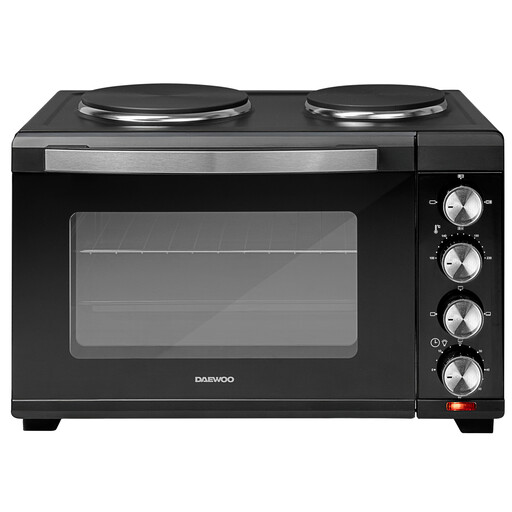
This countertop option is for consumers considering a separate place to bake when the shared oven is occupied. Confirm that its baking settings, tart-tin clearance and electrical requirements suit your kitchen before choosing it.
 No image available
DAEWOO SDA1609GE 32 L countertop oven with dual hotplates
Consider this countertop model if you need access to an oven while the shared one is occupied and have an agreed space for it.
The product name states 32 L capacity and 3000 W; neither figure confirms tart-tin fit or that a particular shared socket arrangement is suitable. Check the usable rack dimensions, baking settings and appliance electrical requirements before buying.
Joybuy
Common questions
Can I use a countertop oven in a shared kitchen?
You can consider one if your household or property rules permit it and there is a stable, clear worktop and suitable electrical arrangement. Electrical Safety First advises keeping appliance ventilation unobstructed; agree with other users where the oven will sit and how the space will be kept clear.
Can I plug a mini oven into an extension lead?
Do not assume an extension lead is suitable for a mini oven. Electrical Safety First advises checking the lead's marked current limit against everything connected to it and avoiding overloaded or daisy-chained extensions; check the oven instructions and your intended socket arrangement too.
How can I tell whether a mini oven fits my chocolate-tart tin?
Compare the tin's outside diameter and height, including its rim or handles, with the oven's usable rack dimensions and required clearance from the heating elements. Litre capacity alone cannot confirm the fit; ask the retailer or manufacturer for internal measurements if you cannot find them.


