Family meal multitaskers
If fish parcels share oven time with vegetables, potatoes or dessert, check whether the shelves and your dishes fit together. Hot-air systems may offer multi-level cooking, but check the claim for the exact model.


For a family meal with fish parcels and sides, start with an oven whose cavity and shelf arrangement can hold the dishes you plan to cook together. A fan oven is a practical option when those dishes can share a cooking temperature; consider separate cavities for different settings, or steam if you expect to use it regularly for delicate fish and seafood. Check cabinet fit and the exact model’s connection requirements before choosing either format.
If fish parcels share oven time with vegetables, potatoes or dessert, check whether the shelves and your dishes fit together. Hot-air systems may offer multi-level cooking, but check the claim for the exact model.
If you often cook fish or other seafood beyond parcel meals, steam settings may be worth considering. AEG identifies seafood and fish uses for settings on its steam-oven ranges; check which functions the model you are considering includes.
If the oven must replace an existing appliance, measure the housing and check the required connection before comparing cooking functions. Single, compact and double ovens can call for different installation spaces.
Choose the cavity arrangement around the dishes you cook together, then check moisture-control features and installation fit. Manufacturer multi-level claims describe particular systems and models, not a guarantee of cooking results.
Consider it when: Fish parcels and sides usually cook at compatible settings and you want one cavity for the meal.
Trade-off: One cavity is less flexible when dishes need substantially different temperatures.
Consider it when: You expect to use steam settings regularly for fish, seafood or other moisture-sensitive dishes.
Trade-off: Steam is optional for occasional fish parcels, and water handling and cleaning vary by model.
Consider it when: You often need fish parcels and another dish cooking at different settings.
Trade-off: Two cavities require a suitable housing; a double oven should not be assumed to fit a single-oven opening.
| Concern | What to check | Who this matters to |
|---|---|---|
| Cooking several dishes | Check usable shelf positions and whether your parcel dishes and side trays fit at the same time. | I want to cook fish parcels and sides together without crowding the oven. Around 29% of consumers put coordinating several dishes first. |
| Moisture control | Check the exact steam modes, water handling and cleaning routine before choosing a steam-capable model. | If I cook delicate fish regularly, I want a setting I will use beyond occasional parcels. For around 18% of consumers, moisture-conscious cooking is the primary need. |
| Installation fit | Measure the housing and check the model’s installation dimensions and required gas or electrical connection. | Replacing an integrated oven means I need the new appliance to fit and connect in my kitchen. About 24% of consumers place installation fit first. |
| Cleaning effort | Check which parts of the cavity the stated cleaning system covers and what manual cleaning remains. | After frequent family meals, I want residue to be manageable. Keeping cleaning effort down comes first for around 29% of consumers. |
Single and double ovens can have similar front widths but need substantially different housing heights.
Measure the cabinet opening and compare it with the exact model’s installation instructions before ordering.
A mismatch may require cabinet alteration or additional installation work.
Connection methods and electrical requirements vary by model.
Check the appliance’s stated power requirement and installation instructions against your kitchen supply. Electrical Safety First advises having an oven fitted by a qualified electrician; do not use an extension lead for a high-load oven.
A model requiring a fixed connection may also require electrical work.
A conventional fan oven can bake fish parcels; steam functions become more relevant if you regularly cook seafood or other moisture-sensitive dishes.
Think about how often you would use steam, then compare cavity space, fit and cleaning requirements alongside it.
A stated number of cooking levels does not establish the temperature accuracy of an individual oven. Which? measures control accuracy during its built-in-oven testing.
Use manufacturer features to identify models to examine, then look for independent results for the exact model where available.
AEG has steam-capable oven lines to consider if fish and other moisture-sensitive dishes feature regularly in your cooking.
NEFF’s CircoTherm line is relevant if several dishes need space in a single built-in oven.
Selected Hotpoint ovens offer a full-size cavity and stated multi-level cooking for family meals.
Bosch offers compact steam and double-oven formats that serve different kitchen layouts and cooking patterns.
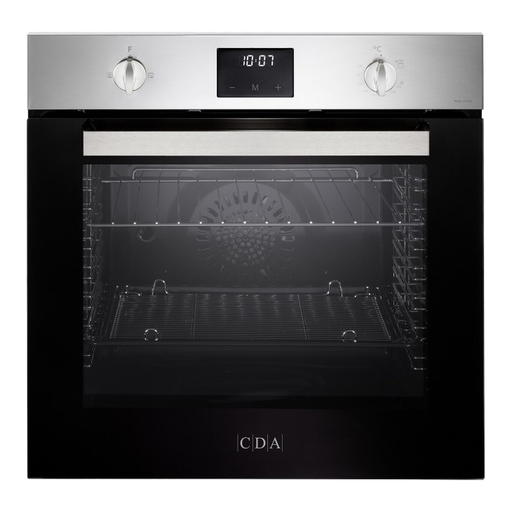
This built-in gas fan oven offers a single 70 L cavity to consider for a family meal. Check your available gas connection, cabinet opening and usable shelf arrangement before deciding whether it suits fish parcels alongside side dishes.
 No image available
Consider this single-cavity gas fan oven if you want space for a family meal and have a suitable gas connection. The product name states a 70 L capacity and an A rating; check the usable shelf positions, cabinet dimensions and gas installation requirements for your kitchen.
No. A standard fan oven can bake fish parcels; steam is more worth considering if you regularly cook delicate fish or seafood in other ways. AEG identifies seafood and fish uses for its steam settings, but those are manufacturer recommendations, not proof that steam is needed for every recipe.
A single fan oven suits meals whose dishes can share compatible settings and fit in one cavity. A double oven offers separate cavities when fish and another dish often need different settings, provided the taller appliance fits your housing.
Check the exact oven’s power requirement, connection method and installation dimensions against your kitchen. Electrical Safety First advises having an oven fitted by a qualified electrician; follow the manufacturer’s instructions and seek competent advice if the supply or connection is uncertain.
Let the oven cool fully before cleaning it. Follow the exact model’s cleaning instructions: catalytic coatings, hydrolytic or steam cleaning, and other systems can cover different parts of the cavity and are not interchangeable.