Holiday-cottage cooks without a dependable oven
If the cottage oven is unavailable, unsuitable or occupied by other food, you need another way to bake the loaf. Check what the host provides before deciding to bring an appliance.


Use the cottage’s existing oven if it is available, suitable and permitted for use. Consider a countertop mini oven when you need separate oven space, or an oven with hotplates when you also lack a practical way to cook sides. Before bringing either appliance, check that your loaf tin fits and that the cottage has a suitable place to use it.
If the cottage oven is unavailable, unsuitable or occupied by other food, you need another way to bake the loaf. Check what the host provides before deciding to bring an appliance.
Your priority is an oven that holds your own loaf tin and can be placed safely on the available worktop, rather than extra cooking functions you will not use.
If there is no practical cooker, you may need oven space for the nut loaf as well as hotplates for gravy, vegetables or other sides.
Check the existing oven before choosing a portable one. Great British Chefs’ nut-roast recipe uses a 1kg loaf tin and calls for 180°C for 35–45 minutes; another recipe may need different settings.
Choose it when: The oven is usable and the host permits its use; one loaf does not, by itself, call for another appliance.
Allow for: Shared shelf space if other dishes need the oven at the same time.
Choose it when: You need separate baking space for the loaf but already have a way to cook any sides.
Allow for: Limited internal space and a suitable, ventilated position on the worktop.
Choose it when: The cottage has no practical cooker and you need to prepare sauce or sides as well as bake the loaf.
Allow for: A larger worktop footprint and additional hot surfaces.
| Concern | What to check | Who this matters to |
|---|---|---|
| Loaf-tin and worktop fit | Measure your tin, including handles, against usable shelf or tray space; check the appliance footprint and room to open its door. | If my tin will not fit or the door cannot close, capacity in litres will not help me bake the loaf. Roughly 36% of consumers put physical fit first. |
| Cooking the whole meal | Decide whether the cottage has a usable hob; if not, compare oven-and-hotplate formats with the space and electrical setup available. | Without a practical hob, I need somewhere to prepare gravy or sides while the loaf bakes. Around 29% of consumers prioritise that whole-meal need. |
| Baking controls | For the cited Great British Chefs recipe, look for a stated range including 180°C and a timer or monitored cooking period covering 35–45 minutes. | I want controls that accommodate my chosen recipe, while allowing me to check the loaf as it bakes. About 21% of consumers place baking control first. |
| Safe temporary use | Check host permission and the exact model manual for surface, clearance and electrical requirements; plan where it can cool before storage. | In an unfamiliar cottage kitchen, I need a suitable place to use and then store a hot appliance. Roughly 14% of consumers make safe placement their primary concern. |
A 22L, 28L or 30L figure does not tell you the usable shelf dimensions or whether the door will close around your tin.
Measure the tin, including handles, and compare it with the model’s internal dimensions or supplied tray before choosing an oven.
An oven-only unit can provide baking space, but gravy and sides still need another cooking method.
If the cottage has no usable hob, consider whether an oven with hotplates fits your meal plan and the available worktop.
Countertop ovens have hot surfaces and model-specific placement requirements. The Russell Hobbs 22780 manual, for example, requires a stable, level, heat-resistant surface and at least 50mm of clearance all round.
Follow your exact model’s manual, keep it clear of flammable materials and let it cool before moving or storing it.
A result for one named oven does not establish that it fits your loaf tin or can be used in your accommodation.
Use rankings to identify models worth checking, then compare their dimensions and instructions with the cottage setup.
These examples illustrate different countertop-oven formats. Check the exact model rather than assuming that features or instructions apply across a brand’s range.
Its 22L Mini Oven is an oven-only option for a small kitchen or additional baking space.
The Mini Kitchen 22780 combines a 30L fan-assisted oven with two hotplates.
The cited 28L Mini Oven with Hob offers oven and hob cooking in one countertop unit.
The cited 30L countertop model is an oven-only format for cooks who do not need added hotplates.
The Foodi 10-in-1 Multifunction Oven is a countertop option to investigate if you want cooking modes beyond a single loaf bake.
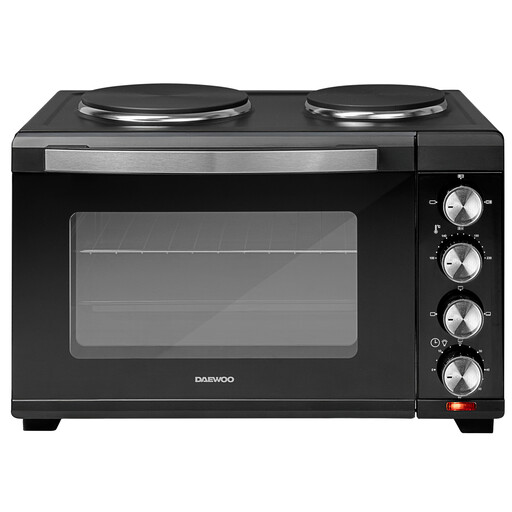
This oven-and-hotplate option is relevant if you need separate oven space for the loaf and a way to prepare sides without a practical cottage cooker. Confirm that the host permits a portable appliance before choosing it.
 No image available
For a cottage without a usable hob, this oven-and-hotplate format lets you plan separate cooking for the loaf and sides, provided there is a suitable place to use it. The product title specifies a 32L oven, two hotplates and 3000W. Check your loaf tin against the usable oven space, confirm the baking controls against your recipe, and follow the exact model’s placement and electrical instructions.
For the Great British Chefs recipe using a 1kg loaf tin, preheat to 180°C and cook for 35–45 minutes. Check that your oven’s controls cover your chosen recipe, and monitor the loaf rather than treating that setting as universal.
Not necessarily: capacity alone does not establish shelf width, usable height or door clearance. Measure your tin, including handles, and compare it with the exact model’s internal dimensions or supplied tray.
Not if you only need oven space or the cottage already has a usable hob. Hotplates become relevant when you also need to prepare gravy or sides without another practical cooker; allow for their worktop footprint and hot surfaces.
Use it only where the host permits it and where you can follow the exact model’s placement instructions. For example, the Russell Hobbs 22780 manual requires a stable, level, heat-resistant surface and at least 50mm of clearance all round; requirements for another oven may differ.