Occasional small-tray bakers
If you mainly bake one tray of oat bars at a time, start with your tin’s dimensions, then check for a stated fan or convection function, a usable timer and somewhere suitable to put a countertop oven.


For an occasional tray of oat bars, consider a countertop convection oven if your tin fits its shelf and you have suitable worktop space and electrical supply. A compact built-in oven makes more sense during a kitchen refit, while a standard built-in fan oven is easier to justify if it will also be your main oven. Check the exact tin fit and baking controls rather than choosing by litre capacity alone.
If you mainly bake one tray of oat bars at a time, start with your tin’s dimensions, then check for a stated fan or convection function, a usable timer and somewhere suitable to put a countertop oven.
If you are changing your kitchen, compare the available worktop space with the cabinet space and installation requirements of a built-in compact oven. A compact format does not, by itself, establish that your tin will fit.
If you make repeat batches, preheat feedback, timing controls and cleaning may matter more than finding the smallest oven. Which? assesses temperature accuracy and heat distribution separately in its built-in oven testing, so a fan label alone should not be taken as a promise of identical baking results.
Consider it when: You bake one small tray at a time and can accommodate the oven, your tin and its required clearances on the worktop.
Trade-off: It avoids built-in cabinet work, but tin fit and electrical load still need model-specific checks.
Consider it when: You want a stated Bake function and preheat feedback for repeat batches; Sage lists both for its SOV860BSS4GUK1.
Trade-off: Extra functions do not establish tin fit or a reliable time adjustment for your oat-bar recipe.
Consider it when: You are fitting or refitting a kitchen and prefer a permanent appliance to one on the worktop.
Trade-off: Bosch’s compact built-in range illustrates the format, but cabinet fit, cooking functions and electrical requirements vary by model.
Consider it when: The appliance will also be your main household oven, not just a place to bake occasional oat-bar trays.
Trade-off: It commits cabinet space to a full-size installation; check the exact oven’s connection and fitting requirements.
| Concern | What to check | Who this matters to |
|---|---|---|
| Tin and kitchen fit | Measure the tin including handles. Compare it with the exact oven’s internal shelf or supplied-tray dimensions, required clearances and worktop footprint or cabinet cut-out. | If I bake just one small tray, I need my tin to fit without taking over the available space; around 33% of consumers would put bakeware and kitchen fit first. |
| Baking control | Confirm a fan or convection bake mode for the exact model, then check its timer and temperature controls. | For repeat batches, I want controls I can use consistently rather than functions I rarely need; roughly 25% of consumers would prioritise baking control. |
| Supply and installation | Check rated power, connection requirements and the manufacturer’s siting instructions. Electrical Safety First warns against overloading extension leads. | If my kitchen supply or cabinet needs attention, I need to understand the installation before choosing; around 25% of consumers would make supply and installation their main concern. |
| Cleaning and ownership | Read the model’s cleaning instructions. For an oven within the applicable UK energy-information rules, check its energy label and product information sheet. | After sticky bakes, I want manageable cleaning and clear information for ongoing use; roughly 17% of consumers would prioritise upkeep and ownership information. |
A cavity figure does not tell you whether a rectangular oat-bar tin clears the door and fits on the usable shelf. The product information lists the Tefal OF445840 at 19 litres and the Quest 35379 at 26 litres, but those figures cannot establish fit for your tin.
Measure the tin’s outside width and depth, including handles, and compare them with the exact model’s shelf or tray dimensions and required clearances.
Mini ovens offer different cooking modes. A grill or conventional heating setting is not a substitute for the fan or convection mode you intend to use.
Check the exact model’s specification or manual for a stated fan, convection or hot-air baking mode.
Electrical Safety First warns that ovens used alongside other large appliances may overload an extension lead, creating a fire risk. A compact oven’s physical size does not establish its electrical load.
Check the appliance’s rated power and connection instructions against the intended supply. Avoid overloaded or daisy-chained extensions, and ask a qualified electrician if the supply is uncertain.
Sage makes a convection cooking-time claim for its own oven, but that does not provide a time or temperature conversion for your oat-bar mixture or another model.
Use your recipe as a starting point, watch the first batch and note the timing that works with your oven and tin.
Sage’s SOV860BSS4GUK1 illustrates the countertop oven route with programmed controls.
The Optimo OF445840 illustrates a compact countertop oven for a small-batch baking setup.
Bosch’s UK compact built-in range is relevant when a kitchen refit calls for a permanent, smaller-format oven.
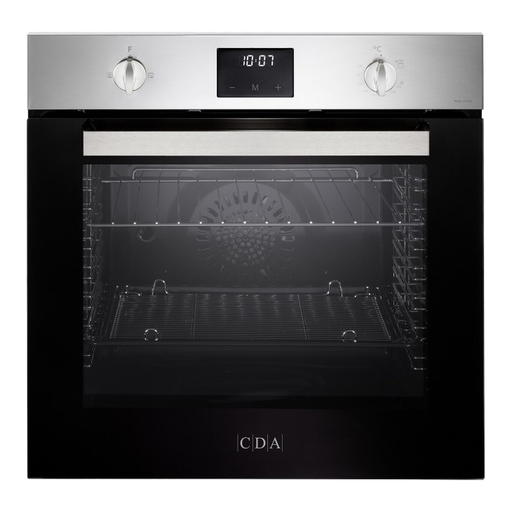
This standard built-in fan oven is worth considering if you also need a permanent main oven, rather than an appliance solely for occasional small oat-bar trays.
 No image available
Consider this built-in gas fan oven if it will serve as your main oven as well as baking oat bars.
It has a stated 70 L capacity and stainless steel finish. Before ordering, check your tin against the internal shelf dimensions and confirm the cabinet, gas connection and installation requirements for your kitchen.
If you specifically want a convection oven, check that the exact model states a fan or convection baking mode; do not assume every mini oven has one. Electrical Safety First describes fan ovens as distributing heat evenly, but your recipe and tin can still affect the result, so watch the first batch.
Do not assume an extension lead is suitable just because the plug fits. Electrical Safety First warns that ovens used with other large appliances may overload one; check the oven’s rated power, its instructions and the extension device’s rating, and consult a qualified electrician if you are unsure about the supply.
Check the exact oven and your existing supply before arranging installation. Electrical Safety First notes that some ovens use a standard plug while others require hardwiring into a dedicated circuit, and recommends consulting a qualified electrician when requirements are uncertain.
For a domestic oven within the applicable energy-information rules, check its energy label and product information sheet. GOV.UK says in-scope products must be supplied with this information; confirm that the rules cover the exact appliance rather than treating an energy class as evidence of tin fit or baking results.
Let the oven cool fully, then follow the cleaning instructions for your model. Electrical Safety First advises regular cleaning after the appliance has cooled and keeping flammable items, including tea towels and oven gloves, away from heat.