Top-down lesson beginners
You want a repeatable overhead view without taking up much of the small table with camera equipment.


Plan the overhead mount and camera-to-paper distance before choosing a camera: the lens needs to focus at that distance while showing the whole folding area. A compact vlogging camera may suit close detail, a pocket gimbal suits a compact setup with handheld cutaways, and a camcorder is worth considering when zoom and broader production needs matter. None can be assumed safe on an overhead support without checking the attachment and loaded weight.
You want a repeatable overhead view without taking up much of the small table with camera equipment.
You need small creases and paper edges to remain visible as your hands move. The camera’s closest focusing distance and behaviour while refocusing deserve particular attention.
You plan to record fuller lessons, perhaps adding wider shots, later crops or handheld cutaways to the fixed overhead view.
For a small folding table, establish where the camera can sit safely and what its lens will show from there. Then decide how much close-detail control and recording flexibility the lesson needs.
Consider it when: Close folds and adjustable framing matter; check the focusing distance of the exact model.
Trade-off: A built-in stand or adjustable screen does not establish overhead-mount compatibility.
Consider it when: You also want a compact camera for handheld lesson introductions or cutaways.
Trade-off: DJI specifies a 20 cm minimum object distance for Osmo Pocket 3, which must fit the planned overhead position.
Consider it when: Zoom and in-camera cropping are useful alongside the fixed lesson view, as offered by Panasonic’s HC-VX3.
Trade-off: Check close focus and whether the chosen overhead support can carry the complete setup.
| Concern | Buying check | Who this matters to |
|---|---|---|
| Stable overhead framing | Measure the table edge and camera height; check the attachment and support’s loaded-weight rating. | I need the camera to stay above the paper without its support crowding my work surface. Around 33% of consumers would make a repeatable overhead setup their primary concern. |
| Close paper detail | Compare the exact model’s minimum focusing distance with the planned lens-to-paper distance, and check the area visible in frame. | When I bring a fold towards the lens, I still need the crease to be clear and the sheet to fit the shot. Close-detail clarity would come first for around 27% of consumers. |
| Simple setup | Check screen position, any remote-control option and the accessories needed for your chosen support. | If I film alone, I want to inspect the framing without repeatedly dismantling the setup. Around 20% of consumers would put straightforward operation first. |
| Lesson workflow | Check recording settings, media requirements and power for the intended lesson length. | I may record a complete lesson and make shorter crops or additional angles afterwards. Recording and editing flexibility would be the main need for around 20% of consumers. |
A stand designed to rest on a surface does not establish that the camera can be suspended safely above a table. Canon describes multiple positions for the PowerShot V10 stand, not an overhead installation.
Measure the table edge and intended camera height, then confirm the camera attachment, clamp fit and support’s loaded-weight rating.
An overhead arm, adapter or counterbalance may be needed in addition to a camera’s supplied stand.
Recording resolution does not tell you whether a lens can focus at your chosen height or whether the whole sheet will fit in the shot.
Check the exact model’s minimum focusing distance and view from the planned mount position; try the framing with a sheet of paper where possible.
DJI specifies no built-in storage for Osmo Pocket 3, so the camera needs compatible microSD media to record.
Confirm the card requirements for your intended recording settings and lesson length before buying.
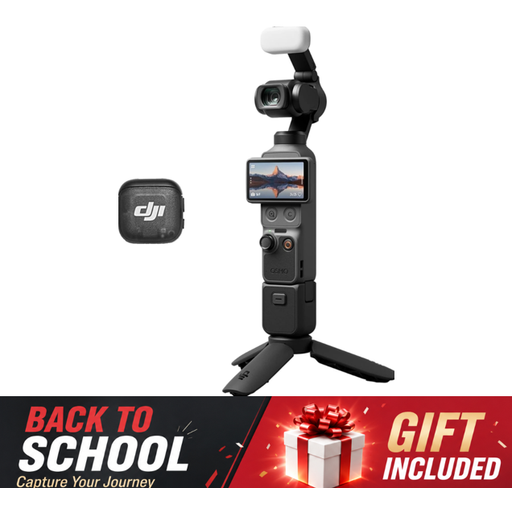
Osmo Pocket 3 is a compact pocket-gimbal option for a fixed lesson view plus handheld cutaways.
PowerShot V10 offers a compact camera with an integrated stand for surface-level or angled lesson shots.
The ZV-1 II, also designated ZV-1M2, is a compact zoom-camera option when framing may change during a lesson.
The HC-VX3 is a camcorder option for lessons that also call for zoomed shots or in-camera cropping.
These choices cover pocket-gimbal cameras and a compact vlogging camera for filming a small-table lesson. Compare each model’s focus and framing at your planned height, then check the complete overhead mounting arrangement.
 No image available
Consider this compact gimbal camera if you want handheld cutaways alongside the overhead lesson.
DJI specifies a 20 cm minimum object distance for Osmo Pocket 3. Check that the whole folding area fits in frame at a distance where the camera can focus.
DJI specifies no built-in storage, so a compatible microSD card is required. Confirm the recording mode you intend to use and whether the camera and support can be attached safely overhead.
 No image available
Consider this pocket-gimbal listing if a compact recording setup and the stated handle attachment suit your plans.
The product title lists 107GB built-in storage and a handle with a 1/4-inch thread. Check the model’s minimum focusing distance, the available recording modes and recording duration for your lesson.
A threaded handle alone does not establish that the camera, handle and chosen support form a safe overhead installation.
 No image available
Consider this compact vlogging camera if you want to assess a wide view of the folding area from a fixed position.
The product name specifies a 1-inch sensor and an ultra-wide lens. Check its minimum focusing distance and the actual paper area visible from your intended mount height.
Check the camera attachment and the support’s loaded-weight rating before positioning it above the table.
No: choose a recording setting that shows the folds clearly and suits your storage and editing workflow. 4K is worth considering if you plan to crop the footage later; Panasonic specifically describes creating 2K footage from 4K capture on the HC-VX3.
The limit depends on the exact model and its lens. DJI states a 20 cm minimum object distance for Osmo Pocket 3; Sony specifies approximately 5 cm for ZV-1 II / ZV-1M2; and Canon gives 0.05 m for PowerShot V10. At any chosen distance, also check that the whole working area fits in frame.
Do not assume so. Canon describes multiple positions for the PowerShot V10’s built-in stand, but that does not establish suspended use. Check the camera attachment, support rating, clamp fit and camera-to-paper distance for the complete setup.
A camera that fails statutory standards may give you remedies under the Consumer Rights Act 2015, separate from any retailer change-of-mind returns policy. The applicable remedy and timing depend on the circumstances; keep your order details and contact the seller promptly if the camera is faulty or not as described.