
24/7 Customer Support

Free returns

Same-day & Next-day Delivery

Quality Guaranteed

Unlock Your Welcome Offers: FREE Delivery | Up to 80% OFF | Free 30-day JoyPlus trial
Download the APP
Paint markers and pens can solve very different problems: decorating ceramics, labelling timber, writing on glass, updating a café board or marking concrete on a building site. The challenge is matching the ink and nib to the job. A colourful assorted marker set may be useful for crafts but unsuitable for a permanent outdoor mark, while a heavy-duty paint marker may be excessive for children’s artwork.
This guide explains the specifications that matter, common buying traps and suitable options for different UK users.
“Paint marker” does not automatically mean the mark will be permanent. Some chalk markers and liquid glass pens are intended for wet erasing with a damp cloth, making them suitable for windows, mirrors, menu boards and non-porous displays. Others use oil-based or weather-resistant paint for longer-lasting marks.
Before buying, decide whether you need:
Using the wrong ink can lead to marks that disappear outdoors or surfaces that are difficult to clean.
A colour that looks attractive on paper may have poor contrast on a real surface. White and yellow are often easier to see on dark materials, while black is more defined on light backgrounds. Red and blue can be useful for coding, but their visibility depends on the surface colour and lighting.
For construction, warehouse or workshop use, consider a high-contrast colour combination rather than buying a large palette that contains shades you rarely use.
A fine fibre tip is helpful for writing and detailed outlines, but it may be slow for filling large areas. Round and brush tips offer broader coverage, while a valve-action tip can help control paint flow on hard surfaces. Solid Paintstik markers avoid liquid drips, but their application feels different from a conventional pen.
Also check whether the marker needs shaking, priming or pressing before use. Failing to activate a paint pen correctly can produce an uneven first line or cause unnecessary ink waste.
The surface is the starting point. Acrylic paint pens are generally selected for creative work on materials such as rocks, wood, ceramic, glass, plastic, fabric, paper and canvas. Look for stated compatibility rather than assuming a marker works on every material.
For metal, concrete and outdoor applications, choose a product described for multi-surface marking, with features such as oil-based ink or weather resistance. For non-porous displays, wet-erase liquid chalk markers can be more practical where regular changes are expected.
Porous surfaces such as untreated wood, cardboard and concrete may absorb ink and make removal difficult. Always test an inconspicuous area first.
Tip design affects both control and coverage:
A 0.5mm needle tip, such as the type used on some erasable gel pens, is designed for precise writing rather than paint application.
Quick-drying ink can reduce smudging, particularly for left-handed writers and workshop users, but it may also dry inside the nib if the cap is left off. Recap every marker immediately after use and follow the stated storage position. Some pens are best stored horizontally, while others should be kept with the cap secure in a case.
For children’s activities, washable dot markers with water-based ink can reduce clean-up concerns, but “washable” is not a guarantee that every stain will disappear from every fabric. Clean spills while fresh and follow the manufacturer’s age and supervision guidance.
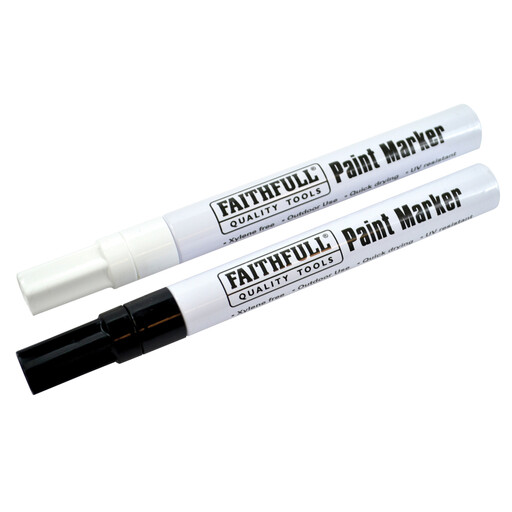
Why This Fits Their Persona: A compact two-colour option for DIY tasks, basic labelling and high-contrast marks around the home, garage or workshop.
The black and white pairing focuses on contrast instead of an oversized colour selection, and its oil-based ink is described for quick-drying, durable marking.
Two high-contrast colours; designed for metal, wood, plastic and glass; robust tip and ergonomic barrel.
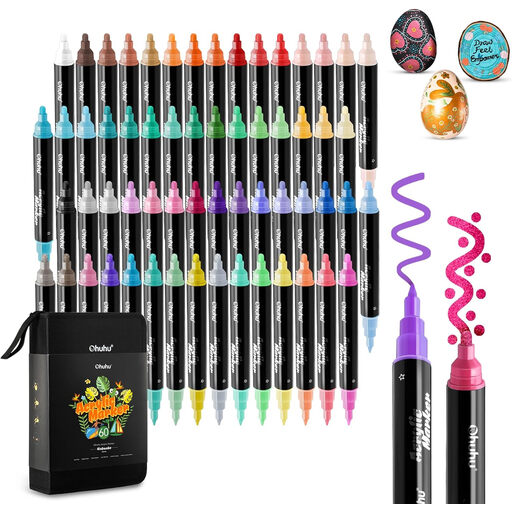
Why This Fits Their Persona: Suitable for artists and adult crafters wanting a broad palette for rocks, canvas, ceramics, glass, wood and other creative surfaces.
The dual-tip format gives both detail and broader coverage, reducing the need to buy separate fine and medium pens for each project.
60 colours, including metallic and neon shades; water-based high-opacity ink; fine and round tips; replacement nibs included.
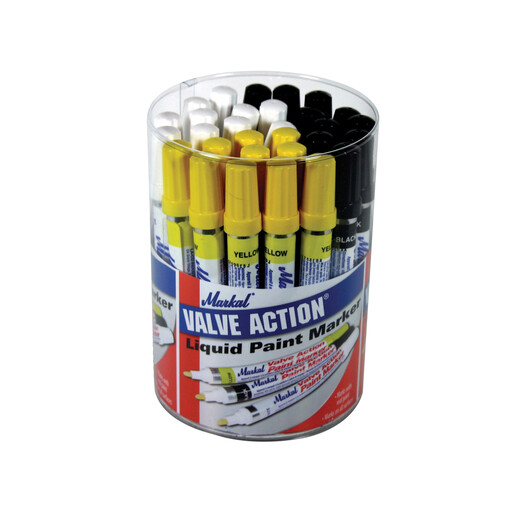
Why This Fits Their Persona: A practical choice for tradespeople, construction workers, workshops and industrial users who need several visible colours for repeated marking.
The valve-action mechanism is intended to control paint flow, while the pack includes yellow, white and black for contrasting marks on different backgrounds.
24-marker quantity; designed for metal, wood, plastic and glass; weather-resistant paint and quick-drying finish.
Shake paint pens as directed, prime the nib on scrap material and recap them promptly. Use oil-based or solvent-containing markers in a well-ventilated area, and avoid contact with eyes and skin. Keep all markers away from young children, particularly products with small caps or replacement nibs.
For children’s activities, check the recommended age, supervise use and choose washable water-based products where appropriate. Do not use wet-erase markers on porous surfaces if you need easy removal.
We have compiled a complete, real-time list of products that fully satisfy these strict selection criteria and UK safety regulations.
Many are, but the finish depends on the ink. Wet-erase chalk markers and liquid glass markers are designed for non-porous surfaces and can generally be wiped away with a damp cloth. Test first, particularly on treated glass or surfaces that may scratch.
Shelf life and working life depend on the ink, cap seal, storage conditions and frequency of use. Keeping the cap tightly closed and storing markers as instructed helps reduce drying. Outdoor marks may also change with weather, cleaning and surface wear.
The cost depends on the project. A small two-pack may be more economical for occasional DIY jobs, while an assorted colour marker set or 24-pack can reduce the need for repeated individual purchases when several colours are used regularly. For everyday office writing, erasable gel pens or whiteboard markers are usually more appropriate than paint pens.