Regular conservatory desk workers
If you work or study at the same desk repeatedly, a fixed heater position, thermostat and programmable heating periods may suit your routine without taking up floor space beside the chair.


Choose a wall-mounted panel heater if the desk stays in one place and there is a suitable mounting position; a stable freestanding model offers more flexibility if the layout changes. A thermostat and timer can help match heating to desk hours, but check the conservatory’s size, glazing, insulation and draughts before choosing an output. Keep the heater’s vents clear and check the electrical load alongside desk equipment.
If you work or study at the same desk repeatedly, a fixed heater position, thermostat and programmable heating periods may suit your routine without taking up floor space beside the chair.
If the desk arrangement changes or wall mounting is impractical, a freestanding heater offers flexibility. It still needs a stable position, clear space around it and a safe cable route.
If heat escapes readily through glazing, doors or gaps, check the room’s heat loss before expecting a panel heater near the desk to warm the whole space. GOV.UK identifies glazing and insulation as relevant property details when assessing energy efficiency.
Start with the room and the proposed heater position, then compare controls for the hours you use the desk. Check the electrical connection before settling on a model.
| Concern | What to check | Who this matters to |
|---|---|---|
| Output and heat loss | Measure the room and compare its glazing, insulation and draughts with the exact model’s sizing guidance; wattage alone does not establish suitability. | If the conservatory loses heat quickly, I want to know whether a heater can keep my desk area comfortable. Around 36% of consumers put matching output to heat loss first. |
| Heating schedule | Check for a thermostat and timer or weekly programme; confirm any requirements for app control on the exact model. | When my desk hours are predictable, I want warmth during those sessions rather than leaving the heater running unnecessarily. Keeping to a desk-time schedule comes first for around 29% of consumers. |
| Position and mounting | Check permitted mounting options, dimensions, supplied fittings, cable route and the clearances in the manual. | If the chair and furniture leave little clear space, I need a position that works without obstructing movement or airflow. Around 21% of consumers make a workable layout their main priority. |
| Electrical connection | Compare the heater and other connected devices with the marked rating of any extension lead; do not daisy-chain leads. | With a computer and monitor already beside my desk, I need to know the connection can accommodate the heater safely. That is the first concern for around 14% of consumers. |
A rated output does not tell you whether the heater will suit your conservatory. Room size, glazing, insulation and draughts affect the choice; GOV.UK identifies glazing and insulation as relevant property details.
Measure the space, note where it loses heat and consult the sizing guidance for the exact heater before selecting an output.
A crowded desk area can obstruct airflow or bring objects into contact with the appliance. Elnur’s PH Plus instructions say to keep its inlet and outlet clear and not to use the heater to dry clothes.
Follow the chosen model’s clearances and keep papers, cables and other objects away from its vents and surfaces.
Computers, monitors and chargers may already share the desk-area connection. Electrical Safety First warns that overloading an extension lead or adaptor, particularly with a high-powered appliance such as a heater, can be dangerous.
Check the marked lead rating against the combined load, and never connect one extension lead to another.
A timer or app can help you control when a heater operates, but neither establishes that its output suits a glazed or draughty conservatory.
Assess the room and heater output first, then choose the scheduling controls that fit your desk hours.
An option to examine for a regular desk position where a wall-mounted heater suits the layout.
A range worth comparing if you are deciding between freestanding and wall-mounted placement.
A programmable panel-heater range to examine for repeated desk sessions.
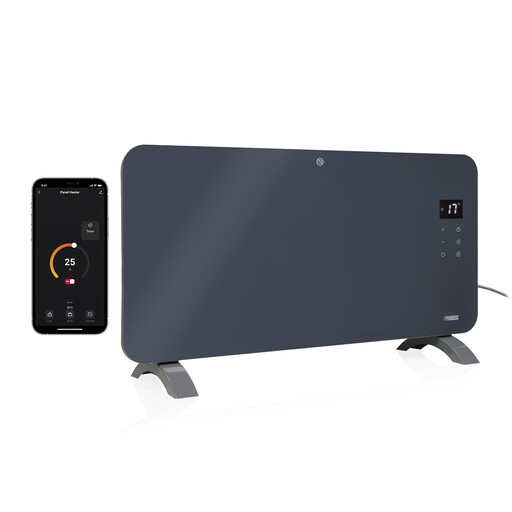
This app-connected glass panel heater is a choice to assess for scheduled warmth near a regular conservatory desk. Check room suitability and the permitted mounting arrangement before buying.
 No image available
Consider this model if you want to control heating around regular desk sessions and can place it in accordance with its instructions.
The product name specifies 1500 W, app connectivity, a 24-hour timer and anti-tilt protection. Wall mounting is listed, but confirm whether freestanding use is permitted and which fittings are supplied.
Check the model’s clearances and sizing guidance against your conservatory, and check the proposed electrical connection alongside your desk equipment.
Yes, if the exact model’s instructions permit the location and you can maintain its required clearances. Keep papers, curtains, furniture and cables away, and place a freestanding heater where a chair or foot traffic will not knock it. Elnur’s PH Plus instructions specifically say not to cover the heater or obstruct its inlet and outlet.
Only use that arrangement if the extension lead’s marked rating accommodates the combined load of the heater and every other connected device. Electrical Safety First advises against overloading leads and adaptors and says not to connect one extension lead to another.
No; a heater with a thermostat and timer may meet a predictable desk routine without Wi-Fi. App control is worth considering if you want to adjust a schedule remotely, but check the exact model’s controls and any additional equipment it requires.