Occasional hobby-room users
If you work on projects at set times rather than occupying the room all day, a thermostat and schedule help you plan when the heater runs.


Start with the exact heater’s stated room coverage and allow for draughts, poor insulation and a cold starting temperature; wattage alone cannot tell you whether it will suit the room. A thermostat and timer fit planned hobby sessions, while the choice between wall mounting and freestanding use depends on the model’s approved configuration. Check its connection method and location instructions before buying.
If you work on projects at set times rather than occupying the room all day, a thermostat and schedule help you plan when the heater runs.
If the room is draughty or poorly insulated, measure it and compare its conditions with the claimed heating area of each exact model. Heatingpoint cautions against using a universal wattage rule for room size.
If projects require adaptable floor space, decide whether a permanent wall position works or whether you need a heater expressly approved for freestanding use.
Check room coverage first, then choose controls and placement that suit your sessions without overlooking safe use.
| Concern | What to check | Who this matters to |
|---|---|---|
| Enough heat for the room | Measure the floor area and compare draughts and insulation with the exact model’s claimed heating area; do not use wattage as a coverage guarantee. | I need the room to become comfortable despite a cold start, so I put model-specific coverage ahead of extra controls. Around 37% of consumers would make sufficient heating capacity their primary concern. |
| Control between sessions | Check for a thermostat and a suitable daily or weekly timer; if you want app control, check whether it needs separate hardware. | When I use the room only for planned projects, I want to avoid leaving the heater running between sessions. For around 27% of consumers, scheduled control is the main priority. |
| Placement and connection | Confirm approved wall or freestanding use, included fittings and whether the model has a plug or requires a fixed connection. | I rearrange my work area and need a heater position that will not get in the way. Placement flexibility would come first for around 18% of consumers. |
| Safe use and location | Check clearance and location instructions; for a damp space, check the exact model’s ingress protection (IP) rating and suitability. | With materials and furniture around my workspace, I need a heater I can position and use as instructed. Around 18% of consumers would put safe placement and location suitability first. |
A cold, draughty hobby room may be harder to warm than its floor area suggests. Heatingpoint advises that there is no fixed wattage rule that fits every room.
Measure the room, note draughts and insulation, and use the exact heater’s stated coverage as a starting point rather than transferring another model’s claim.
Installation differs: Dimplex specifies fused-spur installation for its PLXE range, while Ecostrad lists both feet and wall brackets for iQ Plus. Ecostrad also states that iQ Plus is not suitable for bathrooms.
Check the connection, approved mounting arrangement, supplied accessories and location instructions for the model you intend to buy.
Dimplex says PLXE app control requires a Dimplex Control Hub and RF module; Ecostrad lists built-in Wi-Fi for iQ Plus.
Before choosing remote control, check what hardware is included and whether the schedule you need can be set directly on the heater.
A separate hub and module add equipment to obtain and set up if you choose PLXE app control.
Curtains, furniture and project materials can obstruct a heater. GOV.UK fire-safety guidance says to keep heaters away from curtains and furniture and never use them to dry clothes.
Keep the heater and its grilles clear. For portable electric heaters, follow Electrical Safety First’s advice not to use them overnight; GOV.UK advises unplugging electric heaters when going out or going to bed.
These model ranges illustrate differences worth checking; features and installation requirements do not necessarily apply to every heater from the same brand.
Its installed PLXE range is relevant if you want a fixed heater with digital scheduling.
Its range includes timer-controlled and smart panel heaters, with mounting choices that vary by model.
Its iQ Plus range is an option to examine if built-in Wi-Fi and a choice of approved positions matter.
This Princess model offers app-connected controls for planned hobby-room sessions. Check its room coverage, approved placement and location instructions against your space before choosing it.
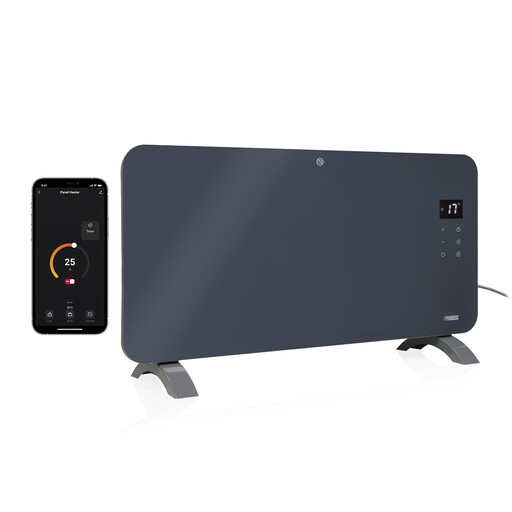 No image available
For hobby sessions at planned times, the stated 24-hour timer and app connection may be useful.
Rated output: 1500 W. Compare the model’s heating-area guidance with your room, and confirm its approved mounting arrangement and damp-location suitability where relevant.
Measure the room and start with the exact model’s claimed heating area, allowing for poor insulation, draughts and a cold starting temperature. Heatingpoint cautions that no universal wattage rule covers every room; Devola’s claim of up to 17 m², for example, applies to its DVM15B rather than to all 1,500 W heaters.
Wall mounting suits a permanent position that leaves the floor clear; freestanding use suits a changing layout only when the exact heater is approved for it. Check the supplied fittings and connection instructions, and position a freestanding heater where it cannot be knocked over or obstructed.
Electrical Safety First recommends not using portable heaters overnight. GOV.UK advises unplugging electric heaters when going out or going to bed; keep heaters away from curtains and furniture, and do not use them to dry clothes.
No: check the exact model’s IP rating and installation instructions for the intended location. Dimplex specifies IP24 for PLXE, while Ecostrad rates iQ Plus IP20 and says it is not suitable for bathrooms. Seek location-specific installation advice if the hobby room has bathroom-like damp conditions.