Size the heater for the whole room, taking its volume, insulation, windows and draughts into account. Choose a convection panel when you need to raise the office air temperature; programmable controls can suit scheduled work, while an infrared panel is a different choice for focused warmth at the desk. Either type needs a suitable position and the right controls for the way you will use it.
Who is each approach for?
Whole-room home-office warmers
If you spend long stretches in the office and want the room air warmed rather than just the desk area, assess the room volume, insulation, glazing and draughts before choosing an output. Dimplex UK identifies these room characteristics as factors in heating requirements.
Schedule-led hybrid workers
If office hours follow a pattern, a thermostat and timer may help you set heating periods around work. App control may also be useful when your schedule changes, provided the selected model and any required accessories support it.
Desk-zone or space-conscious users
If you mainly want warmth around an occupied workstation, an infrared panel is worth considering as a focused-heating option. Check its position, sizing guidance and controller arrangement for the particular room; Herschel Infrared offers panels aimed at this use.
What matters when choosing?
Decide whether you need to warm the whole office or focus on the desk area, then check room fit, controls and a safe place for the heater.
Convection panel
Choose it when: You want to raise and maintain the office air temperature.
Allow for: The output must suit the room, and the heater needs unobstructed airflow.
Infrared panel
Choose it when: Focused warmth near an occupied workstation is the aim.
Allow for: Panel position and controls matter, and focused heating may not meet a whole-room heating need.
| Concern | What to check when buying | Who this matters to |
|---|
| Output for the room |
Measure the room and note its insulation, glazing and draughts. Check the chosen model against the manufacturer's room-sizing guidance. |
If I need the entire office warm through a long workday, a desk location alone cannot tell me what output to choose; around 31% of consumers put room fit first. |
| Workday controls |
Check the thermostat and timer. If remote control matters, confirm app compatibility and any required hardware. |
When my work hours change, I want heating I can schedule or adjust rather than leave running unnecessarily. Around 25% of consumers make workday control their primary concern. |
| Desk-area placement |
Check mounting or freestanding instructions, required clearances and a safe cable route. Keep convection grilles clear. |
With a desk, chair, papers and cables in the room, I need a position that keeps the heater unobstructed; about 25% of consumers put safe desk-area placement first. |
| Electricity use |
Compare rated input in kW and the hours you expect to use the heater; a thermostat or schedule can limit avoidable running time. |
If I use the office for only part of the day, I want to understand how long the heater may run. Roughly 19% of consumers prioritise electricity use. |
Mistakes to avoid
-
Choosing by a generic room-size label alone
Two offices with the same floor area can have different heating requirements because insulation, windows, draughts and ceiling height differ, as Dimplex UK explains.
Measure the room, note where it loses heat and check the output against guidance for the specific model.
An undersized heater may run for long periods without maintaining the temperature you want.
-
Assuming every smart-control accessory is included
Control arrangements vary by model. Dimplex says app control for its PLXE range requires an RF module and a Dimplex Control Hub.
Check the selected heater's instructions for its controller, required accessories and network compatibility before ordering.
Separate hubs or controllers add equipment to obtain and set up.
-
Blocking the heater behind desk furniture
Convection heaters need clear space for airflow. Nearby papers, curtains or furniture can also create a safety risk.
Follow the model's clearance instructions, keep grilles unobstructed and never cover the heater or use it to dry items.
-
Using an overloaded extension lead
Electrical Safety First warns against overloading sockets and leads, while Devon and Somerset Fire and Rescue Service advises against plugging a heater into an extension lead.
Plan for a suitable wall socket, check the heater's electrical requirements and never daisy-chain extension leads.
Relevant brands to consider
Dimplex
Dimplex offers PLXE convection panel heaters with electronic time and temperature controls.
- The PLXE range is relevant when programmed whole-room heating is the priority.
- Dimplex says PLXE app control requires an RF module and Dimplex Control Hub; check the exact model and accessories.
Mill
Mill lists panel-heater models from 250 W to 1500 W and offers app-controlled devices.
- Different listed outputs and control options give buyers models to check against their room and work pattern.
- Select output for the office's heat loss rather than assuming an app feature establishes room suitability.
Ecostrad
Ecostrad describes its smart convection panel heaters as supplementary heating alongside an existing system.
- The range is relevant when an office needs a controllable heating top-up.
- For a persistently cold room, check the selected model's output against the room's heating requirement.
Herschel Infrared
Herschel Infrared offers wall-mountable infrared panels, including options aimed at workstation use.
- Its panels are relevant to buyers deliberately considering focused radiant warmth.
- Check the panel position, the brand's sizing guidance and whether the chosen package includes the controls you need.
Panel heater options on Joybuy
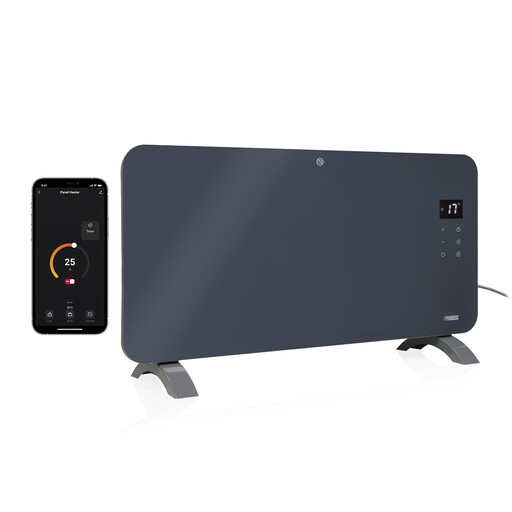
This panel-heater option is relevant to a home office where scheduled controls and a wall-mounted setup are under consideration. Check its output against your room before choosing it.
 No image available
Princess Smart Glass Panel Heater 1500 W
Consider this panel heater if you want timed control in a home office and are assessing a wall-mounted position.
Rated at 1500 W, with Wi-Fi and app connectivity, a 24-hour timer and anti-tilt protection stated in its product name. Check whether 1500 W suits your room and confirm the supported mounting setup and any feet or fittings needed for your chosen position.
Joybuy
Common questions
How do I choose the wattage for a chilly home office?
Choose an output using the room's heating requirement, not floor area or desk position alone. Account for ceiling height, insulation, windows and draughts, then check the selected manufacturer's sizing guidance for the model.
Can I plug a panel heater into an extension lead?
Plan to use a suitable wall socket rather than an extension lead. Devon and Somerset Fire and Rescue Service advises against using an extension lead with a heater, and Electrical Safety First warns against overloading sockets or leads.
What should I check before putting a panel heater near my desk?
Check the model's placement and clearance instructions, keep its grilles clear and route the cable away from walkways. Keep furniture, curtains and papers away from the heater; Devon and Somerset Fire and Rescue Service advises at least one metre of separation from furniture and curtains.
Does a “Lot 20” label establish that a heater meets current UK requirements?
Do not use the label alone as a conformity check for a particular heater. Check the selected product's supplied conformity and safety information with its seller or manufacturer; the UK legislation record for Regulation 2015/1188 is maintained in revised form, while the Department for Energy Security and Net Zero's 2026 consultation describes proposed changes, not requirements established by that proposal.


