Small-bedroom background-heat buyers
If you want warmth while the room is occupied, a compact model with a thermostat and timer may suit your routine. Compare its stated room guidance with your bedroom rather than choosing by output alone.


For modest background warmth in a small bedroom, consider a compact panel heater with a thermostat and timer; a dual-output model offers a choice of settings, while a programmable wall-mounted model suits a predictable routine. Check the exact model’s room guidance, mounting requirements and clearances before choosing: wattage or a claimed room area alone cannot settle whether it suits your bedroom.
If you want warmth while the room is occupied, a compact model with a thermostat and timer may suit your routine. Compare its stated room guidance with your bedroom rather than choosing by output alone.
If you want to move the heater or choose between output settings, check that the exact model supports the intended arrangement. A freestanding heater also needs a safe position away from bedding, curtains and furniture.
If you use the bedroom at predictable times, scheduled temperature control may matter more to you than manual switching. Check which programming functions and accessories the exact model requires.
Start with a position that meets the heater’s clearance instructions, then compare room suitability, controls and mounting options for the way you use the bedroom.
| Concern | What to check | Who this matters to |
|---|---|---|
| Room fit and output | Compare the exact model’s rated output and room guidance with the bedroom’s size, insulation and draughts. | If my bedroom loses heat quickly, I need to know whether the heater suits the actual room rather than rely on its size label. Around 25% of consumers put room fit first. |
| Temperature and scheduling | Check the thermostat and timer functions on the exact model, including any accessories needed for remote control. | When I use the room at regular times, I want heating I can set around that routine. For around 25% of consumers, scheduling is the primary need. |
| Bedroom placement and safety | Read the model’s clearance and installation instructions; keep airflow unobstructed and portable heaters away from bedding and curtains. | I need a position that keeps the heater clear of textiles and furniture, particularly when space is tight. Placement is the first concern for around 31% of consumers. |
| Mounting flexibility | Confirm whether the exact variant supports wall mounting, freestanding use or both, and which fittings are supplied. | If the bedroom layout may change, I need to decide whether a fixed position or a movable heater makes more sense. Around 19% of consumers prioritise that flexibility. |
A stated coverage area applies to the particular model and may not reflect your bedroom’s insulation, draughts or desired temperature.
Use it to narrow your choices, then compare the manufacturer’s guidance with the room and the proposed installation position.
The Dimplex PLXE manual warns that covering the heater or obstructing its airflow can cause overheating and a fire risk. A timer or thermostat does not remove that risk.
Keep the heater’s openings clear, never use it to dry clothes and follow the clearances in the exact model’s manual.
Bedroom textiles can sit close to a poorly placed heater. The Home Office advises unplugging electric heaters when going to bed, and Electrical Safety First recommends against using portable heaters overnight.
Keep portable units away from bedding, curtains and furniture, and switch them off and unplug them before sleep.
Mounting and control arrangements differ by model. Dimplex says smartphone control for its PLXE range requires an RF module and Dimplex Control Hub.
Check the complete model number, approved mounting method, supplied fittings and any accessories needed for the controls you intend to use.
Remote operation on some models requires additional control hardware.
The PLXE wall-mounted range is relevant if you want programmed time and temperature control.
The compact DVS500W is relevant if you are comparing wall-mounted and freestanding options for a small room.
The EPMH1000LED is relevant if you want two output settings and a choice of wall-mounted or freestanding use.
The wall-mounted HSP500T is relevant if a compact heater with scheduled control suits your layout.
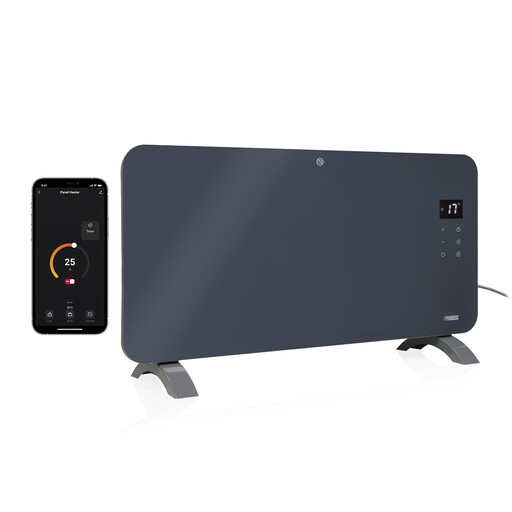
This panel heater has a stated 1500W output and controls for planned use. Check the manufacturer’s room and installation guidance before choosing it for a small bedroom.
 No image available
Consider this model if a 24-hour timer and app control suit your planned use. Its title states a 1500W output and wall-mounted use; check the manufacturer’s room guidance, clearances and installation instructions for your bedroom.
Freestanding use is also claimed, but confirm that the exact model supports it and that the necessary stand is included before relying on that arrangement.
Do not leave a portable electric heater running when you go to bed: the Home Office advises unplugging electric heaters at bedtime, and Electrical Safety First recommends against overnight portable-heater use. For a wall-mounted panel heater, follow the exact model’s installation and operating instructions; a timer does not make covering or obstructing it safe.
Wall mounting can keep floor space clear if your wall and the model’s instructions allow it; freestanding use offers repositioning if the exact variant supports it. Whichever arrangement you choose, follow the required clearances from bedding, curtains and furniture.
They are useful when you want temperature control and use the room at predictable times. Compare the exact model’s thermostat and scheduling functions, and check whether any remote-control feature needs additional hardware.