Who needs to consider what?

Regular conservatory users

If the conservatory serves as a workspace, reading room or regular sitting area, a thermostat and timer can help you plan warmth around occupied periods. Check whether any app controls you want are built in or require additional hardware.

People with a chilly glazed room

A modest floor area does not settle the output question when glazing, the roof or draughts allow heat to escape. Assess the room’s conditions before relying on a heater’s stated room-size guide; Energy Saving Trust notes that direct electric heating can be costly in poorly insulated spaces.

Households needing flexible placement

A freestanding heater may suit occasional use or movement between rooms, provided it can stand securely with clear vents and a safely routed cable. Keep it away from curtains and furniture, as advised by the Home Office and Electrical Safety First.

What matters when choosing?

For an occupied conservatory, consider heat loss first, then decide which controls fit your routine and where the heater can sit safely.

Concern What to check Who this matters to
Heat loss and output Check the exact model’s rated output and sizing guidance against the room’s glazing, roof and draughts. Do not use floor area alone. If my conservatory feels cold despite being small, I need to know whether the heater can maintain a comfortable temperature. Around 38% of consumers put adequate warmth first.
Controls and occupied hours Check the thermostat and timer settings against your routine; confirm whether app control needs extra hardware. When I use the room at set times, I want heat when I am there rather than leaving it running throughout the day. Roughly 37% of consumers prioritise control over occupied hours.
Placement and installation Confirm wall-only or freestanding use, required clearances and the electrical connection. Keep air inlets and outlets unobstructed. If the room has limited floor space or the heater needs to move, I need a position that stays stable and clear of furnishings. About 25% of consumers place safe, flexible positioning first.

Buying pitfalls

  • Choosing wattage from floor area alone

    A room-size claim applies to the model and conditions behind it, not automatically to a glazed conservatory. Devola, for example, describes its 1 kW DVNDM10 as suitable for rooms up to 12 m²; that figure does not establish its suitability for every room of that size.

    Use the candidate manufacturer’s sizing guidance, then account for the conservatory’s roof, glazing, draughts and intended cold-weather use.

    If the room loses heat faster than expected, the heater may run for long periods without providing the comfort you wanted.

  • Treating a movable heater as unattended fixed heating

    A portable heater can be knocked over or placed too close to curtains and furniture. The Home Office advises keeping heaters clear of furnishings and not using them to dry clothes; Electrical Safety First advises against using portable heaters overnight.

    For freestanding use, follow the model’s clearance instructions, place it securely and route its cable safely. If it will stay in one place, compare the installation requirements of a wall-mounted model instead.

  • Assuming app control comes with the heater

    Control options vary by model. Dimplex says app operation for its PLXE Series C requires a separately sold Control Hub and RF module.

    Check what the exact heater can do on its own and which accessories are required for the controls you intend to use.

    Additional control hardware may be needed before the planned app functions are available.

  • Overlooking the heater’s purchase history

    Electrical Safety First advises buying portable heaters from a reputable retailer rather than a third-party online seller, avoiding second-hand heaters and registering a product so the manufacturer can make contact about recalls.

    Choose a traceable heater, retain its purchase details and register it if the manufacturer offers registration.

Relevant brands to consider

Dimplex

The PLXE Series C is a fixed, programmable panel-heater range with outputs from 0.50 kW to 3.00 kW, according to Dimplex.

  • Dimplex specifies an electronic thermostat, seven-day scheduling, adaptive start, open-window detection, locks and an IP24 rating for the range.
  • App operation requires separately sold hardware. Dimplex specifies a supplied 1.3 m cable for fused-spur installation, so check the electrical requirements for the intended position.

Devola

Devola offers panel-heater options at 1 kW, 1.5 kW, 2 kW and 2.4 kW; the DVNDM10 illustrates a model offered for either wall mounting or freestanding use.

  • The DVNDM10 is listed with a 24/7 timer, adjustable thermostat, open-window detection, child lock, feet and casters.
  • Devola’s suitability claim of up to 12 m² applies to that 1 kW model, not to every conservatory or Devola heater.

Stiebel Eltron

The wall-mounted CNS Trend NC convector range includes 0.5 kW, 0.75 kW, 1 kW and 1.5 kW variants, according to Stiebel Eltron.

  • Stiebel Eltron lists a weekly timer, frost protection, open-window detection, self-learning preheat and overheat protection.
  • This is a wall-mounted option rather than a heater to move between rooms. Its manual requires clearances and warns that parts can become very hot.

Panel heaters on Joybuy

This panel heater is worth considering if you have a dedicated wall position and want a timer for occupied periods. Check its mounting options and output against your room before choosing it.
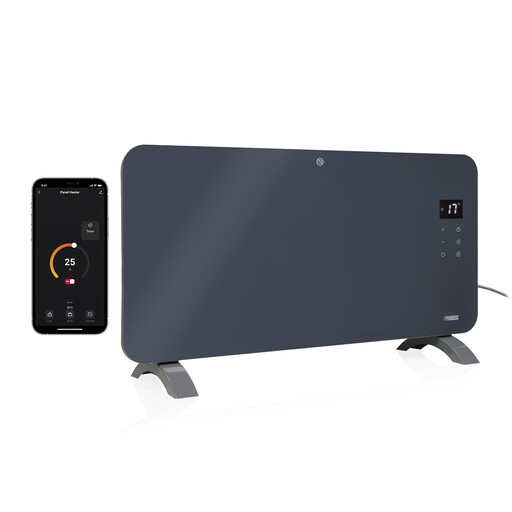
Princess Smart Glass Panel Heater, 1500 W

Princess Smart Glass Panel Heater, 1500 W

Consider this model for a dedicated heating position where its stated timer and electronic thermostat suit your occupied hours. The product title lists Wi-Fi and app connectivity, anti-tilt protection and a 24-hour timer; check the timer’s scheduling options before relying on them for your routine.

Wall mounting is described, but the information about freestanding use conflicts. Confirm whether it can stand on feet and whether those feet are included. Check the manufacturer’s sizing guidance against the conservatory’s heat loss before deciding whether 1500 W is suitable.

View on Joybuy

Common questions

Can I leave a panel heater running overnight in the conservatory?

Do not treat a portable or freestanding heater as unattended overnight heating: Electrical Safety First advises against overnight use of portable heaters. For a wall-mounted model, follow its own operating instructions and keep it uncovered with airflow unobstructed.

Will turning the thermostat higher warm the room faster?

No. Energy Saving Trust explains that raising a room thermostat’s setting does not make heating work faster; it changes the target temperature. If the conservatory is slow to warm or cannot stay comfortable, assess the heater’s output alongside the room’s heat loss.

Can I rely on a heater’s stated room-size rating?

Use it as a starting point for that exact model, not as a guarantee for a conservatory. Devola states that its 1 kW DVNDM10 suits rooms up to 12 m², but glazing, roof construction and draughts can change what the room needs.

What should I check before wall mounting a panel heater?

Check the exact model’s fixing method, electrical connection and required clearances before choosing a wall position. For example, Dimplex instructs PLXE users to use its supplied bracket, avoid placing the heater directly below a fixed socket and keep its air inlet and outlet clear.