Choose a wall-mounted panel heater if it will stay in one small room and preserving floor space matters; choose a freestanding panel or convector if you need to move it or cannot mount it. Check the exact model’s room-size guidance, controls and required clearances before deciding. Electrical Safety First notes that convection heaters warm a room more slowly, while De'Longhi describes its fan heaters as providing immediate directional warmth.
Who is this heater for?
Small-room comfort seekers
If you occupy a compact bedroom, study or home office while heating it, a convector’s room-wide warmth may suit you better than heat directed at one spot. Electrical Safety First notes that convection heating takes longer to warm a room.
Space-conscious renters and homeowners
If floor area is limited, decide whether the heater can stay in a suitable wall position or needs to move between rooms. Check the permitted mounting options for the exact model.
Households focused on safe placement
When people or pets share the room with a heater, its position, cable and clearances need attention. GOV.UK advises keeping heaters away from curtains and furniture and switching electric heaters off when going out or going to bed.
What matters when choosing?
Wall-mounted panel heater
Choose it when: the heater will stay in one room and you want to keep the floor clear.
Allow for: a suitable installation position and the clearances required by its instructions.
Freestanding panel or convector
Choose it when: you need to move the heater or cannot install one on the wall.
Allow for: floor space, a stable position and unobstructed airflow around the unit.
| Concern |
What to check |
Who it matters to |
| Room-wide warmth |
Check the manufacturer’s room-size or output guidance for the exact model and whether it has a thermostat. |
If I spend my working hours in this room, I want its air warmed rather than a burst of heat aimed at my desk; around 38% of consumers would put room-wide warmth first. |
| Safe placement |
Check the required clearances and, for a freestanding model, its stability and listed safety controls. |
When children or pets use the room, I need a place for the heater that keeps it clear of furnishings and passing feet; roughly 31% of consumers would prioritise safe placement. |
| Controls and space |
Look for a thermostat and a timer if use follows a routine; confirm the permitted mounting format. |
If I use the room at regular times but have little spare floor area, I want heating that fits both my schedule and the layout; around 31% of consumers would put controls and space fit first. |
Buying pitfalls to avoid
-
Choosing by wattage alone
Output by itself does not establish whether a heater suits the room. Convection warmth also takes time to build.
Start with the manufacturer’s room-size guidance for the exact model, then consider whether its thermostat and timer suit the hours you occupy the room.
-
Assuming a thermostat makes unattended use safe
A thermostat does not remove the need for clear space around a heater. GOV.UK advises unplugging electric heaters when going out or going to bed.
Keep the heater away from curtains and furniture, leave its vents clear and follow its instructions for use and switch-off.
-
Assuming every panel heater works in both positions
Fixed and freestanding arrangements are model-specific; a suitable-looking panel may not support the setup you need.
Check its permitted configurations, dimensions, included fittings and installation instructions before ordering.
Wall mounting may also require suitable fixings or installation work for the chosen position.
-
Relying on a short listing description
Controls and safety features differ by model, and a feature named in a title may need closer checking before you rely on it.
Confirm the full model identifier, supply arrangement, manual, warranty terms and product-registration route.
Brands and alternatives to consider
Dimplex
Dimplex offers installed panel heaters for rooms where a fixed position and floor space matter.
- Dimplex describes wall- and ceiling-mounted panel-heater formats with controls for managing room temperature.
- Output, installation requirements and functions such as open-window detection vary by model; check the exact heater.
De'Longhi
De'Longhi’s portable-heater range is relevant when comparing a panel heater with a movable alternative.
- De'Longhi describes its fan heaters as providing immediate directional warmth.
- Check the exact product type and specifications rather than treating a portable fan heater, convector and panel heater as interchangeable.
Princess
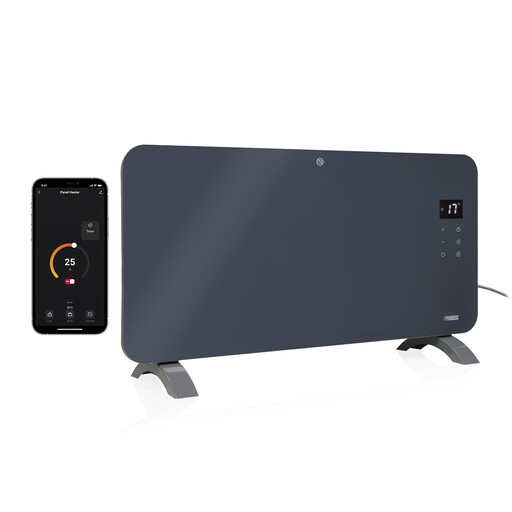
The Princess Smart Glass Panel Heater is a 1500 W option for buyers considering scheduled heating and wall mounting.
- The Joybuy listing names an electronic thermostat, app control, a timer and a child lock for this model.
- Check the manual for permitted installation arrangements and clearances, and confirm that the manufacturer’s room guidance suits your space.
Panel heaters on Joybuy
This wall-mountable panel heater may suit a room where you want thermostat and timer controls; check the room fit and installation arrangements for the exact model.
 No image available
Princess Smart Glass Panel Heater, 1500 W
Consider this model for a room used on a regular schedule if wall mounting suits its layout and the manufacturer’s room guidance fits your space.
Listed features include 1500 W output, an electronic thermostat, a 24-hour timer, app control, a child lock and anti-tilt protection.
The title also lists freestanding use; confirm the permitted configurations, any required feet and installation clearances in the model instructions before relying on that option.
View on Joybuy
Panel heater questions answered
Can I leave a panel heater on overnight in an occupied bedroom?
Do not assume that a thermostat or timer makes overnight use appropriate. GOV.UK advises unplugging electric heaters when going out or going to bed; for a fixed panel heater, follow the exact manufacturer’s instructions for its installation and use.
What if the heater will be near a bed or desk?
Choose a position that meets the heater’s specified clearances and keeps its vents unobstructed. GOV.UK advises keeping heaters away from curtains and furniture and never using them to dry clothes; wall mounting frees floor space but does not remove those placement requirements.


