Choose the heater’s output for the lounge’s dimensions and heat loss, not simply because the room is described as small. For regular use around other people, look for temperature and scheduling controls, then decide between wall mounting and a freestanding setup according to installation permission, available space and safe placement.
Who needs this heater?
Regular shared-lounge users
If people sit in the lounge for extended periods, a thermostat and timer let you set a temperature and heating schedule instead of repeatedly switching the heater by hand. Check the selected model’s controls and operating sound rather than assuming every panel heater is equally quiet.
Consumers focused on one occupied room
If the lounge is the room you need to warm, match the output to its size and heat loss. Scheduling matters when the room is occupied at predictable times; a higher wattage alone does not establish how long the heater will run.
Renters and households that rearrange furniture
A freestanding arrangement may suit a changing layout, provided there is a safe place for the heater. For wall mounting in a rented home, check the tenancy arrangements before making alterations and confirm which fittings come with the chosen model.
What matters when choosing?
Start with the room’s measurements and likely heat loss. Then choose controls you will use and a mounting position that leaves the heater clear of furniture and movement through the lounge.
| Concern | What to check | Who this matters to |
|---|
| Output and room fit |
Measure floor area and consider insulation, glazing, ceiling height and open doors. Adax by SolAire Heating Products suggests 80 W/m² as a starting point for a typically insulated room, not a guaranteed requirement. |
I need the heater to suit the room’s actual heat loss, rather than choosing by its small-room label alone. Around 36% of consumers put room fit first. |
| Temperature and scheduling |
Check for an adjustable thermostat and a timer that fits the lounge’s occupied periods. |
When the lounge is used at predictable times, I want warmth without leaving the heater operating unnecessarily. Consumers who prioritise that control account for around 29%. |
| Shared-space placement |
Check the model’s required clearances and whether its cable and position will keep walkways and air grilles clear. |
With people passing close to furnishings, I need a position where the heater will not be knocked or obstructed. That is the primary concern for around 21% of consumers. |
| Installation flexibility |
Confirm the mounting method, any required permission and whether compatible freestanding feet are included. |
If I cannot make permanent alterations or expect to move the heater, the fittings change which setup I can use. Around 14% of consumers put that flexibility first. |
Mistakes to avoid
-
Choosing wattage from the word “small”
The same floor area can have different heating needs depending on insulation, windows, ceiling height and doors to adjoining spaces.
Measure the lounge before comparing available outputs. Use a sizing guide as a starting point, then account for the room’s particular heat loss.
An undersized heater can run for longer without reaching the chosen temperature.
-
Assuming controls eliminate electricity use
A thermostat or timer can limit unnecessary operating time, but the heater still uses electricity while its heating element is on.
Choose a schedule that reflects when the lounge is occupied and consider the heater’s rated output alongside expected hours of use.
-
Leaving freestanding placement until after purchase
A shared lounge may have furniture, curtains and people moving around the heater. Electrical Safety First says convection heaters need clear space around and above them.
Follow the model’s clearance instructions, avoid obstructing walkways and keep the heater away from curtains and furniture. GOV.UK fire-safety guidance says not to dry clothes on electric heaters and to unplug them when going out or going to bed.
-
Assuming every mounting or app accessory is included
Requirements differ between ranges: Dimplex says PLXE app control needs a separate RF module and Control Hub, while the Adax Neo supplier lists leg brackets separately.
Check the exact variant’s supplied fittings, compatible feet and any modules needed for the controls you intend to use before deciding where it will go.
Extra fittings or control modules may be needed for the setup you choose.
Relevant brands to consider
Dimplex
Dimplex offers installed panel heaters, including the slimline PLXE Classic range with electronic time and temperature controls.
- Dimplex describes the PLXE Classic as quiet in operation and lists adaptive start and open-window detection.
- PLXE app control requires a separately purchased RF module and Dimplex Control Hub; check the selected output and mounting arrangement.
Adax
The Adax Neo line offers several output variants for consumers comparing a slimline panel heater with thermostat and timer controls.
- The UK supplier lists Neo variants from 400 W to 2000 W, with a timer and open-window detection.
- The supplier lists leg brackets separately. Confirm the selected variant and compatible fittings if freestanding use matters.
Panel heaters on Joybuy
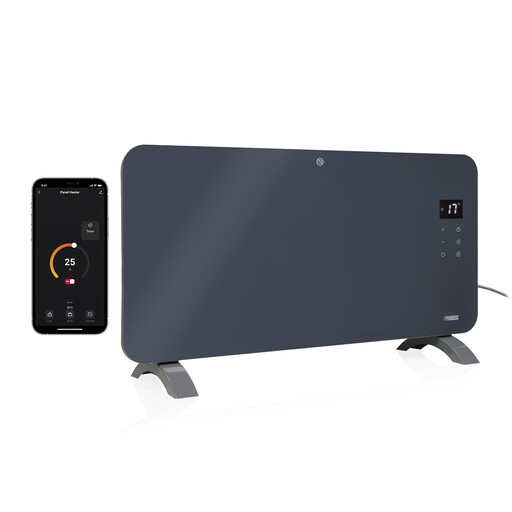
This panel heater has controls relevant to regular shared-lounge use. Check whether its 1500 W output fits your room and which fittings are supplied for the mounting arrangement you want.
 No image available
Princess Smart Glass Panel Heater 1500 W with Wi-Fi
Consider this model if you want a timed panel heater for a regularly occupied lounge and its output suits your room.
The product title specifies 1500 W, Wi-Fi app connectivity and a 24-hour timer. It describes both wall-mounted and freestanding use, but confirm the exact mounting arrangement and whether compatible feet are included before choosing a position.
View on Joybuy
Common questions
How do I estimate the right output for a small lounge?
Measure the floor area, then account for insulation, glazing, ceiling height and doors that may be left open. Adax by SolAire Heating Products suggests 60 W/m² for a well-insulated room, 80 W/m² for a typically insulated room and 130 W/m² or more where insulation is poor, glazing is extensive or ceilings are high; these are sizing starting points, not guarantees for a particular room.
How can I estimate a panel heater’s electricity use?
Multiply its rated output in kW by the hours it operates at full output to estimate kWh used during those hours. A thermostat may switch the heating element off after the room reaches its set temperature, so actual use depends on the room and how the heater operates.
Can I leave a freestanding electric heater on when I go out or go to bed?
GOV.UK fire-safety guidance says to unplug electric heaters when you go out or go to bed. Keep the heater away from curtains and furniture, do not use it to dry clothes and follow its placement instructions.
Can I wall-mount a panel heater in a rented shared lounge?
Check permission before making alterations. Shelter England advises tenants in England to get their landlord’s agreement in writing before making improvements; elsewhere in the UK, check your tenancy agreement and the applicable landlord or property-manager requirements before drilling or changing electrical arrangements.


