Check your accommodation rules before choosing a panel heater: some university residences prohibit personal or portable heaters in student bedrooms. If one is permitted, a freestanding convection panel with a thermostat and timer may suit study periods near a desk; check its room guidance and clearance requirements, and get approval before considering wall mounting.
Who needs to make this choice?
Students in permitted private rooms
If your tenancy allows a personal heater, you may want supplementary warmth near a desk without permanently changing the room. Check whether the model can stand where you need it and whether its required clearances leave enough usable space.
Students in halls with appliance rules
Permission comes before specifications. The University of St Andrews prohibits heaters in study bedrooms unless the residence provides them, while the University of Manchester lists portable heaters as banned items. Your own residence rules determine what you can use.
Students with regular study hours
A thermostat and timer can help you plan when the heater runs. If you are considering app controls, check that they suit your routine rather than assuming they will reduce electricity use on their own.
What matters before buying?
Establish whether a personal heater is allowed, then assess placement beside the desk and the controls you would actually use.
| Concern |
What to check |
Who this matters to |
| Permission and electrical safety |
Read your residence or tenancy rules, confirm the permitted heater type and check that the electrical supply and socket are suitable. |
If my halls prohibit personal heaters, even a compact model would be unusable; around 42% of consumers would put permission and electrical safety first. |
| Desk-area fit |
Check the model's dimensions, supplied feet or brackets, required clearances and room-size guidance. |
I need warmth while studying without obstructing the walkway or fixing anything to the wall; roughly 33% of consumers would prioritise desk-area fit. |
| Electricity use and controls |
Compare rated wattage with your expected active hours, then check the thermostat, timer and scheduling functions. |
For regular study sessions, I want the heater off when I leave rather than relying on memory; about 25% of consumers would place electricity use and scheduling first. |
Mistakes to avoid
-
Ordering before checking halls rules
A heater's features do not make it acceptable in a residence that prohibits it. The University of St Andrews restricts heaters in study bedrooms, and the University of Manchester bans portable heaters.
Read your own agreement and ask the accommodation team if the wording is unclear. If personal heaters are prohibited, raise the room-heating problem with your accommodation provider instead.
-
Assuming a timer makes heating use negligible
Controls can limit unnecessary running time, but a heater still uses electricity while operating. At full rated output, a 1kW heater uses 1kWh in an hour; actual use depends on thermostat cycling and settings.
Choose a timer or schedule that fits when you study, and compare electricity use using the model's wattage and the hours you expect it to run.
-
Planning to wall-mount without permission
A fixed panel can leave more floor space, but room alterations may not be allowed even when a personal heater is permitted.
Obtain approval before fixing a heater to the wall. If you need temporary placement, confirm that the exact model supports freestanding use and that its feet are supplied.
-
Overloading a socket or using an unsuitable adapter
Staffordshire Fire and Rescue Service advises against overloading sockets and recommends one appliance per plug where possible. University of Essex guidance identifies 220–240V and 50Hz as suitable UK mains specifications.
Check the heater's electrical rating, follow its manual and your accommodation rules, and keep its cable undamaged and unobstructed.
Relevant brands to consider
Dimplex
The PLXE line focuses on fixed panel heating with electronic temperature and time controls.
- The PLX100E is specified as a 1kW, IP24 wall-mounted panel with a thermostat and seven-day timer.
- Its fixed installation suits a room where wall mounting is approved, not one where the heater must move beside the desk.
Devola
Devola lists panel heaters with freestanding or wall-mountable formats and a range of control options.
- Its range includes 1000W, 1500W and 2000W models, with timers or Wi-Fi on some versions.
- Check the particular model's feet, accessories, wattage and placement requirements rather than applying range-wide features to every heater.
Duux
The Edge 1000 is a convection heater offered for freestanding or wall-mounted placement.
- Duux specifies 1000W output, a 6.5cm body depth and app-based controls for the Edge 1000.
- Duux's guidance of rooms up to 15m² depends on room conditions; freestanding use also remains subject to accommodation rules.
Ecostrad
The iQ Plus 1000W is a slim panel with Wi-Fi scheduling and both floor and wall placement options.
- The cited model listing specifies a 52mm body and includes feet and wall brackets.
- The listing says this model is not suitable for bathroom installation; wall mounting requires permission where the room rules restrict alterations.
Herschel
Select XLS is an infrared-panel alternative for someone considering warmth directed towards a defined desk position.
- Herschel offers Select XLS versions from 300W to 1100W, with wall or ceiling installation and optional freestanding feet.
- It uses a different heating approach from the convection panels here; check the required controls and approved mounting arrangement for the exact version.
Joybuy panel heaters for desk-area use
These panel heaters offer different placement and control options for a student-room desk area. Confirm that your accommodation permits the heater and any proposed installation before choosing between them.
 No image available
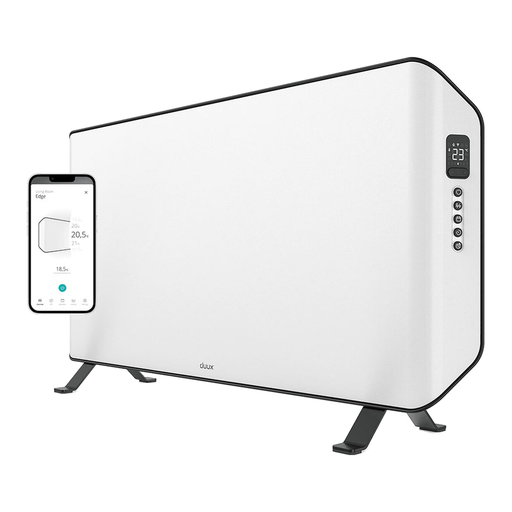
Duux Edge 1000 DXCH21UK Convection Heater, White
Consider this model if a freestanding heater is permitted and you want to schedule warmth for desk-based study.
Rated at 1000W, with Wi-Fi control and a wall-mounting option. Duux gives room guidance of up to 15m², which depends on room conditions. Check mains compatibility before buying, and obtain permission before wall mounting.
View on Joybuy
 No image available
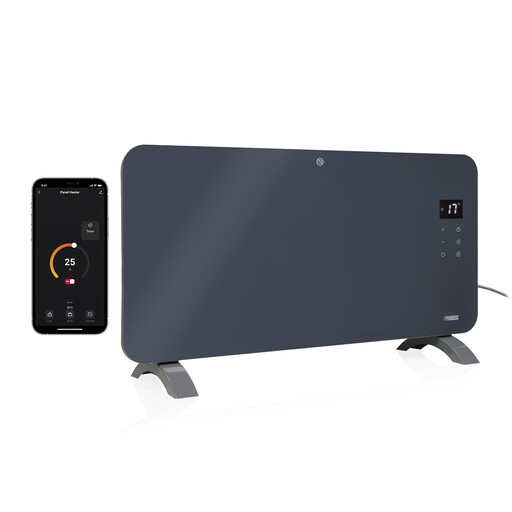
Princess Smart Glass Panel Heater, 1500 W
Consider this model where a wall-mounted panel is permitted and app control or a timer fits your study routine.
The product name specifies 1500 W output, Wi-Fi and app control, a 24-hour timer and anti-tilt protection. Check the permitted mounting arrangement before ordering; if you need freestanding use, confirm whether the required feet are supplied.
View on Joybuy
Common questions
Can I use a personal panel heater in student halls?
Only if your particular residence permits it. The University of St Andrews prohibits heaters in study bedrooms unless supplied by the residence, and the University of Manchester lists portable heaters as banned items. Check your own handbook and ask for written clarification if needed.
Is a 1kW panel heater suitable for a desk area?
A 1kW model is worth considering for supplementary warmth, but check the whole room rather than choosing by desk size alone. Duux gives the Edge 1000 guidance of up to 15m²; the cited Ecostrad iQ Plus 1000W listing gives up to 10m² with modern insulation and 7m² with poor insulation. These model-specific guides do not guarantee the same result in your room.
Can I plug a panel heater into an extension lead?
Do not assume an extension lead is a suitable setup. Staffordshire Fire and Rescue Service advises against overloading sockets and recommends one appliance per plug where possible. Follow the heater manual and your accommodation's electrical rules.
What should I check on a heater bought from abroad?
Check its rated supply voltage and frequency against the electrical supply where you will use it. University of Essex guidance identifies 220–240V and 50Hz as suitable UK mains specifications; also check the plug and your accommodation's appliance rules before use.


