Students in small, chilly bedrooms
Limited floor space makes placement important. Measure the room and compare it with the heater’s model-specific coverage guidance rather than using wattage as a universal room-size rule.


Choose a panel heater only if your accommodation permits it and you can position it clear of bedding, curtains and furniture. Measure the room and compare it with the exact model’s stated coverage; a thermostat and timer can help manage when it runs, but neither makes unattended use safe.
Limited floor space makes placement important. Measure the room and compare it with the heater’s model-specific coverage guidance rather than using wattage as a universal room-size rule.
If drilling is not permitted, look for a suitable freestanding configuration. Check the accommodation rules before bringing in a supplementary heater, even if you do not plan to fix it to a wall.
Rated power determines the electricity drawn while the heating element is on. Compare output with the room’s needs, then check whether the thermostat and timer suit your routine.
Check permission and safe placement before comparing room coverage, electricity use and everyday convenience. A heater’s stated coverage applies to its particular model and remains a guide rather than a promise of warmth in a draughty room.
| Concern | What to check | Who this matters to |
|---|---|---|
| Safe use and permission | Check accommodation rules and whether an allowed installation leaves the clear space required by the heater’s instructions. | If my room is crowded or wall fixing is restricted, I need a heater I can place and use safely without breaching the rules; roughly 31% of consumers put safe use and permission first. |
| Room coverage | Measure the floor area and compare it with the exact model’s stated coverage, allowing for draughts and insulation. | When my room stays chilly, I need output suited to its size and condition rather than the highest wattage on the shelf; around 25% of consumers make adequate coverage their primary concern. |
| Electricity use | Compare rated power and look for a thermostat and timer that fit the times you can safely use the heater. | If I monitor how much electricity I use, I want control over when the element runs; about 25% of consumers prioritise managing electricity use. |
| Space and convenience | Check dimensions, weight, cable length and whether the required feet or wall-mounting parts are supplied. | With one room serving as both bedroom and study space, I need a heater that fits without obstructing furniture or walkways; approximately 19% of consumers put compact, convenient use first. |
A higher-rated heater draws more electricity while operating at full output, but manufacturer coverage figures differ between models. A lower-output model may also struggle in a larger or draughtier room.
Measure the room, check the exact variant’s coverage guidance and consider its thermostat and timer alongside its rated power.
Automatic switching does not remove the risk of a heater being covered or displaced. Dimplex warns about that risk in its PLXE manual, while Electrical Safety First recommends not using a portable heater overnight.
Follow the model’s instructions, keep it clear of clothes and furnishings, and do not leave a portable heater operating when you go out or go to bed.
Halls and rented rooms can have rules for supplementary heaters, and a wall-mounted model may require drilling.
Check with the accommodation provider before buying or installing one. If fixing is not allowed, confirm that the model has a suitable freestanding configuration and a safe place to stand.
Electrical Safety First advises buying portable heaters from a reputable retailer and cautions against second-hand units whose safety condition may be uncertain.
Keep proof of purchase, register the heater if the manufacturer offers registration, and check product recalls if you have concerns about a model.
The PLXE range is a wall-mounted option for rooms where fixed installation and programmed heating are permitted.
The DVNDM range offers several outputs for comparing a room’s size with a specific heater variant.
The Artis iQ range is an option for students considering programmed or Wi-Fi-controlled heating.
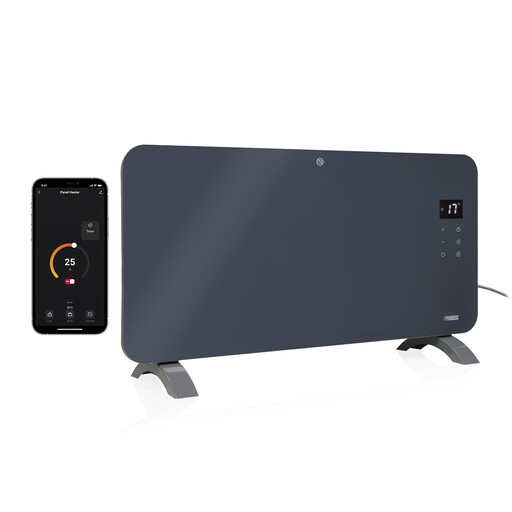
The Smart Glass Panel Heater 1500G is a 1,500 W option with scheduling and app controls.
This 1,500 W glass panel heater is a choice to examine if scheduled controls suit your routine and your accommodation permits a safe place for it. Check its suitability for your room and the supplied installation parts before buying.
 No image available
Consider this model for a study-bedroom where scheduled heating is useful and its placement is permitted.
The Joybuy listing specifies a 1,500 W output, electronic thermostat, timer, Wi-Fi app control and child lock.
Check that the heater suits your measured room and whether the parts needed for freestanding use are included. Confirm the plug and cable configuration before buying.
Check your halls handbook or tenancy agreement and ask the accommodation provider before buying one. Permission to use a supplementary heater and permission to drill for wall mounting are separate questions; either way, follow the heater’s placement instructions.
Start with your measured room area and the exact heater’s stated coverage. Ecostrad lists its 1,000 W Artis iQ for approximately 8–10 m², while Devola lists its 1,000 W DVNDM10 for up to 12 m²; both are manufacturer guidance that may not reflect draughts, insulation or unusually cold conditions.
Rated wattage indicates the electricity drawn while the heating element operates at full output: a 1,000 W heater uses 1 kWh over an hour of continuous full-output heating, while a 2,000 W heater uses 2 kWh. Actual use can differ when a thermostat cycles the element on and off.
Do not plan to run a portable heater overnight: Electrical Safety First recommends against it. Heaters can also overload socket outlets or extension leads, so follow the exact model’s instructions and use a suitable wall socket rather than assuming an extension lead is appropriate.