What matters when choosing
Decide whether you need background warmth throughout the room or direct warmth at a fixed position, then check the heater’s controls, placement and the condition of the cold wall.
| Concern |
What to check |
Who this matters to |
| Steady room warmth |
Check the exact model’s room guidance and thermostat, allowing for the room’s heat loss and the space needed for airflow. |
For a room used over several hours, I want steady background warmth rather than a short burst of heat; around 31% of consumers put room comfort first. |
| Electricity use |
Compare rated input power and whether a thermostat or timer can match heating to occupancy; calculate likely use against your own tariff. |
If I heat the room regularly, I want to avoid running the heater when the space is empty. For around 25% of consumers, controlling electricity use is the primary need. |
| Cold-wall condition |
Look for recurring condensation, mould, damp patches or signs of water ingress before treating extra heat as the solution. |
When a wall remains cold or shows damp, I need to find out what is causing it, not just raise the air temperature; around 25% of consumers put that question first. |
| Safe, flexible placement |
Check the model’s clearances, cable reach and mounting requirements; obtain permission before drilling in a rented flat. |
In a tight room where I may need to move the heater, I need a safe position without assuming I can wall-mount it. That is the leading concern for around 19% of consumers. |
Panel heater choices on Joybuy
This panel heater is relevant if you want room warmth with app-based scheduling and have a suitable place for it. Check the exact installation arrangement before choosing it for a rented flat.
 No image available
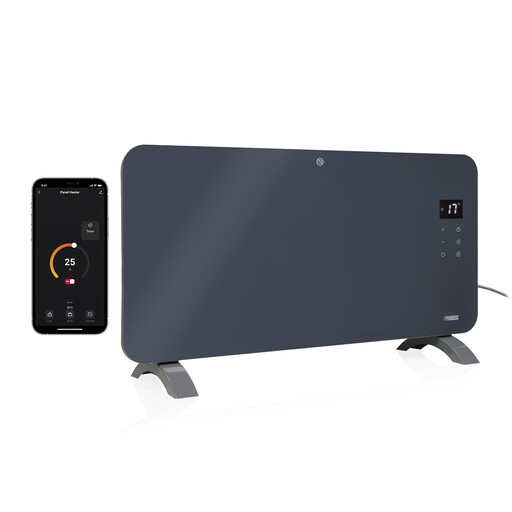
Princess Smart Glass Panel Heater 1500 W with Wi-Fi
Consider this model if you want a panel heater with app control and a 24-hour timer for scheduled room heating.
Its stated output is 1500 W. Check the manufacturer’s guidance against your room’s heat loss and confirm the required installation clearances.
The product name mentions both wall-mounted and freestanding use; confirm the exact configuration and any supports needed before relying on freestanding placement.
Joybuy
Common questions
Will a panel heater fix a cold wall?
No. A convection panel heater can warm room air, but it cannot repair water ingress, a building defect or mould. If damp or mould persists, investigate and report the underlying problem rather than relying on extra heating alone.
How can I work out a panel heater’s running cost?
Multiply its input power in kW by the hours it runs and your electricity tariff’s unit rate. A thermostat may cycle the heater off, so continuous operation at its rated input is not necessarily its actual use; room heat loss also matters.
Can I use an extension lead with a portable heater?
Plan to use a suitable wall socket instead. Electrical Safety First warns that high-powered appliances such as heaters can overload extension leads and socket outlets; check the supplied cable reaches a safe heater position.
Can I wall-mount a panel heater in a rented flat?
Check your tenancy terms and obtain permission from the landlord or managing agent before drilling or making a permanent installation. If the wall is damp or damaged, seek an assessment before mounting a heater on it.
Would an infrared panel suit a cold room better?
An infrared panel may suit a fixed seating or desk position where you receive direct radiant warmth, but it is not automatically a better way to warm all the room air. Energy Saving Trust explains that infrared heats surfaces in its path; it will not address the cause of a cold wall.


