People with limited dwarf-wall space
A low-height wall-mounted format may fit beneath conservatory glazing where a standard-height panel will not. Check the exact heater dimensions and mounting clearances against the available wall.


A low-level plug-in panel may suit a conservatory with little wall space beneath the glazing; a hard-wired convector suits a planned permanent installation. Whichever format you choose, check the heater’s output against the room’s size and insulation, then consider scheduling and frost protection for intermittent use. Controls cannot make up for persistent heat loss.
A low-height wall-mounted format may fit beneath conservatory glazing where a standard-height panel will not. Check the exact heater dimensions and mounting clearances against the available wall.
Look for controls that let you schedule heating around use of the room. Dimplex and ThermoSphere list programmable schedules and frost-protection functions for the ranges discussed below.
Allow for the room’s heat loss when assessing output. ThermoSphere’s stated room coverage differs between good and poor insulation, while BRE’s conservatory research for the Department of Energy and Climate Change notes that heating a conservatory can add substantial demand.
Start with the room’s heat loss and available wall space; then decide whether a plug-in or permanent installation fits how you will use it.
| Concern | What to check | Who this matters to |
|---|---|---|
| Output and heat loss | Measure the room and assess its glazing, roof and draughts. Compare the exact model’s output and stated coverage for the relevant insulation condition. | If my conservatory loses heat readily, I need a heater sized for that room rather than a wattage chosen from floor area alone. Around 42% of consumers put adequate output first. |
| Running-time control | Check the exact model’s thermostat, schedule and frost mode; confirm whether app control needs extra equipment. | When I use the room only occasionally, I want to avoid heating it for longer than necessary. Around 33% of consumers make running-time control their main concern. |
| Fit and installation | Check body dimensions, mounting clearances and cable route, plus whether the model uses a plug or requires a fused spur. | With a short wall beneath the glazing or no suitable wiring in place, I need an installation that works in the space available. For around 25% of consumers, fit and installation come first. |
ThermoSphere gives different coverage figures for good and poor insulation. BRE’s conservatory research for the Department of Energy and Climate Change also points to the additional heating demand a conservatory can create.
Measure the room and assess the glazing, roof and draughts before comparing the exact model’s stated coverage. Use its poorer-insulation case unless the room is demonstrably well insulated.
An undersized heater may run for long periods without making the room sufficiently warm.
Dimplex specifies fused-spur installation for its PLXE range, and ThermoSphere states that its convector panel heater needs direct mains wiring.
Confirm the connection method before ordering. If you need a plug-in heater, choose a model explicitly supplied for that installation and follow its placement instructions.
A fused-spur model requires electrical installation before it can be used.
Scheduling and open-window detection can help avoid unnecessary heating time, but neither removes heat loss through a poorly performing conservatory.
Check the room’s heat loss and the heater’s output as well as its controls; address obvious draughts rather than relying on the timer alone.
A heater needs the clearances specified for its particular installation. Electrical Safety First advises keeping space above and around portable heaters clear.
Follow the exact model’s mounting or placement instructions and keep its airflow paths unobstructed. For a portable heater, follow Electrical Safety First’s advice not to leave it running overnight.
The PLXE Series C is a fixed-installation panel-heater range with several output options and digital controls.
Its convector panel-heater range is intended for a permanent, directly wired installation.
The Sunrise Eco-Pro 1250W is presented by Ducasa Direct as a low-level wall-mounted option for conservatory dwarf walls.
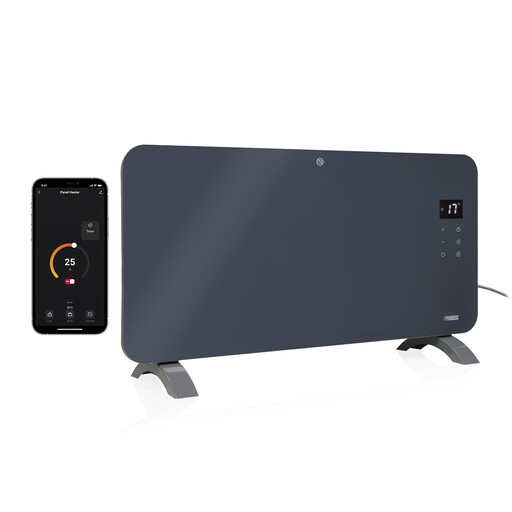
This wall-mounted or freestanding panel-heater option offers a timer for a conservatory used intermittently. Check its output against your room’s heat loss and confirm the connection and placement requirements before choosing it.
 No image available
Consider this panel if you want a timer for heating a conservatory when it is in use, provided its output and installation suit the room.
The product title specifies 1500 W output, Wi-Fi and app connectivity, a 24-hour timer, anti-tilt protection, and wall-mounted or freestanding use.
Check the exact model’s conservatory sizing guidance, electrical connection and installation clearances before ordering.
Start with the room’s dimensions and insulation condition, then compare the exact heater’s published sizing basis. ThermoSphere states that its 2,000 W TSCR covers up to 18 m² with good insulation but 12 m² with poor insulation, so a lightly insulated conservatory should not be assessed using the good-insulation figure.
Choose by the installation your conservatory can accommodate, not by heater appearance. Ducasa Direct lists a fitted UK plug for the low-level Sunrise Eco-Pro 1250W; Dimplex PLXE and ThermoSphere’s convector range require a fused-spur installation. Check wall clearances and socket or wiring arrangements for the exact model.
Follow the exact heater’s clearance and installation instructions, and keep its airflow paths clear. For portable heaters, Electrical Safety First advises leaving clear space above and around them and not running them overnight.
Further work can affect the status of an otherwise exempt conservatory or porch under GOV.UK guidance applicable to England and excepted energy buildings in Wales. Before structural alterations or an electrical installation project, ask the relevant local building-control body and a qualified installer what applies to the proposed work.