People with persistently cold bedroom walls
You need to assess the room’s heat loss before choosing an output. As Energy Saving Trust explains, heating the room does not insulate an external wall or stop draughts.


Choose the heater’s output using the bedroom’s dimensions, windows, external walls and draughts, rather than a floor-area shortcut. Energy Saving Trust explains that heat escapes through building fabric and draughts, so a panel heater can warm the room without fixing a cold wall. For regular use, look for temperature control and scheduling once the output is assessed, then check the exact model’s mounting and electrical requirements.
You need to assess the room’s heat loss before choosing an output. As Energy Saving Trust explains, heating the room does not insulate an external wall or stop draughts.
A thermostat and schedule may help match heating to when you use the room. Dimplex and Devola describe these controls on selected panel-heater ranges; check the exact model.
If permanent fitting is not possible, a freestanding option may suit the room, provided there is a safe position clear of curtains and furniture. GOV.UK advises keeping heaters away from both.
Assess heat demand before comparing controls; then check whether the intended position and electrical connection suit the exact heater.
| Concern | What to check | Who this matters to |
|---|---|---|
| Output for a cold room | Use room dimensions, windows and external-wall construction in a heater-sizing calculation; account for draughts when assessing heat loss. | If my bedroom has cold external walls, I need an output suited to its actual heat loss, not just its floor area. Around 38% of consumers would put sizing first. |
| Temperature and scheduling | Check the exact model’s thermostat and programmable timer; confirm Wi-Fi control if you need remote changes. | When I use the bedroom at predictable times, I want control over when it heats rather than routinely heating an empty room. Roughly 31% of consumers would prioritise that control. |
| Placement and installation | Check mounting or freestanding instructions, required clearances and whether the electrical connection calls for competent installation. | With bedding, curtains and furniture nearby, I need a position that meets the heater’s instructions and suits my electrical setup. Around 31% of consumers would make safe placement their main concern. |
Energy Saving Trust explains that heat continues to escape through building fabric and draughts; a heater does not correct either cause.
Use the room’s dimensions, windows and construction to assess the required output, and consider suitable insulation or draught control separately without blocking necessary ventilation.
A timer, app or open-window function controls operation but does not establish whether the heater can meet this bedroom’s heat demand.
Assess the output first, then choose the controls you will use. Check features against the exact model rather than a brand’s wider range.
Bedding, curtains, furniture or clothes against a heater can obstruct airflow and create an overheating or fire risk.
Follow the model’s stated clearances, never cover the unit and keep portable heaters away from curtains and furniture, as GOV.UK advises.
Installation varies. Hyco’s Accona instructions, for example, call for a competent person and a permanent electrical connection with earthing and an appropriately rated isolating switch.
Read the exact model’s instructions before ordering to establish whether the intended position and electrical arrangement are suitable.
Panel-heater ranges include digitally controlled PLXE models and Alta Wi-Fi models intended for wall mounting.
Its panel-heater range includes classic and glass-fronted designs, with wall-mounted and freestanding options.
The Accona range comprises fixed panel heaters in several stated outputs, from 0.5 kW to 2.4 kW.
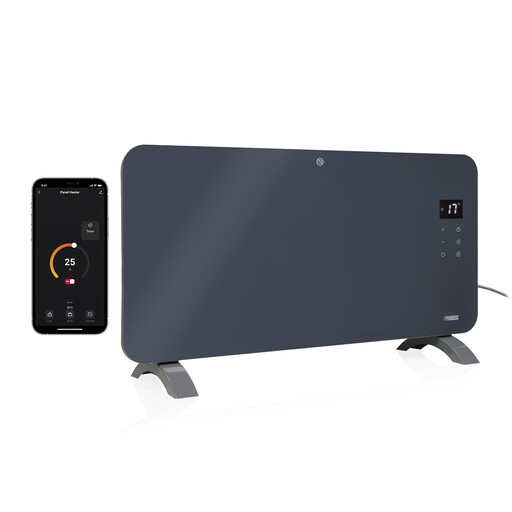
This wall-mounted, app-controlled panel heater may suit a bedroom where its output and installation requirements match the room. Check those conditions before choosing it for cold-wall heating.
 No image available
For scheduled bedroom heating where wall mounting is feasible, this model lists a thermostat, timer and app control.
Its stated output is 1500 W, and the product information lists a wall-mounting kit. That output alone does not establish whether it is sufficient for a bedroom with cold walls.
Check the model instructions for clearances and electrical connection. If you intend to use it freestanding, confirm whether the necessary feet or stand are included.
No. A panel heater can warm the room, but it does not insulate an external wall or stop draughts. Energy Saving Trust explains that both building fabric and draughts contribute to heat loss; address suitable draughts without blocking necessary ventilation.
Use a room-specific sizing calculation rather than a universal wattage rule. Dimplex’s heating calculator asks for room measurements and external windows and doors, while ELNUR UK also considers property construction. For an unusually cold or complex room, seek installation advice before settling on an output.
GOV.UK advises unplugging portable electric heaters when you go to bed or leave home. A fixed panel heater has different installation and operating instructions, which you should check for the exact model rather than treating portable-heater guidance as permission for unattended use.
Check the exact heater’s bracket, required clearances and electrical-connection instructions before choosing a position. Dimplex specifies use of the supplied bracket for its Alta heater, while Hyco’s Accona manual requires competent installation and a permanent electrical connection; requirements must not be assumed to be the same for every model.