Regular home-office users
If you work in the same room for several hours on most working days, maintaining room-air warmth may matter more than a brief burst of heat.


Choose a thermostatically controlled convection panel heater if you need to maintain the air temperature throughout an office used for long stretches; check its schedule, room-sizing guidance and installation requirements. An infrared panel is an alternative when warmth at the desk matters more and it can face the occupied area. Neither type fixes heat escaping through a cold wall or the cause of damp.
If you work in the same room for several hours on most working days, maintaining room-air warmth may matter more than a brief burst of heat.
If discomfort is concentrated at your workstation, an infrared panel is worth considering where it can face the seated area without obstruction. Energy Saving Trust describes infrared heating as radiant rather than conventional room-air heating.
If condensation or mould accompanies the cold wall, heating is only part of the decision. North Hertfordshire District Council explains that condensation forms on cold surfaces, while Energy Saving Trust notes that better insulation reduces the heating a home needs.
Check why the wall is cold before sizing a heater. Then decide whether you need warmer air across the office or direct warmth where you sit.
Choose when: You use the whole office for sustained periods and want a thermostat to hold a selected room-air temperature.
Trade-off: Heat escaping through a cold wall can prolong operation; allow the clearance required by the exact model.
Choose when: Direct warmth at a fixed desk position matters most and the panel can face that position.
Trade-off: Warmth depends more on placement and an unobstructed radiant path than with room-air convection, as Energy Saving Trust's explanation of infrared heating indicates.
| Concern | What to check | Who this matters to |
|---|---|---|
| Cold-wall heat loss | Look for draughts, condensation, mould or signs of water ingress before comparing room dimensions with the exact heater's sizing guidance. | If the wall stays cold or damp, I need to understand why before relying on a larger heater. Around 31% of consumers put that diagnosis first. |
| Workday comfort | Check for a thermostat and a timer or weekly programme; confirm the controls on the exact model. | For a full working day at the desk, I want the room to follow my routine without repeated manual switching. Keeping that routine comfortable comes first for around 25% of consumers. |
| Electricity use | Compare scheduling and temperature controls, then consider the heater's stated power alongside your likely hours of use. | If I heat only the office while it is occupied, control over operating time matters more to me than simply choosing a higher wattage. Around 25% of consumers make controllable electricity use their main concern. |
| Placement and installation | Check wall suitability, connection type and required clearance. Electrical Safety First advises keeping combustible items at least one metre from portable heaters. | With papers, furniture and cables near my workstation, I need a heater I can place and connect safely. Safe installation and clear space are the first priority for around 19% of consumers. |
A heater can improve room comfort without addressing draughts, poor insulation or moisture. North Hertfordshire District Council notes that condensation forms on cold surfaces; a persistent damp mark also calls for investigation rather than an assumption that more heating will resolve it.
Check the wall for draughts, condensation, mould and signs of water ingress, then consider insulation, ventilation or repair work as appropriate.
If heat continues to escape, the heater may need to run for longer to maintain comfort.
Wi-Fi, weekly programming and open-window detection vary between models. A smart-control feature on one heater does not establish what another model includes.
Check the exact specification and instructions for the thermostat, schedule, app requirements and whether the heater plugs in or needs a permanent connection.
Some smart-heating arrangements may need a separate controller or additional installation work.
Nearby paper, curtains and furniture can create a fire risk. Electrical Safety First advises keeping combustible items at least one metre away from portable heaters.
Leave the clearance specified in the instructions, keep vents unobstructed and avoid overloading extension leads or socket outlets.
Infrared delivers radiant heat, so where the panel faces matters to comfort at the desk. It should not be assumed to warm every part of the office in the same way as convection.
Plan the panel position around where you sit, and check the exact model's sizing and controller guidance.
Dimplex offers direct-acting panel-heater ranges, including digital-control models, for wall-mounted room heating.
Mill's PA2000WIFI4 is a wall-mounted smart panel-heater option for buyers considering integrated connectivity and scheduling.
The CND 200 is a wall-mounted convector for buyers considering combined radiant and convection heat.
Herschel offers Select XLS infrared-panel packages for supplementary heating in spaces including home offices.
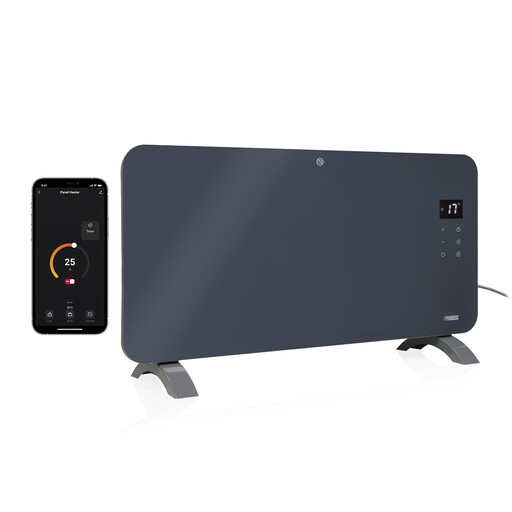
This panel heater offers a wall-mounting option for a home office where floor space and timed operation matter. Compare its sizing guidance and installation instructions with your room and the condition of its cold wall.
 No image available
Consider its wall-mounted option if keeping floor space clear matters in your office. The product name lists 1500 W output, Wi-Fi and app connectivity, a 24h timer, anti-tilt protection and free-standing use. Check the model's room-sizing and installation instructions against your room's heat loss and intended setup.
No: a panel heater can warm the office but does not repair insulation, stop draughts or establish the cause of damp. North Hertfordshire District Council explains that condensation forms on cold surfaces; investigate persistent moisture or a tidemark rather than treating extra heating as a repair.
Choose convection if maintaining the office's room-air temperature is the priority; consider infrared if direct warmth at the desk matters more and the panel can face where you sit. Energy Saving Trust describes infrared as radiant heating, so placement is important and it should not be assumed to heat the whole room like a convection heater.
A thermostat and timer or weekly programme let you set heating around the hours you use the office, provided the exact model has those controls. Energy Saving Trust advises keeping thermostats in free airflow, away from obstructions such as curtains and furniture.
Check the planned work before attempting a hard-wired installation. In England, GOV.UK's Approved Document P gives guidance on electrical safety in dwellings and when work is notifiable; elsewhere in the UK, check the applicable local requirements. Follow the heater's installation instructions and use a competent installer where the work requires one.
Do not overload an extension lead or socket outlet with a high-powered heater; follow the heater's electrical instructions for its connection. Electrical Safety First also advises keeping combustible items at least one metre from portable heaters.