People with scheduled hobby sessions
If you use the room on repeat evenings or weekends, a thermostat and timer can help you arrange heating around those sessions. Check that the controls offer a schedule you will actually use.


Choose a thermostatically controlled panel heater whose output is suitable for the room’s dimensions and heat loss; a timer is useful if hobby sessions follow a regular schedule. Wall mounting preserves floor space, while a freestanding model can suit a changing layout if it has a safe, clear position. A heater is not a remedy for persistent damp or mould: cold walls also call for effective ventilation and investigation of the moisture source.
If you use the room on repeat evenings or weekends, a thermostat and timer can help you arrange heating around those sessions. Check that the controls offer a schedule you will actually use.
Cold external walls, visible condensation or mould make the room’s ventilation and condition part of the heating decision. GOV.UK guidance explains that trapped moisture can condense on cold walls; heating alone should not stand in for investigating persistent damp.
If benches or stored projects move, a freestanding heater may be easier to reposition than a fixed unit. Each position still needs stable placement and clear space around the heater, in line with Electrical Safety First’s portable-heater advice.
Start with the cold room’s heating and moisture needs, then choose controls and a mounting format that fit how you use the space. The percentages indicate how consumers might prioritise one primary concern when making this particular choice; other needs can still matter to the same person.
| Concern | What to check | Who this matters to |
|---|---|---|
| Comfort despite heat loss | Measure the room and note external walls, glazing and draughts. Compare its conditions with the exact model’s output and room-size guidance. | If cold walls make hobby sessions uncomfortable, I need enough controllable heat for the actual room rather than a room-area figure alone. Around 31% of consumers would put cold-room comfort first. |
| Condensation and mould | Look for persistent moisture or staining, and keep intended ventilation working; investigate damp rather than relying on heater output. | When moisture collects on the walls, I need to know whether the room needs attention beyond heating. For around 25% of consumers, managing that moisture risk would be the primary concern. |
| Heating time and controls | Look for an adjustable thermostat and, for regular sessions, a suitable timer. Consider app control only if you would use it. | If I work in the room at predictable times, I want warmth during those sessions without leaving direct electric heating on unnecessarily. Limiting avoidable running time would come first for around 25% of consumers. |
| Placement around projects | Confirm the exact model’s mounting options and fittings. For portable use, allow a stable position with unobstructed airflow away from stored materials. | When benches and supplies change position, I need a heater I can place without crowding its airflow or my work area. Around 19% of consumers would make safe, flexible placement their main priority. |
GOV.UK guidance explains that indoor moisture can condense on cold walls when ventilation is ineffective. Hammersmith & Fulham Council also notes that cold walls can remain a mould concern even with routine heating and ventilation.
Keep ventilation paths working and investigate persistent mould, damp patches or water staining separately from the heater purchase.
A model’s stated room coverage cannot account for every combination of cold walls, glazing, ceiling height and draughts. Energy Saving Trust notes that poor insulation can make electric heating expensive.
Measure the room, compare exact-model guidance and consider its heat loss before choosing an output.
A heater that cannot meet the room’s heating demand may run for long periods without making the space comfortable.
Stored materials can obstruct airflow or sit too close to a heater. Placement needs particular attention when the room layout changes.
Keep the heater stable, its grilles clear and fabrics, paper and other stored supplies away from it. Electrical Safety First advises against using a portable heater overnight.
A timer or app can change when heating runs, but it does not reduce the room’s underlying heat loss. Ecostrad describes its smart panel heaters as supplementary heating rather than a solution to the condition of the room.
For a simple routine, check whether a thermostat and timer meet your needs before choosing Wi-Fi or app features.
Dimplex offers installed panel heaters with wall- and ceiling-mounted options.
Devola’s panel-heater range includes different finishes and control options. Its DVNDM20 is presented by Devola as a 2 kW model with a seven-day timer and wall-mounted or freestanding use.
Ecostrad presents its smart panel heaters as supplementary heating; its Artis iQ range includes programmable controls.
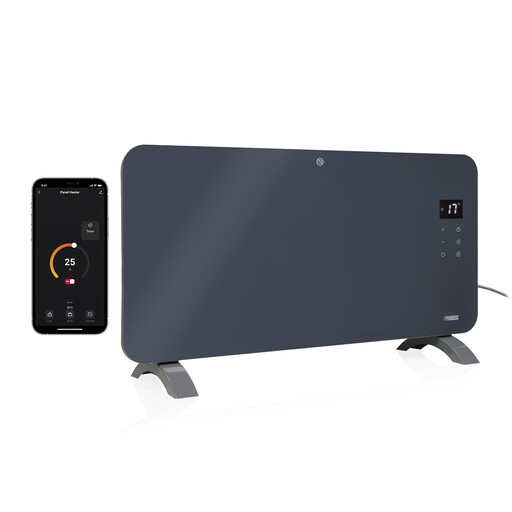
This panel heater is a choice to consider for scheduled hobby-room use where wall mounting may help preserve floor space. Check its suitability for the room’s heat loss and confirm the intended mounting arrangement before buying.
 No image available
Its thermostat and 24-hour timer suit planned sessions where you want control over heating times. The title also specifies Wi-Fi and app control and anti-tilt protection; confirm whether the wall-mounted or freestanding arrangement you need is supplied with the required fittings. Check the 1500 W model against the room’s dimensions and heat loss rather than assuming it will heat every cold-walled room adequately.
No: a panel heater may warm the room, but it cannot repair a moisture source or inadequate ventilation. GOV.UK guidance explains that trapped moisture can condense on cold walls, so investigate persistent damp or mould while keeping intended ventilation working.
Choose wall mounting if you have a suitable fixed position and need to preserve floor space; consider freestanding use if the layout changes or fixing is unsuitable. Confirm the exact model’s supported mounting method and keep a portable heater stable, unobstructed and away from stored materials.
An adjustable thermostat and a timer are useful when sessions follow a schedule. A Wi-Fi or app feature is worth considering if you would use remote control or change the schedule often; it does not reduce heat loss through cold walls.
Use the exact model’s rated power, your expected hours of use and your electricity tariff to assess likely consumption. Energy Saving Trust warns that electric heating can be expensive where insulation is poor, so a timer should not replace checking the room’s heat loss.
Choose a heater with a suitable UK plug and follow its placement instructions, leaving airflow clear of hobby materials. Electrical Safety First advises buying portable heaters from a reputable retailer, registering eligible products for recall information and not using a portable heater overnight.