People working at a fixed desk
If the desk stays in one cold spot and chair space is limited, a wall-mounted heater keeps the floor clear. Check the exact model’s mounting position and electrical connection before choosing it.


Choose a wall-mounted panel heater when your desk stays in one place and you can meet the model’s mounting, electrical-connection and airflow requirements. A freestanding slim convector suits a desk that moves between rooms or a space where fixed installation is unsuitable, but it needs floor space and safe clearance from furnishings and cables.
If the desk stays in one cold spot and chair space is limited, a wall-mounted heater keeps the floor clear. Check the exact model’s mounting position and electrical connection before choosing it.
A freestanding slim convector can move with your work area without a fixed wall installation. It still needs a suitable place on the floor and the clearance specified in its instructions.
Where cables, papers or soft furnishings are close to the intended heater position, plan the airflow and electrical setup before deciding which format fits. Electrical Safety First advises keeping clear space around convection heaters and checking the load on extension equipment.
Choose when: The desk has a permanent position and keeping the floor clear matters.
Accept: Its position is less flexible, and mounting and connection requirements vary by model.
Choose when: You need to move supplementary warmth between rooms or cannot install a fixed heater.
Accept: It occupies floor space and needs unobstructed airflow around it.
For supplementary warmth near a desk, choose the position and installation type first; then compare controls and the space needed to use the heater safely.
| Concern | What to check | Who this matters to |
|---|---|---|
| Warmth at one workstation | Check whether the heater is wall-mounted or freestanding, its dimensions, output settings and required clearance. | If my desk stays in one spot, I want supplementary warmth without putting a heater in the chair area. For around 33% of consumers, warmth at a fixed workstation is the primary concern. |
| Quiet, controllable use | Look for a thermostat and check whether the model has a fan, whether it can be switched off and where the controls sit. | During calls or focused work, I want to adjust the temperature without an unwanted fan running nearby. Quiet, controllable use comes first for roughly 25% of consumers. |
| Work-hour scheduling | Compare daily and weekly timer functions, programmable temperatures and controls you can operate as intended. | When I work regular hours, I want the heater’s settings to fit that routine rather than leaving it on unnecessarily. About 25% of consumers place scheduling first. |
| Placement and electrical safety | Check the model’s clearance instructions, plug or connection type and the rating of any extension equipment. | With cables and furniture close to my desk, I need a position and electrical setup that let me follow the heater’s safety instructions. This is the leading concern for around 17% of consumers. |
A higher maximum input does not, by itself, establish which heater fits a desk area. The available space, output settings and controls also affect the choice.
Compare the exact model’s dimensions, heat settings, thermostat and timer against where and when you intend to use it.
Electrical Safety First says convection heaters need clear space above and around them; blocked grilles can contribute to overheating.
Keep papers, curtains, soft furnishings and cable clutter away from the heater, and follow its specified clearance distances.
Electrical Safety First warns that appliances exceeding an extension lead’s maximum current rating can cause overheating.
Check the heater’s rated input and the combined load against the equipment’s marked rating. Do not daisy-chain extension leads, and fully unwind a cable reel before use.
Stiebel Eltron specifies its CNS-U 1500 Plus LCD (UK) as a permanently connected wall-mounted convector. A slim shape alone does not tell you whether a heater can move between rooms.
Check the exact model’s mounting method, connection type and supplied fittings before choosing it for a temporary workspace.
A permanently connected model may involve installation work and cannot move with a changing desk position as a freestanding heater can.
Dimplex’s installed panel-heater range is relevant when you want heating at a fixed desk position without using floor space.
Its wall-mounted convector line is a fixed-installation option for a desk that remains in one place.
De'Longhi’s slim convectors provide a freestanding alternative where fixed installation does not suit the desk area.
These choices cover a panel heater for a fixed desk position and a freestanding slim convector for a workspace that may move. Check each model’s installation and placement requirements against your room.
 No image available
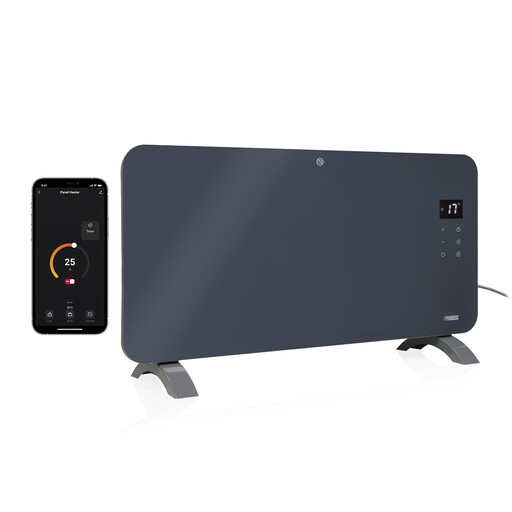
Consider this panel heater for a fixed desk position where wall mounting can keep the floor clear. Its listed features include 1500 W input, Wi-Fi and app controls, a timer and anti-tilt protection. If you intend to use it freestanding, check whether the required base is included; confirm the mounting clearances and electrical connection before installation.
 No image available
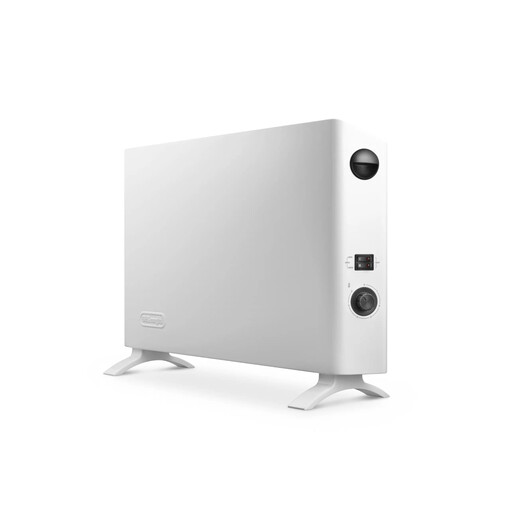
Consider this freestanding convector if you need to move supplementary warmth between desk locations rather than install a wall heater. The listed model has three heat settings and a thermostat. Allow floor space and the clearance required by its instructions, and confirm the supplied plug type before buying.
Check the lead’s marked maximum rating against the heater and everything else connected to it before use. Electrical Safety First warns against exceeding that rating or daisy-chaining extension equipment; a cable reel should be fully unwound.
Electrical Safety First recommends not using a portable heater overnight. Follow the instructions for your particular heater as well as arranging a safe position for it during normal use.
Both need suitable airflow and placement, but a wall-mounted heater also requires you to check its mounting and electrical-connection instructions. Stiebel Eltron specifies a permanent connection for the CNS-U 1500 Plus LCD (UK), so do not assume a wall model simply plugs in.
Not necessarily in Great Britain: GOV.UK guidance dated April 2026 says CE marking continues to be recognised alongside UKCA marking where the relevant product regulations apply. A mark does not replace checking the heater’s instructions, safety information and suitability for your intended setup.