What matters when choosing?
Establish whether you are heating an enclosed room or an open area before comparing output and controls. Decide where the heater can be placed safely before choosing between a fixed and freestanding model.
| Concern | What to check | Who this matters to |
|---|
| Room separation |
Measure the small room and note open doorways, glazing and draughts. Treat coverage figures as conditional on heat loss. |
If my room stays open to the living area, I need to know how readily warmth will escape before sizing a heater. Around 31% of consumers put the boundary of the heated space first. |
| Heating time |
Check for an adjustable thermostat and a timer that suits when the room is occupied; confirm whether app control needs accessories. |
For a room I use at regular times, I want heating that can follow that routine rather than run unnecessarily. Controlling heating time is the primary concern for around 25% of consumers. |
| Placement |
Choose wall mounting or freestanding use, check what supports are included, and allow at least one metre between a portable heater and combustible items, as Hertfordshire County Council advises. |
If I move between spaces, I need a heater I can position without crowding furniture or creating an unstable setup. Around 25% of consumers chiefly weigh up placement and flexibility. |
| Output |
Compare rated wattage against the room’s dimensions and likely heat loss, particularly where there are external walls, large windows or an open connection. |
In an exposed room, I need enough capacity for the conditions rather than a wattage chosen solely from its floor area. Output is the leading consideration for around 19% of consumers. |
Panel heaters on Joybuy for a regularly used small room
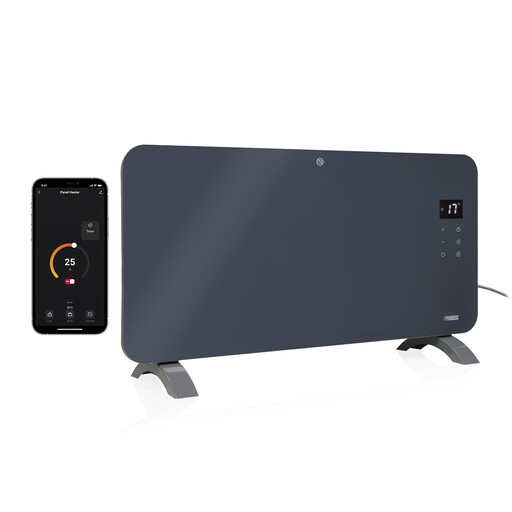
This wall-mountable panel heater is relevant when you want a fixed position and timed heating in a small room. Check the room’s heat loss before deciding whether its output is suitable.
 No image available
Princess Smart Glass Panel Heater, 1500 W
Consider this model for timed background heating where a fixed wall position suits the room. Its listed features include Wi-Fi and app connectivity, a 24-hour timer, anti-tilt protection and wall-mounted or freestanding use. A wall-mounting kit is identified as included; if you intend to use it freestanding, confirm whether the necessary supports are supplied. Check the room’s dimensions, enclosure and heat loss before choosing 1500 W.
View on Joybuy
Common questions
Will a panel heater warm a small room that opens into a large living room?
It can provide background warmth, but an open connection makes it harder to heat the small area separately. Assess the room’s dimensions and heat loss rather than relying on a generic coverage label; Electric Radiator Shop notes that heater sizing depends on heat loss.
How should I choose the heater’s wattage?
Start with the small room’s area, ceiling height, glazing, external walls, insulation and draughts, then check how the manufacturer or retailer applies its sizing guidance. Do not choose wattage solely because the adjoining living room is large.
Will a thermostat and timer reduce electricity use?
They can help avoid heating the room for longer than needed, provided you set them to match occupancy. They cannot prevent heat escaping from a poorly insulated or open space, so consider likely active heating time as well as the heater’s rated input.
Can I leave a portable heater on overnight?
Switch it off when going to bed unless the manufacturer explicitly says the particular model is designed for that use and you can follow its instructions. GOV.UK advises unplugging electric heaters when going out or going to bed; keep heaters away from curtains and furniture, and never use them to dry clothes.
Will a wall-mounted panel heater need electrical installation?
Check the exact model’s connection and mounting instructions before buying: the required work depends on how that model is designed to be connected. If the intended setup requires electrical wiring, arrange appropriate professional installation rather than assuming it can simply be plugged in.


