Space-limited snack makers
If you make one or two sandwiches at a time, look at how the appliance stores after use as well as the space it needs on the worktop while hot. Some documented models offer upright storage and cord storage.


Choose a compact press with a floating or adjustable-height lid if you want room for different sandwich thicknesses without pressing down hard on the filling. If containing a softer, fuller banana sandwich matters more, consider a deep-fill sandwich maker with a locking mode instead. In a small kitchen, check operating clearance as well as storage space, and decide whether removable plates are worth the extra parts to store.
If you make one or two sandwiches at a time, look at how the appliance stores after use as well as the space it needs on the worktop while hot. Some documented models offer upright storage and cord storage.
If banana filling tends to press against the edges, consider whether an adjustable lid gives your bread enough room or whether deep-fill plates and a locking sandwich mode better suit the sandwich you want to make.
If you make toasted sandwiches regularly, removable plates may matter more to you than the smallest stored appliance. Check the cleaning instructions for the exact model before assuming its plates can go in a dishwasher.
Start with the space available while the appliance is in use, then decide how you want it to handle the filling; cleaning and extra cooking formats can follow.
| Concern | What to check | Who this matters to |
|---|---|---|
| Storage and operating space | Check stored dimensions and whether upright storage is permitted; compare the intended worktop position with the manual’s heat-clearance instructions. | I need to put the appliance away after making a sandwich, but it also has to fit safely beneath my wall units while in use. Around 36% of consumers put space first. |
| Handling soft filling | Compare a floating or adjustable-height lid with deep-fill plates and a locking sandwich mode. | For a fuller banana sandwich, I would rather contain the filling than squeeze the bread flat. Around 29% of consumers make filling control their main concern. |
| Cleaning | Check whether plates are removable and whether the exact plates are dishwasher-safe. | If I make toasties often, cleaning around fixed plates could become a nuisance. Roughly 21% of consumers put easier cleaning first. |
| Several snack formats | Check which plate sets are supplied and where you would store them. | I want one appliance for paninis, toasties or waffles, provided the spare plates have a place in my cupboard. About 14% of consumers prioritise this flexibility. |
A floating lid accommodates thickness, but grill plates do not form the same enclosed pocket as cut-and-seal sandwich plates. A generous, soft filling may therefore be harder to contain.
Choose the plate format according to whether variable thickness or contained edges matter more for your banana sandwiches.
Upright storage does not tell you how much clearance an appliance needs while hot. The Cuisinart UK manual specifies 100 mm around the front, back and sides of the GRSM4U.
Measure the proposed cooking position, including the space beneath shelves or wall units, against the exact model manual.
The appliance needs to suit where it will be used, not merely fit the cupboard. Electrical Safety First advises checking for a UK three-pin plug and fuse when buying for UK use.
Confirm the supplied plug, intended market and manufacturer support with the retailer before ordering.
Interchangeable plates offer other snack formats, but every additional set takes storage space.
If banana sandwiches are your main use, compare a simpler press or sandwich maker with the space needed for the complete multi-plate set.
The Small Fit Grill 25800 is relevant if storage is a leading concern in your kitchen.
The GRSM4U offers a choice between grilled paninis and sandwiches made with deep-fill plates.
The VST026 is a panini-maker option; the VST098 is relevant if you will use toastie and waffle formats too.
The Snack Time SW343D40 is relevant if you want a compact appliance for paninis and waffles.
These options take different approaches to a small kitchen: a contact grill for worktop use and a microwave toastie maker for use with a suitable microwave. Check how each handles your preferred bread and banana filling before choosing.
 No image available
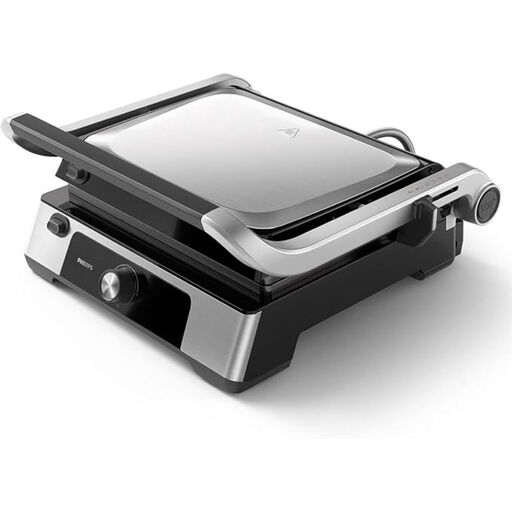
Consider this contact-grill format if you want to toast banana sandwiches on the worktop. Check how its plate spacing accommodates your bread and filling, and confirm operating clearance and storage orientation in the model instructions.
The plates are listed as not dishwasher-safe.
 No image available
This microwave toastie maker is an alternative if you do not want a separate worktop press. Check that it fits your microwave and that its sandwich shape accommodates the amount of banana filling you intend to use.
The product is described as compact and dishwasher-safe; follow its instructions to identify which parts can be washed in a dishwasher.
Choose a panini press with a floating hinge if accommodating different sandwich thicknesses matters most; choose a deep-fill sandwich maker with a locking mode if you would rather contain a softer, fuller filling. Electrical Safety First distinguishes floating-hinge presses from sandwich toasters with cut-and-seal plates.
Check its operating clearances in the exact manual rather than relying on its stored dimensions. For example, the Cuisinart UK manual specifies 100 mm around the front, back and sides of the GRSM4U; another model may have different requirements, including for space above it.
Unplug the press, let it cool and follow its model-specific cleaning instructions. Electrical Safety First advises cleaning only when unplugged; removable dishwasher-safe plates are available on some models, but do not assume every plate or appliance part can go in a dishwasher.
Check that the appliance is intended for use in Great Britain and confirm the supplied plug and manufacturer support before ordering. Electrical Safety First advises buying from a reputable retailer and checking for a UK three-pin plug and fuse; follow the particular appliance’s instructions once it arrives.