Space-limited toastie makers
If you usually make one or two chocolate sandwiches, you may value a manageable external size, closed storage and a contained cord more than a larger batch capacity.


For occasional chocolate toasties, start with a compact press that fits both your storage space and a clear operating area, then check that its plates and hinge suit your bread and filling. A larger flat-plate press makes more sense if you regularly prepare several sandwiches together; an interchangeable-plate maker is worth considering if you will also use its other plate formats. Either choice adds space or accessories to manage.
If you usually make one or two chocolate sandwiches, you may value a manageable external size, closed storage and a contained cord more than a larger batch capacity.
If your bread and fillings vary in thickness, look at how the lid accommodates them rather than relying on the stated sandwich count alone.
If you would also use waffle or other interchangeable plates, weigh those options against the space needed to keep and clean additional plate sets.
Consider it when: storage space matters more than making several sandwiches at once.
Trade-off: a small exterior does not establish how much bread fits on the plates.
Consider it when: you regularly make several sandwiches together; Breville UK describes its VST025 as holding up to three and its VST026 as holding up to four.
Trade-off: that capacity is useful only if you can accommodate the appliance when it is in use and stored away.
Consider it when: you expect to use sandwich and waffle plates, not just make chocolate toasties.
Trade-off: extra plate sets need their own storage and cleaning.
| Concern | What to check | Who this matters to |
|---|---|---|
| Storage and worktop fit | Measure the shelf and usable worktop; compare external dimensions and check the storage lock and required operating clearance. | If cupboard and worktop space are tight, I need a press I can put away and still use with adequate clearance. Roughly 42% of consumers put space first. |
| Chocolate cleanup and shared use | Check the model’s cleaning instructions and whether plates are removable. For an allergen-free meal, use separate clean and sanitised equipment rather than relying on ordinary wiping. | When melted filling leaves residue, I want cleanup I can manage; if someone needs allergen-free food, shared equipment raises a separate concern. Around 33% of consumers prioritise cleaning and residue control. |
| Sandwich thickness and batch size | Check the plate area and whether the hinge accommodates your filling; match stated capacity to the number you usually make. | If I make thick-filled toasties or serve several people together, I need the bread to fit without forcing the lid and may want fewer batches. Approximately 25% of consumers put fit and capacity first. |
A higher stated capacity does not tell you whether the appliance fits your shelf or leaves enough room for use. Quest Appliances specifies its Compact Panini Press & Grill at 9.0 cm high, 22.0 cm wide and 27.0 cm long, giving you dimensions to compare with your space.
Measure the storage location and a clear operating area before buying, and check whether the lid locks for storage.
Wipe-clean surfaces can help with ordinary chocolate residue, but they do not make shared equipment suitable for an allergen-free meal. Coventry City Council warns that allergen residue can remain on dual-use grills.
Follow the appliance’s cleaning instructions after it cools. Where an allergen-free meal is required, use separate clean and sanitised equipment.
Breville UK’s safety instructions call for adequate air space above and around its sandwich press and warn against use beneath cupboards, curtains or other flammable materials.
Plan a clear, level, heat-tolerant place to operate the press, and let it cool before storage.
A reference point for comparing flat-plate presses with different stated sandwich capacities.
A multi-snack option for consumers who would use more than one plate format.
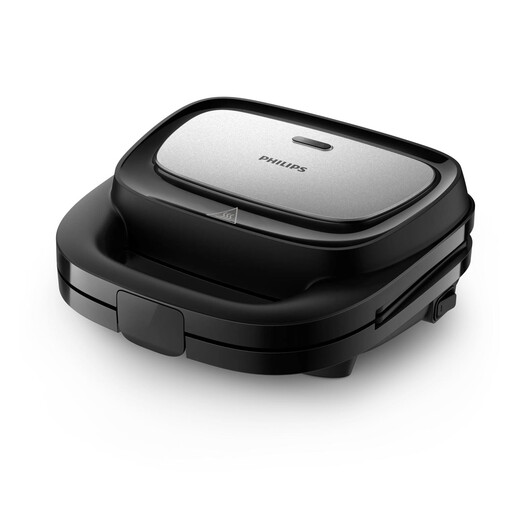
A compact-press reference for comparing stated external size with the space you have.
A mini-press option if you also want to consider open-grill use.
These sandwich and toastie makers offer different ways to approach the small-kitchen task, including a microwave option and a multicooker. Check how each works and whether your bread fits rather than assuming every option is an electric panini press.
 No image available
Consider this compact microwave toastie maker if you have a microwave and want an alternative to a plug-in press.
The name identifies it as dishwasher-safe; check which components the instructions permit you to wash. Confirm that your bread and filling fit, and check your microwave against the stated 1200 W maximum.
 No image available
Consider this sandwich maker if you would use more than one plate format as well as making toasties.
Confirm exactly which plates are supplied and whether your bread and filling fit. The product information mentions an EU power cord, so check the plug arrangement needed for UK use with the seller.
 No image available
Consider this multicooker if you want to make toasties alongside other foods, rather than buy a dedicated panini press.
Its product name specifies 700 W and a non-stick surface. Check the cooking area against your usual bread and confirm that the lid will accommodate your filling.
Check the hinge and plate area first to see whether your bread and filling can fit without forcing the lid. Breville UK and Quest Appliances describe high, flexible or floating hinges on specific presses; a wattage figure alone cannot establish sandwich fit.
Switch off and unplug the press, let it cool, then follow the instructions for your exact model. Breville UK’s safety instructions say to let its press cool before cleaning or storage and not to immerse the appliance, cord or plug in water.
Do not rely on ordinary wiping to make a shared press suitable for an allergen-free meal. Coventry City Council warns that allergen residue can remain on dual-use grills in food settings; use separate clean and sanitised equipment when preparing food for someone who needs to avoid an allergen.
Running a food business brings food-safety management duties: GOV.UK says a food business must make and follow a system for managing food safety. Check the requirements for your proposed business with the relevant local authority before selling food.