Shared-kitchen clean-up prioritiser
You want to remove onion, cheese or oil residue before someone else uses the appliance. Plate access and a workable cleaning routine matter more to you than maximum capacity.


For thick onion panini, choose a press with a high or adjustable hinge and plates that fit the bread you use. In a shared kitchen, make cleaning between users a priority: removable plates give better access to food residue, while a fixed-plate press calls for careful cleaning in place. Check which parts of the exact model can go in a dishwasher rather than assuming all removable plates can.
You want to remove onion, cheese or oil residue before someone else uses the appliance. Plate access and a workable cleaning routine matter more to you than maximum capacity.
You use bread such as ciabatta or focaccia with substantial fillings and need to check that the lid can close over it without pressing food into the hinge.
You want to make panini alongside other snacks or grilled foods, provided the extra plates or cooking modes will be used and can be stored together.
For onion panini in a shared kitchen, check how the appliance will be cleaned between users, whether it fits your filled bread, and whether additional cooking functions justify the storage space.
| Concern | What to check | Who this matters to |
|---|---|---|
| Cleaning between users | Check whether the plates detach and which parts the manufacturer permits you to wash in a dishwasher. | If I leave onion, cheese or oil on the plates, the next person has to deal with it; around 50% of consumers would put thorough clean-up first. |
| Fit for thick panini | Check the hinge design and usable plate area against the bread and filling you intend to use. | I want to toast a filled ciabatta without forcing the lid shut; fitting thicker bread would be the primary need for around 30% of consumers. |
| Multiple uses and storage | Check the included plate types, cooking modes and appliance dimensions before allocating shared cupboard space. | When cupboard space is shared, I want the extra cooking functions to earn their place; roughly 20% of consumers would prioritise that flexibility. |
A sealed-pocket toastie maker may not accommodate the bread shapes and filling heights you want for onion panini. Breville describes the VST025 as having an extra-high hinged lid for sandwiches of different shapes and sizes.
Check the exact lid and plate design if thick or varied-shaped bread is central to your choice.
A fixed plate must be cleaned in place, including around its edges and hinge. That distinction matters when food residue needs to be cleared before another person uses the press.
Confirm whether the exact model’s plates detach and which parts are dishwasher-safe. For fixed plates, follow the manual’s cleaning instructions after use.
A wattage rating states an electrical specification; by itself, it does not establish how quickly or evenly different presses will toast your bread.
Compare plate fit, hinge clearance, cleaning access and the cooking tasks you need instead.
A workplace may have its own rules for personal electrical appliances. The UK Health and Safety Executive says employers must maintain electrical equipment to prevent danger, but does not prescribe an annual test for every portable appliance.
Ask the workplace or kitchen manager about appliance rules, and do not use a press with a damaged plug, cable or housing.
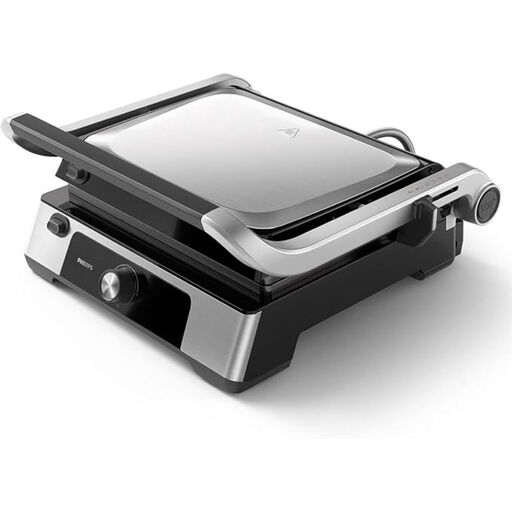
A bread-focused option represented here by the VST025 panini and sandwich press.
A multi-function option represented here by the 26810 Creations 3-in-1 Sandwich Maker.
A contact-grill option represented here by the GR47BU Griddle & Grill.
These choices include removable-plate contact grills and a microwave toastie maker. For a shared kitchen, compare their different cleaning methods and check that the appliance fits both your bread and the way you plan to cook it.
 No image available
Consider this contact grill if your filled panini needs an adjustable-height top plate and you want to remove the plates for cleaning.
It opens to 180° and has adjustable temperature control and a removable drip tray. The plates are not dishwasher-safe; follow the manufacturer’s cleaning instructions. Check the usable cooking area against your bread size.
 No image available
Consider this compact microwave option if you have a compatible microwave and want to make panini without a conventional plug-in press.
Its listed dimensions are 15 × 14.2 × 4.5 cm, and the listing mentions ciabatta. The stated maximum microwave wattage is 1200 W. Check which components are dishwasher-safe and whether a thick filled panini will fit when it is closed.
 No image available
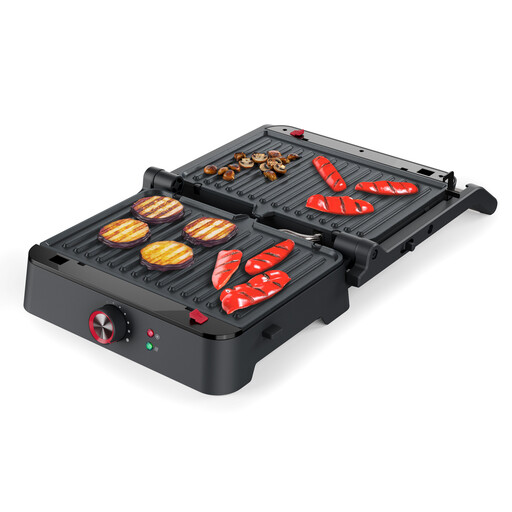
Consider this grill if detachable plates and an open-grill mode matter to your shared kitchen.
It has a stated 1800 W rating, a 27.5 × 18 cm cooking area, an adjustable thermostat and a 180° opening. Check the manufacturer’s intended sandwich use, clearance for thick fillings and whether the plates are dishwasher-safe before choosing it for onion panini.
They are worth prioritising if cleaning between users is your main concern, because the plates can be taken out for washing. Russell Hobbs describes dishwasher-safe plates for its 26810 model, while Cuisinart describes removable plates for the GR47BU; check the washing instructions for the particular press you choose. Removable plates alone do not settle allergen-management needs, so agree on cleaning and equipment-sharing arrangements where those needs apply.
Look for a lid that accommodates the filled bread’s height and plates with enough usable area. Breville describes an extra-high hinged lid on the VST025 for sandwiches of different shapes and sizes. Check the dimensions of your chosen model and avoid forcing its lid closed over an overfilled sandwich.
An annual portable appliance test is not automatically required simply because a panini press is used in an office kitchen. The UK Health and Safety Executive says employers must maintain electrical equipment to prevent danger, while the appropriate checks depend on the equipment and its setting. Follow the workplace’s appliance policy and do not use damaged equipment.
Food-business requirements may apply when the kitchen is used to sell panini or provide them as part of a food operation. Food Standards Agency guidance addresses contamination prevention and cleaning facilities for equipment; the obligations for registration and the premises depend on the particular operation. Confirm the arrangements with the relevant local authority before trading.