Hosts offering a lower-sugar choice
If regular cola is not right for everyone on the guest list, look for a clearly labelled zero-sugar option. Keep guests’ preferences in mind rather than assuming they all want the same sweetener or flavour.


For a New Year’s Eve party, choose zero-sugar cola if reducing sugar matters, and include an explicitly caffeine-free option for guests avoiding caffeine. Regular cola can sit alongside those choices for guests who prefer it, but check sweeteners as well as sugar: the NHS says aspartame is unsuitable for people with phenylketonuria (PKU).
If regular cola is not right for everyone on the guest list, look for a clearly labelled zero-sugar option. Keep guests’ preferences in mind rather than assuming they all want the same sweetener or flavour.
Choose a cola explicitly labelled caffeine free. A zero-sugar label alone does not establish its caffeine status.
Ask guests with PKU what they can have and read the exact pack before serving. The NHS says aspartame is unsuitable for people with PKU; the zero-sugar Coca-Cola and Pepsi examples discussed here carry a source-of-phenylalanine warning.
Decide whether the drinks table needs a sugar-containing cola, a zero-sugar choice, a caffeine-free choice or a combination; then check the labels of the products you buy.
Choose when: Guests want cola with 0g sugars per 100ml and caffeine is acceptable; Coca-Cola Zero Sugar and Pepsi Max list those characteristics.
Bear in mind: Both list caffeine and carry a source-of-phenylalanine warning.
Choose when: Guests want both a zero-sugar cola and an explicitly caffeine-free drink; Pepsi Max Caffeine Free is labelled for both.
Bear in mind: Caffeine free does not mean free from sweeteners; this Pepsi variant carries a source-of-phenylalanine warning.
Choose when: You want to offer a sugar-containing cola alongside the other drinks.
Bear in mind: PepsiCo UK lists 4.5g sugars per 100ml for regular Pepsi, compared with 0g per 100ml for its Pepsi Max variants.
| Priority | What to check | Your needs |
|---|---|---|
| Sugar | Compare sugars per 100ml and the serving size. Read the product label rather than relying on a diet-style name. | I’d like a clearly identified zero-sugar choice, while leaving room for guests who prefer regular cola. |
| Caffeine | Look for an explicit caffeine-free label. Check the ingredients of other colas instead of treating zero sugar as caffeine free. | A late-evening guest may avoid caffeine, so I want a drink they can identify without guessing. |
| Sweeteners | Check for aspartame or E951 and a source-of-phenylalanine warning. The NHS says aspartame is unsuitable for people with PKU. | If someone has PKU, I’ll check the exact pack and ask what drink is suitable for them. |
| Drinks alongside cola | Put water on the table too. The NHS notes that acidic carbonated drinks are associated with dental erosion whether they contain sugar or sweeteners. | For a long party, I want an option besides repeatedly sipping fizzy cola. |
Coca-Cola Zero Sugar and Pepsi Max list caffeine, while Pepsi Max Caffeine Free is a distinct variant.
If a guest avoids caffeine, select a product explicitly labelled caffeine free and check its current pack.
The NHS says aspartame is unsuitable for people with PKU. The zero-sugar Coca-Cola and Pepsi examples carry a source-of-phenylalanine warning.
Ask a guest with PKU what they can have; check the exact ingredients before serving rather than automatically swapping in another zero-sugar cola.
The NHS associates acidic carbonated drinks with dental erosion regardless of whether they contain sugar or sweeteners.
Offer water alongside cola, particularly when drinks will be available throughout the evening.
These examples help distinguish labels within the named product lines; a brand name alone does not tell you a drink’s sugar, caffeine or sweetener content.
Coca-Cola Zero Sugar is a zero-sugar option in the Coca-Cola range, but its ingredient information lists caffeine flavouring.
PepsiCo UK distinguishes regular Pepsi, zero-sugar Pepsi Max and Pepsi Max Caffeine Free.
These 24-can multipacks offer cola choices for guests looking at zero sugar, including options labelled caffeine free. Check each pack’s ingredients before serving anyone with a specific dietary restriction.
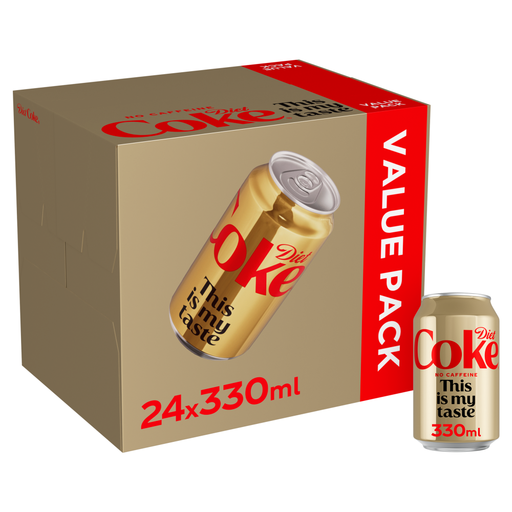 No image available
A 24-can cola option for guests avoiding caffeine. Check the current pack for sugar, sweeteners and any dietary warnings before serving.
 No image available
PepsiCo UK identifies this variant as zero sugar and caffeine free, and lists 0g sugars per 100ml. It carries a source-of-phenylalanine warning; check the pack if serving someone with PKU.
 No image available
A zero-sugar choice when caffeine is acceptable: PepsiCo UK lists 0g sugars per 100ml and includes caffeine in the ingredients. It also carries a source-of-phenylalanine warning.
 No image available
The Coca-Cola Company lists 0g sugars per 100ml for this zero-sugar cola. Its ingredients include caffeine flavouring, and it carries a source-of-phenylalanine warning.
No. Coca-Cola Zero Sugar and Pepsi Max list caffeine or caffeine flavouring. If a guest avoids caffeine, look for an explicitly caffeine-free variant and check its current label.
Do not assume it is suitable. The NHS says aspartame is unsuitable for people with PKU, and the zero-sugar Coca-Cola and Pepsi examples here carry a source-of-phenylalanine warning. Ask the guest what they can have and check the exact pack.
No. The NHS says acidic carbonated drinks are associated with dental erosion whether they contain sugar or sweeteners. Offer water as another choice on the drinks table.
Offer a drink explicitly labelled caffeine free rather than assuming a zero-sugar cola qualifies. The NHS advises pregnant people not to have more than 200mg of caffeine a day; their intake may also come from drinks and foods other than cola.