Salt-first batch cooks
If you make pasta meals repeatedly and are happy to season a tomato base, passata lets you decide what to add rather than relying on a finished sauce.


If controlling the salt you add matters most, buy passata to season yourself: Napolina lists 0.12g salt per 100g for its Tomato Passata, while the finished sauces considered here have higher declared amounts. If a ready-made sauce suits your routine better, compare salt per 100g and the portion you will use, then check how soon an opened pack must be finished before buying several.
If you make pasta meals repeatedly and are happy to season a tomato base, passata lets you decide what to add rather than relying on a finished sauce.
Ready-made jars save preparation steps. Compare their salt figures directly instead of treating labels such as no added sugar or low fat as statements about salt.
When stocking several packs, consider how much you use at each meal and whether you can finish an opened pack within its stated storage period.
Choose between a sauce base and a finished jar before comparing labels: the salt figure matters alongside the preparation and storage that each format requires.
| Concern | What to check | Who this matters to |
|---|---|---|
| Control over salt | Compare declared salt per 100g and check whether the product is passata or a finished sauce. Consider how much you will serve and add when cooking. | If I am cooking several batches, I want to choose the seasoning rather than start with a fully seasoned jar; about 50% of consumers put salt control first. |
| Ready-made convenience | Check salt per 100g and per stated serving on the nutrition panel; a no-added-sugar or low-fat label addresses a different attribute. | For quick meals, I would rather open a finished sauce than prepare one from a base. Ready-made convenience is the primary need for about 30% of consumers. |
| Using a bulk purchase | Check pack weight, the portion you expect to use and the label’s refrigerated storage instruction after opening. | When I stock several packs, I want each opened one to last for the meals I have planned; about 20% of consumers put avoiding unused sauce first. |
Tesco lists 0.64g salt per 100g for its No Added Sugar Bolognese sauce, and ASDA lists 0.67g per 100g for Dolmio Bolognese Low Fat. Neither product name tells you how its salt compares with another sauce.
Use the salt line of the nutrition panel for that comparison, then consider the amount you expect to use.
Storage periods differ between products. The Joybuy listing for Napolina Tomato Passata says to refrigerate and use it within two days of opening; Tesco gives 14 days for its cited No Added Sugar Bolognese sauce.
Plan portions around the instruction on the pack you buy, rather than assuming every jar or carton has the same use window.
An opened pack left beyond its stated use period can mean unused sauce goes to waste.
Napolina describes passata as a base for pasta sauce. It leaves the flavouring decisions to the cook, unlike a finished bolognese or tomato-and-basil jar.
Choose a base when you want to season it yourself; choose a finished sauce when fewer preparation steps matter more, and compare its declared salt separately.
Ingredients and nutrition information can change, which matters more when one purchase is intended to cover several meals.
Check the current pack label for salt, ingredients, allergens and storage instructions before committing to a quantity.
Its Tomato Passata is a tomato base for making pasta sauce, rather than a finished seasoned jar.
Its own-brand Tomato and Basil Pasta Sauce and the Daylesford sauce it sells are finished sauces with distinct nutrition figures.
Its No Added Sugar Bolognese Pasta Sauce is a finished 500g jar.
Its Bolognese Pasta Sauce and Just Essentials Pasta Sauce are finished jars with separate salt declarations.
Bolognese Low Fat Pasta Sauce is a finished sauce; its low-fat description concerns a different attribute from salt.
These passata and tomato purée products suit cooking a pasta sauce from a tomato base. None is presented here as a finished, ready-to-pour sauce; choose according to the seasoning and preparation you want to do.
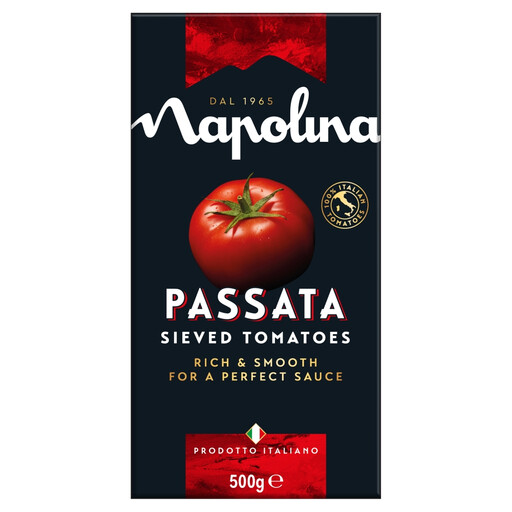 Image unavailable
Choose this tomato base if you want to season a pasta sauce yourself. Napolina lists 0.12g salt per 100g; the Joybuy listing says to refrigerate the passata and use it within two days of opening. It is not a finished seasoned sauce.
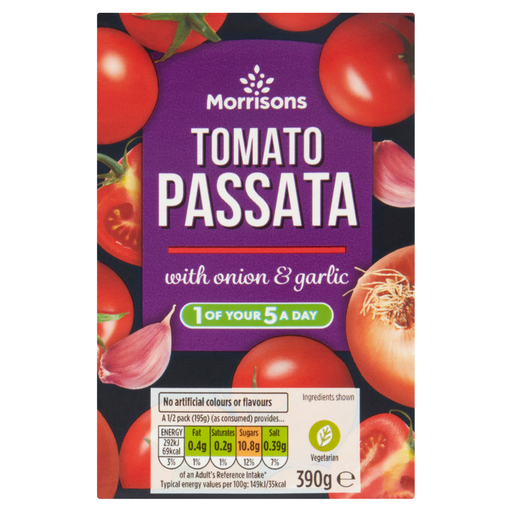 Image unavailable
This 390g passata includes onion and garlic for a sauce you will finish preparing yourself. It is not a confirmed ready-to-pour pasta sauce; the listing says to refrigerate it and use it within two days of opening.
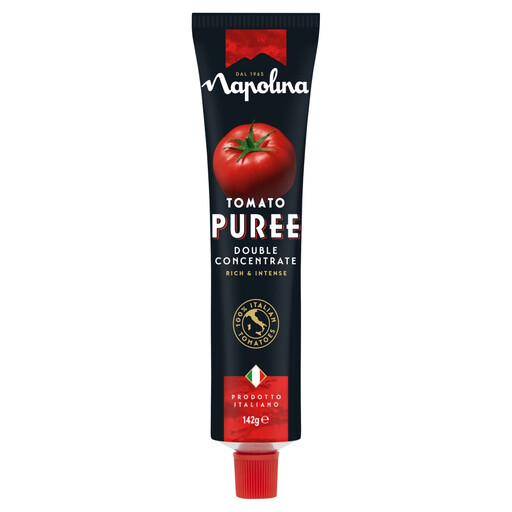 Image unavailable
Use this 142g concentrated tomato ingredient as part of a sauce recipe, not in place of passata or a finished jar. The amount used in a meal depends on the recipe; the listing says to refrigerate the tube after opening and use it within four weeks.
No: those descriptions concern different attributes. Tesco lists 0.64g salt per 100g for its No Added Sugar Bolognese sauce, while ASDA lists 0.67g per 100g for Dolmio Bolognese Low Fat. Compare the salt lines on the products you are choosing between.
Yes, if you are prepared to turn it into a sauce. Napolina describes its passata as a base for pasta sauce, so allow for your own seasoning rather than expecting the flavour of a finished bolognese or tomato-and-basil jar.
Follow the instruction on the current pack; the periods differ. Tesco gives 14 days for its cited No Added Sugar Bolognese sauce, ASDA gives seven days for its cited jars, Marks & Spencer gives five days for the Daylesford sauce, and the Joybuy listing gives two days for Napolina Tomato Passata. Each instructs refrigeration after opening.
No. A comparison between products can be made from their declared salt per 100g without treating either as carrying a reduced-salt claim. Napolina lists 0.12g per 100g for its passata, for example, while Marks & Spencer lists 0.45g per 100g for the finished Daylesford Tomato and Basil Sauce; preparation needs differ as well.
The NHS says adults should have no more than 6g of salt a day, including salt already in food and salt added during cooking. When comparing sauces, consider the amount you will use and the other ingredients in the meal.